

Artificial intelligence has moved from the lab to the core of business operations. Whether it’s automating routine tasks, analyzing massive datasets, or deploying chat interfaces, more companies are turning to custom-built AI systems. But behind every successful machine learning model or chatbot is a solid AI infrastructure something many overlook in the rush to experiment.
In this guide, we’ll explore the key components of AI infrastructure, why it’s more than just installing a few tools, and how you can build your own setup step-by-step. Based in Edinburgh, Miniml works with companies across healthcare, finance, education, and retail to craft tailored AI solutions. From cloud resources to data management, we’ve helped businesses lay the right foundations to build systems that actually work.
What Is AI Infrastructure and Why It Matters
AI infrastructure refers to the combination of hardware, software, and architecture that allows AI systems to run efficiently. It’s not just about having powerful servers or using popular libraries it’s about making sure everything from your data pipelines to model deployment tools is connected, secure, and scalable.
Poor infrastructure can lead to delays, inaccurate predictions, or complete model failures. For example, a retail company using a recommendation engine might see delayed results if its data pipeline isn’t well-structured, causing missed sales opportunities. A well-designed infrastructure ensures everything runs as expected from data ingestion to model output.
Core Components of AI Infrastructure
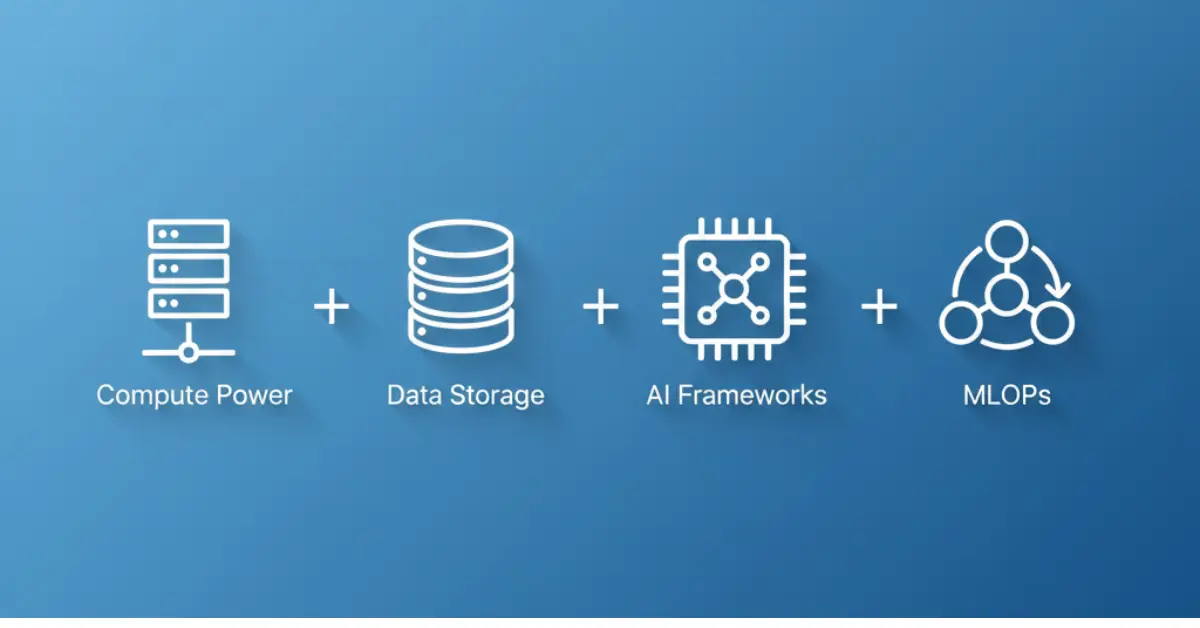
Let’s break down what goes into a functional AI setup. Each of these plays a specific role, and skipping any part can weaken the entire system.

Compute Power
AI workloads require significant processing capability. The choice between CPU, GPU, or TPU depends on your workload:
- CPUs: Good for general tasks and small models
- GPUs: Ideal for deep learning and training large datasets
- TPUs: Specialized chips for tensor computations, useful for neural networks
Cloud platforms like AWS, Azure, and Google Cloud offer virtual machines with GPU and TPU options, allowing you to scale resources without heavy upfront hardware investment.
Data Storage & Management
Data is at the heart of every AI system. Storing it properly and accessing it efficiently is critical.
- Use cloud storage systems like Amazon S3 or Google Cloud Storage for scale
- Implement data versioning tools like DVC to track dataset changes
- Consider data warehousing (e.g., BigQuery, Snowflake) for structured queries
Clean, well-organized data systems make training, evaluation, and troubleshooting easier.

Networking & Bandwidth
When training models or serving responses in real time, network speed plays a big role. Low-latency connections are especially crucial in edge AI, robotics, or real-time applications like fraud detection.
Things to keep in mind:
- Internal network speed for in-house clusters
- Reliable internet connectivity for cloud-based training or inference
- Secure APIs for communication between components
AI Frameworks & Libraries
You’ll need the right frameworks to build and run your models:
- TensorFlow and PyTorch are widely used for deep learning
- scikit-learn works well for traditional machine learning
- Hugging Face is great for NLP and transformer-based models
These libraries help with model development, testing, and deployment across platforms.
MLOps and Model Lifecycle Management
MLOps brings the principles of DevOps to machine learning workflows. It ensures that models are not only trained, but also maintained, updated, and monitored over time.
Key elements include:
- CI/CD pipelines for model deployment
- Monitoring tools like Prometheus, Grafana, or Evidently AI
- Experiment tracking with tools like MLflow or Weights & Biases
Security and Compliance
AI systems deal with sensitive data customer behavior, medical records, financial transactions. Securing this data and meeting regulatory requirements is non-negotiable.
Important areas to address:
- End-to-end encryption of data in transit and at rest
- Role-based access control
- Regular audits and compliance with standards like GDPR, HIPAA, or SOC 2

Tips To Build Your Own AI Infrastructure
If you’re starting from scratch, it can feel overwhelming. But breaking the process down into manageable steps makes it easier to plan and execute effectively.
Start With Clear Use Cases
Before investing in tools or hardware, define what you’re trying to solve. Are you building a fraud detection system? A personalized e-commerce experience? Your use case will guide the rest of your decisions.
Begin With Cloud-Based Prototypes
For most businesses, it’s better to experiment in the cloud before purchasing hardware:
- Use Google Colab or AWS SageMaker Studio Lab for small experiments
- Try cloud AI platforms like Vertex AI, Azure ML, or Databricks for larger workloads
These platforms allow flexibility and scale without long-term commitment.
Build a Modular Architecture
Avoid monolithic systems. A modular setup using containers (Docker) and orchestration tools (Kubernetes) allows each part of your infrastructure to be updated independently.
Benefits include:
- Easier troubleshooting
- Better fault isolation
- Faster deployments
Implement MLOps from Day One
Even small experiments can benefit from basic version control and automation:
- Track experiments using tools like MLflow
- Store models in versioned registries
- Automate retraining and redeployment based on performance metrics
Choose Frameworks That Suit Your Team
Don’t go with tools just because they’re trending. Choose based on your team’s expertise and long-term maintainability. A model built in PyTorch may be easier to manage for some teams than TensorFlow, or vice versa.
Prioritize Data Governance Early
Messy data will lead to messy results. Define policies for:
- Data collection sources
- Labeling consistency
- Storage formats
- Access permissions
This makes future scaling less painful.
Bring in Experts When Needed
Sometimes internal teams don’t have the time or experience to set up infrastructure correctly. Partnering with a consultancy like Miniml allows you to move faster and avoid mistakes that can cost time, data, and resources.
Common Mistakes To Avoid
Even well-funded teams run into trouble by skipping foundational steps. Here are some common pitfalls:
- Relying on a single cloud vendor without fallback plans
- Failing to estimate compute and storage costs
- Neglecting security audits and data privacy practices
- Not testing models in real-world scenarios before launch
- Ignoring feedback loops for continuous improvement
Planning ahead and investing in observability and documentation helps avoid these traps.
How Miniml Supports AI Infrastructure Projects
At Miniml, we work with businesses to design and deploy infrastructure that aligns with real-world use cases. Whether you need to set up a machine learning pipeline in the cloud, run large language models on secure systems, or bring predictive analytics into daily workflows, our team ensures your foundation is future-ready.
We focus on:
- Use-case driven planning
- Cost-efficient cloud and hybrid solutions
- Secure deployment with industry-specific compliance
- Training internal teams for long-term success
Our projects span industries from healthcare and education to finance and retail where each has its own data, compliance, and performance needs.
Final Thoughts
Building AI infrastructure is less about assembling fancy components and more about thoughtful design. It’s about aligning technology with your business goals, planning for change, and building systems that can grow with you.
If you’re ready to start building or upgrading your infrastructure, contact Miniml. We’ll help you map your goals to the right setup saving you time and helping you avoid costly missteps.