

In the world of artificial intelligence, some of the most powerful tools work quietly in the background. One such example is embedding models. These models serve as the foundation for everything from product recommendations to intelligent search engines. While they’re often invisible to the end user, they play a critical role in how businesses interact with data.
Whether you’re in healthcare, finance, retail, or education, embedding models can help uncover patterns, organize complex information, and support better decision-making. In this article, we’ll explain what embedding models are, how they work, and how they’re being used across industries today.
What Are Embedding Models?
At the simplest level, embedding models translate complex data like text, images, or audio into a format that computers can understand: numbers. These numbers take the shape of vectors, which are just long lists of values. The purpose of embedding is to represent the meaning of the data, not just the words or visuals.
For example, the words “car” and “vehicle” might be far apart in a sentence, but embedding models will place them close together in vector space because they have similar meanings. This ability to understand relationships between items makes embeddings especially useful in natural language processing (NLP), computer vision, and recommendation systems.
How Do Embedding Models Work?
Embedding models work by mapping pieces of data into a multi-dimensional vector space. In this space, items with similar meaning or context are placed close together, while unrelated items are farther apart.
Types of Embeddings:
- Word Embeddings: Represent individual words (e.g., Word2Vec, GloVe)
- Sentence Embeddings: Capture the meaning of entire phrases or sentences (e.g., Sentence-BERT)
- Image Embeddings: Used for visual tasks like object recognition or image matching
- Multimodal Embeddings: Combine different data types, such as text and images
The model is typically trained on large amounts of data and fine-tuned to recognize patterns specific to a particular domain, such as medical records or financial documents.
Real-World Applications of Embedding Models
Embedding models aren’t just theory they’re already embedded into the tools and platforms many businesses use every day. Below are some practical use cases showing how they make an impact.
Text-Based Use Cases:
- Semantic Search: Improves search accuracy by understanding the intent behind queries rather than matching exact words.
- Customer Support: Groups similar customer tickets for faster triage and more accurate automated replies.
- Document Clustering: Organizes vast document libraries by meaning instead of keywords.
Image-Based Use Cases:
- Visual Search: Lets users find similar-looking products in a catalog.
- Defect Detection: Identifies abnormalities in manufacturing by comparing image embeddings.
Multimodal Use Cases:
- Healthcare: Matches patient symptoms from notes and diagnostic results to similar past cases.
- Retail: Combines browsing behavior and product images to personalize recommendations.
Why Embedding Models Matter for Businesses
Embedding models offer clear, measurable benefits across various departments, from engineering and data science to sales and customer experience.
Here’s what they bring to the table:
1. Better Search Capabilities
Traditional keyword search has limits. Embeddings enable systems to understand what the user is trying to find, even when queries are vague or misspelled.
2. Personalised Experiences
By identifying relationships between products, users, and behaviors, embedding models help tailor content and recommendations more meaningfully.
3. Smarter Automation
Clustering and categorization become easier when embedding vectors reveal underlying structure in the data. This helps automate workflows and improve targeting.
4. Improved Decision Support
From predicting customer churn to grouping similar financial transactions, embeddings support smarter analytics that help guide business strategy.
Best Practices for Using Embedding Models
Successfully working with embedding models requires thoughtful planning and careful execution. Below are some best practices to keep in mind:
- Start with a Pretrained Model
Don’t reinvent the wheel. Use well-established models like BERT, RoBERTa, or CLIP as a starting point. - Fine-Tune for Your Use Case
Adapt the model to your specific industry or task by training it on your internal data. This dramatically improves accuracy. - Use a Vector Database
Embeddings can be compared using cosine similarity, but that’s computationally expensive at scale. Use specialized databases like FAISS, Pinecone, or Weaviate. - Monitor for Drift
Embeddings can lose relevance as language or behavior changes over time. Periodic retraining helps maintain performance. - Evaluate Regularly
Don’t rely on intuition alone. Use quantitative benchmarks and qualitative reviews to assess how well embeddings are working in your application.

Common Challenges with Embedding Models
While embedding models are powerful, they do come with limitations that need to be understood and addressed.
Potential Roadblocks:
- Interpretability: It’s not always clear why two vectors are similar, which can pose challenges for regulated industries like finance or healthcare.
- Data Quality: Poor input data leads to meaningless embeddings. Preprocessing and cleaning are essential.
- Scalability: Storing and searching millions of vectors can be resource-intensive.
- Bias: Embedding models trained on biased data can unintentionally reinforce harmful stereotypes.
These challenges are not deal-breakers but need to be actively managed with the right expertise and tools.
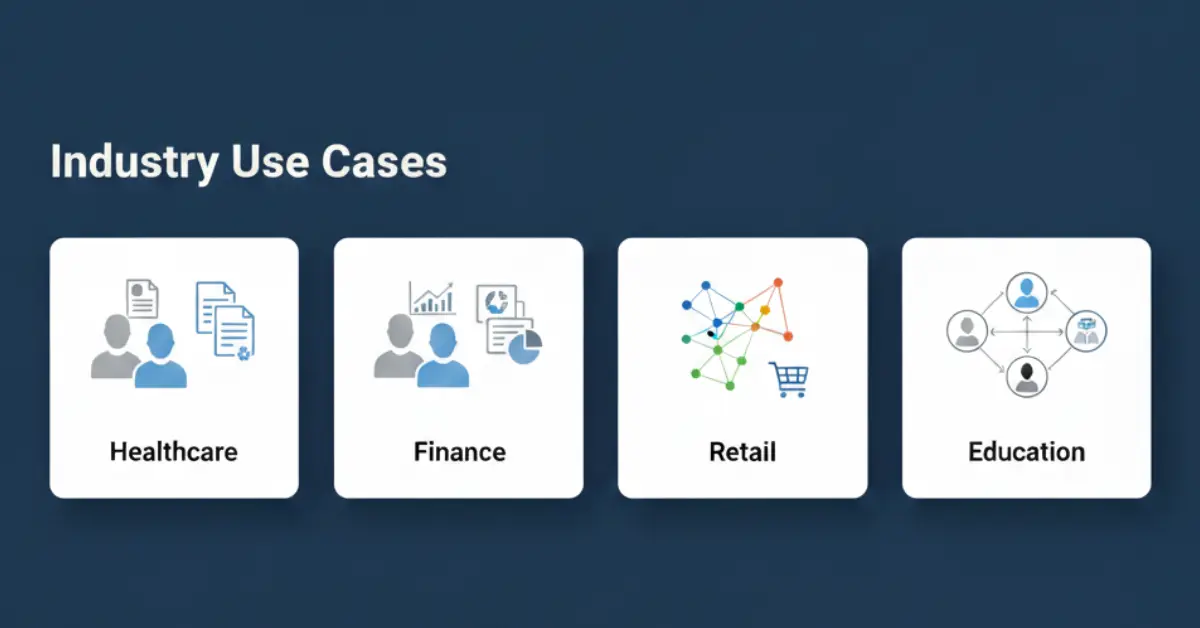
Industry-Specific Use Cases
Healthcare
Embedding models are used to match patients to the right treatments, detect unusual patterns in scans, or surface similar historical cases for review.
Finance
Used for fraud detection, document classification, and portfolio analysis, embeddings provide better risk understanding and data correlation.
Retail
From visual search to personalized product displays, embeddings help match shoppers with what they’re most likely to buy.
Education
Embedding models support intelligent tutoring systems that adapt to a student’s learning pace and style by understanding both content and behavior.
Embeddings and Large Language Models (LLMs)
Large language models like GPT or BERT use embeddings at their core. When these models are used in real-world systems, embeddings often serve as both input and output.
For example, a retrieval-augmented generation (RAG) system uses embeddings to find the most relevant documents from a large database, which are then used to inform a generated answer. Embeddings are also used to compare documents, detect duplicates, and assess similarity.
At Miniml, we work with clients to build LLM-powered solutions that integrate custom embedding workflows from fine-tuning to deploying them inside scalable infrastructure.
How Miniml Supports Embedding Model Projects
As an AI consultancy based in Edinburgh, Miniml helps businesses develop practical, reliable AI systems that include embedding-based components. Whether you need smarter search, more accurate recommendations, or scalable NLP solutions, we can guide you through every stage from strategy to deployment.
We’ve delivered solutions across healthcare, education, retail, and finance, each tailored to domain-specific challenges and goals. Our team ensures the models are explainable, secure, and built to support long-term success.
Conclusion
Embedding models may seem like an advanced concept, but their applications are surprisingly practical. They help machines understand data in a way that aligns closely with how humans think and relate. From powering intelligent search to helping doctors make more informed decisions, embedding models sit at the heart of many modern systems.
If you’re ready to explore how embedding models can help make sense of your data and support your next AI project, get in touch with Miniml today. Let’s build something that fits your business not just your infrastructure.