
Chatbot best practices for AI chatbot development in the UK come down to a narrow scope, answers grounded in your own content, clear bot disclosure, a fast route to a human, and UK GDPR compliance from day one. Our AI customer service chatbots are built on this pattern, and this guide shows you how to apply it.
Key Takeaways on Chatbot Best Practices
- Scope narrowly: A bot that does three jobs well beats one that tries to answer everything.
- Ground every answer: Retrieval from approved content cuts hallucinations, which are confident but wrong answers.
- Comply by design: UK GDPR, ICO transparency guidance and the Equality Act shape the build, not just the privacy notice.
- Treat prompt injection as live: The NCSC says there’s no guaranteed fix yet, so limit what the bot can reach.
- Hand off fast: Customers should reach a person in one step, with the conversation history passed across.
Why UK Chatbot Projects Need Their Own Playbook
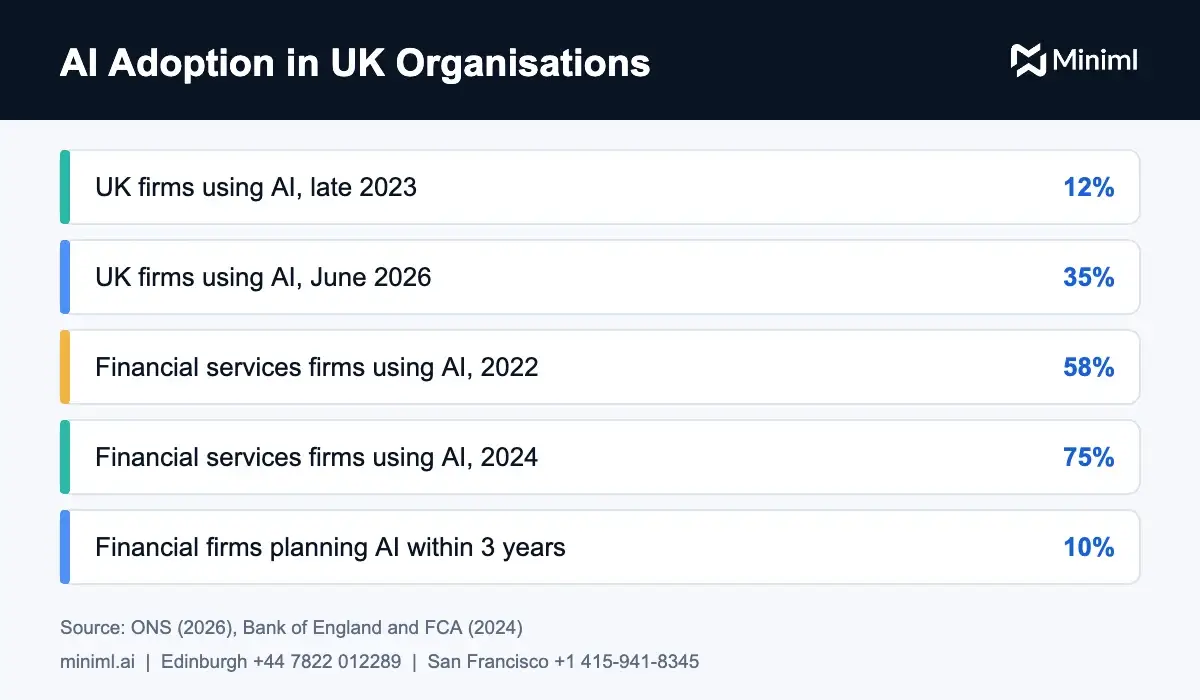
AI use in British business has moved fast. According to ONS AI adoption figures, self-reported AI use among UK firms with 10 or more employees rose from about 12% in late 2023 to about 35% in June 2026. Larger firms are the most likely users, and customer-facing chatbots are one of the most visible forms.
Regulated sectors are further ahead. A joint Bank of England survey with the FCA found 75% of financial services firms already use AI, with another 10% planning to within three years. That’s up from 58% in 2022, so regulators now expect firms to show how these systems are controlled.
The UK hasn’t copied the EU’s single AI law. Instead, the 2023 AI regulation white paper asks existing regulators, such as the ICO and FCA, to apply five cross-sector principles: safety and security, transparency and explainability, fairness, accountability and governance, and contestability and redress. If you also serve EU customers, read our summary of EU AI Act obligations alongside this guide.
What Are the Best Practices for AI Chatbot Development?
The best practices for AI chatbot development are to define a narrow purpose, ground answers in approved content, disclose the bot, protect personal data, design a human handoff, test for accuracy and attacks, make it accessible, and monitor it after launch. Each step needs a named owner.
- Define the job. List the top customer requests the bot will handle and the ones it won’t.
- Ground the answers. Connect the bot to approved policies and help articles, not the open web.
- Disclose the bot. Say it’s automated in the first message.
- Protect personal data. Collect only what’s needed and redact sensitive fields before they reach a model.
- Design the handoff. Give users a clear route to a person at any point.
- Test before launch. Score accuracy, tone and resistance to prompt injection on a fixed test set.
- Build for accessibility. Support screen readers, keyboard use and plain language.
- Monitor and improve. Review failed conversations weekly and update content, not just prompts.
These chatbot best practices apply whether you buy a platform or hire a chatbot development company to build a custom AI chatbot. If you’re still deciding whether a chatbot is the right tool at all, our chatbot to copilot strategy piece covers when an assistant should sit beside staff instead of in front of customers.
Build UK Compliance Into Chatbot Best Practices
Compliance is where most generic guides stop short. For UK chatbot best practices, legal requirements should shape the design brief, because retrofitting them after launch is slow and costly.
UK GDPR and the Data (Use and Access) Act 2025
Any chatbot that handles names, account details or free-text messages processes personal data under UK GDPR. You need a lawful basis, data minimisation (collecting only what you need), retention limits and a route for access and deletion requests. The Data (Use and Access) Act 2025 updates parts of UK data law, including the rules on automated decision-making, and its provisions are being brought in over stages, so check current ICO guidance before you sign off a design.
ICO Transparency and Bot Disclosure
The ICO expects organisations to be open about how personal data is used, including when AI is involved. Applied to chatbot best practices, that means telling users they’re talking to a bot, linking to a clear privacy notice and explaining in plain words what happens to their messages. If the bot’s output feeds a decision about someone, such as eligibility, record how that decision can be explained and challenged.
Accessibility and the Equality Act 2010
The Equality Act 2010 requires reasonable adjustments for disabled people, and a chat widget that doesn’t work with a screen reader can shut them out. Use WCAG 2.2 AA (the web accessibility standard) as your benchmark, and always offer another contact channel, such as phone or email.
Consumer Duty for FCA-Regulated Firms
If you’re FCA-regulated, the Consumer Duty applies to your chatbot as much as to your call centre. The bot must not create unreasonable barriers, such as making it hard to complain or cancel. Test journeys for customers in vulnerable circumstances, and log conversations so you can evidence good outcomes.
LLM-Era Chatbot Best Practices: Grounding, Testing and Security
Large language models (LLMs) make chatbots far more capable, and far less predictable. Older chatbot best practices were written for decision trees, so they skip the new failure modes.
Ground Answers With Retrieval
Retrieval-augmented generation (RAG) means the bot searches your approved documents first, then answers only from what it finds. Showing the source article is one of the simplest chatbot best practices for building trust. If nothing relevant comes back, the bot should say so and offer a person, rather than guess.
Test for Hallucinations
Build a test set of a few hundred real customer questions with approved answers. Score every release for factual accuracy, source use and tone, and treat a drop in scores as a blocker. Rerun the full set whenever you change the model, the prompt or the content.
Defend Against Prompt Injection
Prompt injection is when a user, or a document the bot reads, slips in instructions that override its rules. The NCSC prompt injection guidance warns the risk grows as LLMs pass data to other apps, and there’s no guaranteed fix yet. So limit what the bot can reach, keep actions like refunds behind code checks, and follow an OWASP LLM guardrails guide for layered controls.
Red-Team Before Launch
Red-teaming, one of the newer chatbot best practices, means asking people to try to break the bot on purpose. Include jailbreak attempts, abusive language, requests for other customers’ data and off-topic questions. Fix what you find, then retest.
Design the Human Handoff and Escalation Path
Among all chatbot best practices, the handoff is where trust is won or lost. Customers forgive a bot that can’t help, but not one that traps them. Set clear triggers for passing a conversation to a person:
- The customer asks for a human, in any wording.
- The bot fails to find a grounded answer twice in a row.
- Sentiment turns negative, or the customer mentions a complaint.
- The topic signals vulnerability, such as bereavement, debt or health.
- The request involves money, contracts or account security.
Here’s how we map the handoff when scoping a UK chatbot build:
- List the triggers above and add any sector-specific ones.
- Pass full context, so the agent sees the transcript and extracted details without asking the customer to repeat them.
- Set out-of-hours rules, such as a callback request or ticket, so the handoff never dead-ends.
- Measure handoff quality through repeat contact rates and post-chat surveys.
Our decision rule is simple: if the bot can’t resolve a request type correctly in testing at least as often as a trained agent, it routes that type to a person. If you’d like a second opinion on your current setup, book a chatbot review and we’ll assess your triggers, test set and data flows.
Launch-Readiness Checklist for UK Chatbots
Use this table to check your chatbot best practices before a go or no-go decision. If a row has no evidence, the bot isn’t ready.
| Area | What good looks like | Evidence to keep |
|---|---|---|
| Data protection | Lawful basis set, PII redacted, retention limits applied | DPIA, privacy notice, data flow map |
| Security | Prompt injection tested, actions gated by code | Red-team report, access controls list |
| Accuracy | Grounded answers meet the agreed score | Test set results per release |
| Accessibility | Works with screen readers and keyboard only | WCAG 2.2 AA audit |
| Handoff | One-step route to a person with context | Handoff test scripts, out-of-hours plan |
| Monitoring | Weekly review of failed and escalated chats | Dashboard, change log, named owner |
The UK Government AI Playbook sets out 10 principles for using AI safely, effectively and securely. It’s written for the public sector, but it’s a useful yardstick for any organisation that wants its chatbot best practices to hold up to scrutiny.
How Chatbot Best Practices Differ by UK Sector
The core chatbot best practices stay the same, but the risk and focus shift by sector.
Financial Services
With 75% of firms already using AI, the priority is control. Keep bots away from personalised advice, record every conversation, and test journeys against Consumer Duty outcomes before launch.
Public Sector
Accessibility and plain English come first, because users can’t choose another provider. Offer other channels, publish how the bot works and follow the 10 AI Playbook principles.
Retail and E-commerce
Volume is high and requests are repetitive, so order tracking and returns are strong starting points. The main risks are promising refunds the policy doesn’t allow and handling payment data in open chat.
AI Chatbot Development FAQs
How much does it cost to develop an AI chatbot in the UK?
Costs depend on scope, integrations and compliance work. UK agency pages we reviewed in September 2026 quote from about £3,000 for a simple FAQ bot to £25,000 or more for custom builds. Budget separately for hosting, model usage, testing and ongoing monitoring after launch.
Can I build my own AI chatbot?
Yes. No-code tools let you launch a basic bot quickly. The hard part is doing it safely: grounding answers in approved content, handling personal data under UK GDPR, testing for prompt injection and building a human handoff. Following chatbot best practices matters more than the tool you pick.
Does a chatbot have to comply with UK GDPR?
Yes, if it processes personal data, which most customer chatbots do. You need a lawful basis, a clear privacy notice, data minimisation, retention limits and a way for people to exercise their rights. A data protection impact assessment is wise for any high-risk use.
Should a chatbot tell users it is not a human?
Yes. Disclosing the bot up front is one of the oldest chatbot best practices, and it supports the transparency expected under UK GDPR and ICO guidance. Say it’s automated in the first message and always offer a clear way to reach a person.
What should you never let a customer chatbot do or say?
Don’t let it give regulated financial, legal or medical advice, promise refunds or contract terms it can’t honour, collect card details in open chat, or guess when it has no source. Block those actions in code, not only in the prompt.
How do you test an AI chatbot before launch?
Build a test set of real customer questions, including edge cases and abusive inputs. Score answers for accuracy, grounding and tone, run prompt-injection and jailbreak attempts, check accessibility with a screen reader, and pilot with a small group before a full release.
Plan a Compliant UK Chatbot Build
Chatbot best practices start with a clear scope, a tested answer set and a compliance plan agreed before anyone writes a prompt. Book a scoping call and we’ll help you define the first use case, the handoff rules and the evidence you’ll need at launch. Call our Edinburgh office on +44 7822 012289 or our San Francisco office on +1 415-941-8345.
About Miniml: Miniml is an AI consultancy with offices in Edinburgh and San Francisco that designs, builds and governs custom AI systems.