
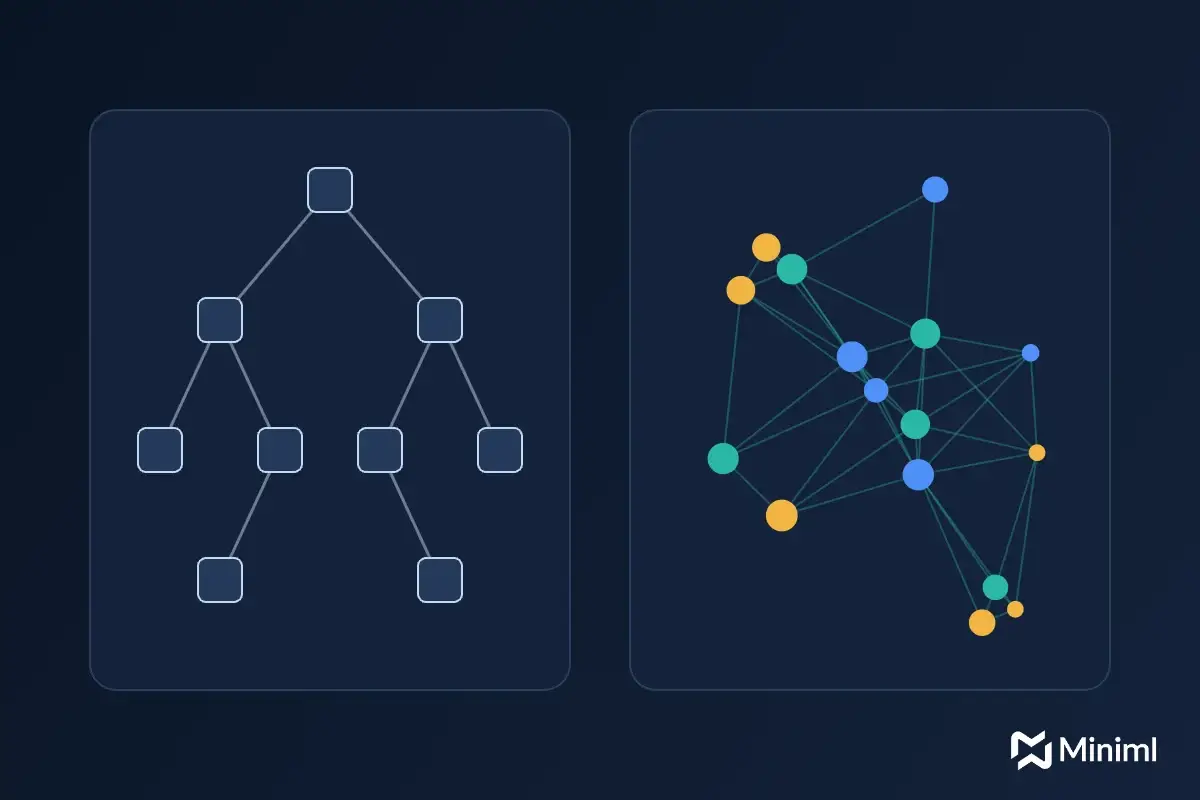
The chatbot vs conversational AI difference comes down to understanding. A traditional chatbot follows preset rules, keywords, and decision trees. Conversational AI uses natural language processing (NLP) and large language models to grasp intent, handle follow-up questions, and reply in context. Many modern chatbots now run on conversational AI.
Key Takeaways on Conversational AI vs Traditional Chatbots
- Rules vs understanding: traditional chatbots match keywords to scripts, while conversational AI interprets intent and context.
- Rule-based bots still win for payments, compliance scripts, and fixed flows where every answer must be identical.
- Model costs have collapsed: inference prices fell more than 280-fold in two years, so the real spend is integration and testing.
- Accuracy is the trade-off: generative models can present false content with confidence, so ground them in your data and add guardrails.
- Hybrid is the default: for most teams, the chatbot vs conversational AI answer is rules for critical steps, AI for open questions, and an easy route to a human.
Chatbot vs Conversational AI: The Key Differences
“Chatbot” covers any software that chats with users. A traditional chatbot is the rule-based kind. Conversational AI is the wider field of systems that understand and generate natural language, so the chatbot vs conversational AI question is really about which engine sits behind the chat window.
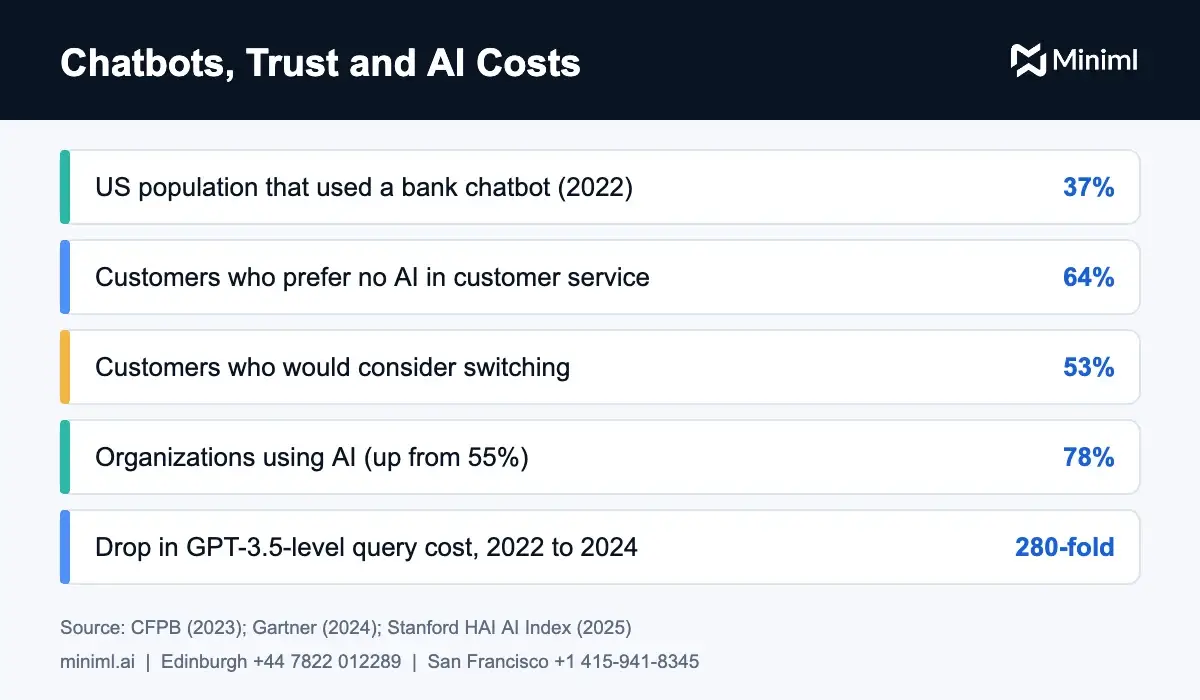
The CFPB chatbot research report describes rule-based bots as using decision-tree or keyword logic with preset responses. It also found that about 37% of the US population used a bank chatbot in 2022, and that all of the top 10 US commercial banks use chatbots. Here’s the chatbot vs conversational AI comparison across seven factors, which shows the difference between chatbot and conversational AI systems in practice:
| Factor | Traditional chatbot | Conversational AI |
|---|---|---|
| How it works | Decision trees, keywords, preset replies | NLP and language models that interpret intent |
| Input it handles | Buttons, menus, exact phrases | Free text, typos, follow-up questions |
| Context memory | Little or none between messages | Tracks the conversation and earlier answers |
| Answer consistency | Identical every time | Wording varies, so it needs guardrails |
| Accuracy risk | Fails only when no rule matches | Can give confident wrong answers |
| Setup and upkeep | Every path scripted by hand | Grounded in your content, tuned through testing |
| Best for | Fixed, regulated, high-stakes flows | Open questions, varied intents, self-service |
Read the table as a set of trade-offs, not a ranking. In any chatbot vs conversational AI decision, the right answer depends on how varied your customers’ questions are and how costly a wrong reply would be.
How Each Type Works Under the Hood
Traditional rule-based chatbots
A rule-based bot is a flowchart with a chat window on top. It scans each message for keywords or offers buttons, then follows a scripted branch. If a customer types something the designer didn’t expect, it falls back to a line like “Sorry, I didn’t understand that.”
That rigidity is also its strength. You know exactly what the bot will say, you can audit every path, and it never makes up a policy.
Conversational AI and LLM chatbots
Conversational AI combines natural language understanding (NLU), which maps a message to an intent, with a large language model (LLM) that writes the reply. The rule based chatbot vs AI chatbot gap shows up most when people ask two things at once, use slang, or change topic mid-chat.
Well-built systems don’t let the model answer from memory alone. They retrieve approved content first, then generate a reply grounded in it.
Seen side by side, the chatbot vs conversational AI split is flexibility versus control. Rules give you certainty but break on anything unexpected. AI copes with messy, real-world language but needs checks to stay accurate. Neither is better in every case.
Agentic AI: the third tier in 2026
Agentic AI adds a third option to the chatbot vs conversational AI comparison, because the newest tier goes beyond answering. Agentic systems take actions, such as updating an order or booking a return, by calling your business systems. We cover that shift in our chatbots to copilots guide. If you’re also weighing a virtual assistant, see our comparison of AI chatbots versus assistants.
When a Traditional Chatbot Still Wins
In the chatbot vs conversational AI debate, newer isn’t always better. Most vendor articles skip this part, but in several cases a rule-based bot is the safer and cheaper choice:
- Payments and account changes: every step must be exact, auditable, and identical for every customer.
- Compliance scripts: regulated disclosures that must appear word for word.
- Deterministic flows: password resets, order status by reference number, and opening hours.
- Low volume: if you handle a few dozen chats a week, scripted paths may cover nearly all of them.
- Strict legal wording: any situation where a reworded answer creates risk.
Here’s the decision rule we use when scoping chatbot vs conversational AI work. If you can list every valid answer in advance, and a wrong answer causes real harm, script it. If the questions are open and varied, use conversational AI. Most businesses have both kinds of question, which is why hybrid designs usually win.
Chatbot vs Conversational AI: Which Costs More?
Model cost used to be the barrier. The Stanford AI Index 2025 reports that querying a GPT-3.5-level model fell from $20 to $0.07 per million tokens between November 2022 and October 2024, a more than 280-fold drop. The same report found 78% of surveyed organizations used AI, up from 55%.
When teams compare conversational AI vs chatbot budgets, they often look only at model fees. The bigger costs now sit elsewhere. Budget for integration with your CRM and help desk, content preparation, testing, monitoring, and human review. A rule-based bot costs little to run, but every new path needs manual scripting, so upkeep grows with each product or policy change.
| Cost area | Traditional chatbot | Conversational AI |
|---|---|---|
| Build | Script every flow by hand | Connect content sources and design guardrails |
| Running | Very low per conversation | Usage fees per token (a token is a small chunk of text) |
| Maintenance | Rewrite flows for every change | Update source content and re-test answers |
| Hidden cost | Customers who give up at dead ends | Reviewing and correcting wrong answers |
The practical chatbot vs conversational AI cost question isn’t “which is cheaper to run?” It’s “which is cheaper to keep accurate as the business changes?” For a small, stable set of questions, that’s often the rule-based bot. For a large, shifting set, it’s usually conversational AI.
Accuracy, Hallucinations, and Customer Trust
Conversational AI can give wrong answers. The NIST Generative AI Profile lists 12 risks that are unique to or made worse by generative AI. One is confabulation: confidently presenting false content, often called hallucination. The CFPB report also notes that LLM-based bots can struggle to give accurate, reliable information.
Customers notice. A Gartner customer service survey found 64% of customers would prefer companies didn’t use AI in customer service, and 53% would consider switching. Their top concerns were difficulty reaching a human and inaccurate answers.
Both concerns are design problems you can manage. Ground replies in approved content, show sources, block topics the bot shouldn’t touch, and keep “talk to a person” one click away. Our LLM guardrails playbook covers the controls in more depth.
This is where the chatbot vs conversational AI trade-off is sharpest. A rule-based bot can’t invent an answer, but it can’t handle an unexpected question either. A well-governed AI bot copes with the unexpected question, as long as you ground it, test it, and watch it after launch.
Planning to replace or upgrade an existing bot? We can review your chat logs, flows, and risk points before you commit to a rebuild. Speak with our engineers about a hybrid design that fits your volumes.
How to Migrate From a Rule-Based Bot to Conversational AI
You don’t need to settle the chatbot vs conversational AI question with a full rebuild or rip out a working bot. A staged migration protects what already works and gives you proof before you scale:
- Mine your chat logs: export three to six months of conversations and find the top intents, dead ends, and drop-off points.
- Keep the critical scripts: leave payments, identity checks, and compliance steps on rule-based flows.
- Add AI in front: let conversational AI handle open questions, grounded in your help center and policy documents.
- Set confidence thresholds: route low-confidence answers to a scripted flow or a person instead of guessing.
- Test on real history: replay past conversations and score accuracy before any customer sees the new bot.
- Launch to a share of traffic: compare resolution and handoff rates with the old bot, then expand in steps.
- Review every week: read transcripts, fix weak answers, and update source content as policies change.
Whichever side of the chatbot vs conversational AI line each flow lands on, be open with customers. Tell them when they’re talking to AI and keep the human handoff visible. Given that 64% of customers would rather companies didn’t use AI in customer service, that openness matters as much as the model you pick.
Finally, track three numbers before and after the switch: resolution rate, handoff rate, and customer satisfaction. They turn the chatbot vs conversational AI debate from opinion into evidence for your own business, and they show you where to invest next.
Chatbot vs Conversational AI FAQs
Is ChatGPT a conversational AI or a chatbot?
ChatGPT is both. It’s a chatbot interface built on conversational AI, specifically a large language model that understands free text and writes its own replies. Unlike a traditional rule-based chatbot, it doesn’t follow preset scripts, so it handles open questions well but can sometimes give confident, incorrect answers.
What are the four types of chatbots?
A common grouping is menu or button bots, keyword bots, rule-based bots built on decision trees, and AI-powered conversational bots. Some lists add hybrid bots, which mix scripted flows with AI, and agentic bots that take actions inside other systems.
What is an example of conversational AI?
Voice assistants, LLM chat tools like ChatGPT, and support bots that understand free-text questions are all examples. A bank assistant that answers “why was I charged twice?” by checking your transactions is conversational AI. A menu that asks you to press 1 for your balance isn’t.
Are rule-based chatbots still worth using?
Yes, for fixed flows where every answer must be exact, such as payments, identity checks, and regulated disclosures. They’re predictable, cheap to run, and easy to audit. Many businesses pair them with conversational AI, which handles the open questions.
Is conversational AI more expensive than a traditional chatbot?
Not always. Model usage prices have fallen sharply, so running costs are rarely the main expense now. The bigger costs are integration, content preparation, testing, and monitoring. Rule-based bots are cheap to run but cost more to maintain as the number of scripted flows grows.
Can conversational AI give wrong answers?
Yes. NIST calls this confabulation: confidently presenting false content. Grounding replies in approved content, guardrails, confidence thresholds, and human handoff all reduce the risk. No design removes it fully, so keep high-stakes steps scripted or reviewed by a person.
Choosing Between Rules and AI for Your Customers
The chatbot vs conversational AI choice isn’t all or nothing. Script what must be exact, use AI where questions vary, and keep a person within reach. To plan a hybrid design for your business, book a scoping call with Miniml. Call our Edinburgh office on +44 7822 012289 or our San Francisco office on +1 415-941-8345.
About Miniml: Miniml is an AI consultancy with offices in Edinburgh and San Francisco that designs, builds and governs custom AI systems. We help UK and US businesses scope, build, and run AI that fits their data, processes, and risk rules.