
NLP in customer service means using natural language processing, software that reads and interprets human language, to understand tickets, chats, emails and calls. It detects intent, gauges sentiment, pulls out key details and drafts replies, so teams resolve issues faster. Our natural language processing services build these systems for support and data teams.
Key Takeaways on NLP in Customer Service
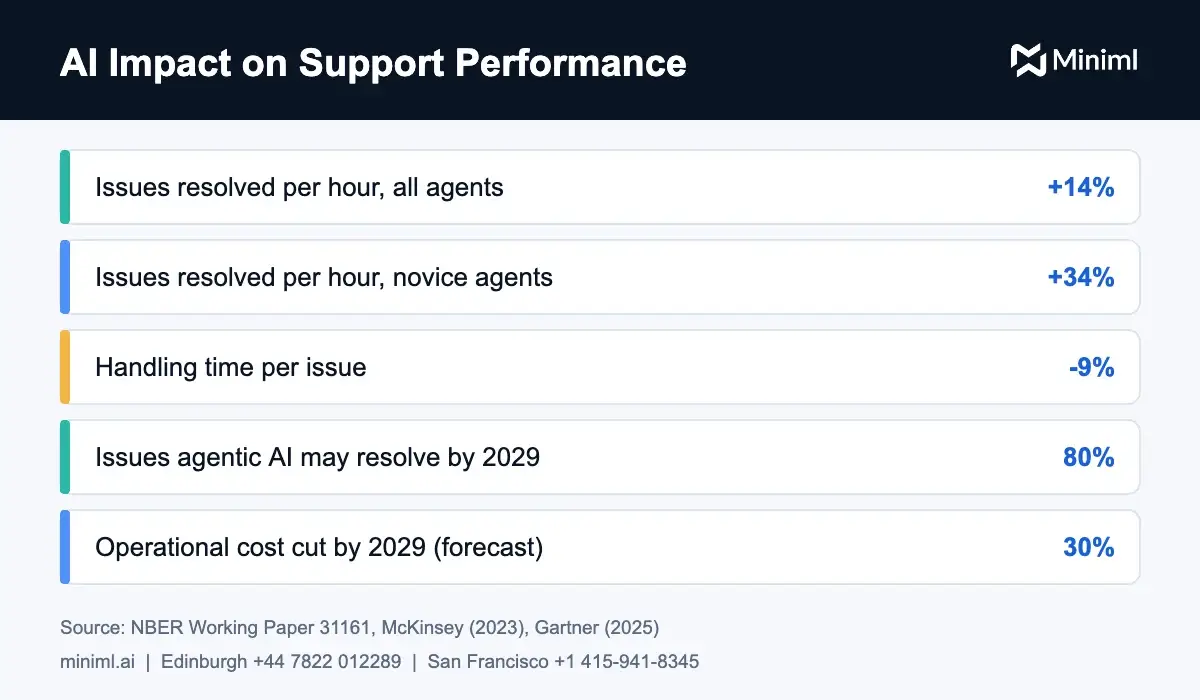
- Agent productivity: In a large field study, an AI assistant raised issues resolved per hour by 14% on average and by 34% for novice agents.
- Data processing: Ticket triage, entity extraction and auto-summaries often pay back faster than a customer-facing chatbot.
- Right tool per task: Classic NLP models suit high-volume classification, while large language models suit drafting and summarizing.
- Measure first: Set baselines for handle time, first contact resolution, deflection and CSAT before any pilot starts.
- Governance: PII redaction, grounded answers and a fast human handoff are requirements, not extras.
How Is NLP Used in Customer Service?
NLP is used in customer service to understand what customers write or say, then act on it. It sorts and routes tickets, detects frustration, suggests answers to agents, powers self-service chat, extracts details from emails and forms, and summarizes conversations. The goal of NLP in customer service is faster, more consistent resolution with less manual reading.
In natural language processing customer service projects, these are the six uses we see most often:
- Intent detection and routing: tagging each request by topic and sending it to the right queue.
- Sentiment analysis: scoring tone so angry or at-risk customers get priority.
- Agent assist: suggesting replies and knowledge articles while the agent works.
- Self-service answers: chat and email bots that resolve simple requests end to end.
- Entity extraction: pulling order numbers, account IDs and dates out of free text.
- Summarization: writing short case notes after chats and calls.
Most teams don’t need every form of NLP in customer service on day one. The right starting point depends on where your agents lose the most time, which is why a ticket sample review should come before any tool choice.
Core NLP in Customer Support Examples
These nlp in customer support examples cover the front line, where customers and agents interact in real time. Each use of NLP in customer service here maps to a clear metric, which makes value easier to prove.
Intent Detection and Smart Routing
An intent model reads the first message and predicts the reason for contact, such as a refund, a login issue or a delivery delay. The ticket then lands in the right queue with the right priority. This cuts transfers, and transfers are one of the biggest drivers of long handle times.
Sentiment and Escalation Signals
Sentiment analysis scores whether a message is calm, annoyed or angry. Paired with customer value data, it can flag a churn risk before the customer asks to cancel. Keep the thresholds simple at first, and review the flagged cases weekly so the model doesn’t escalate everything.
Agent Assist and Suggested Replies
Agent assist is where the evidence for NLP in customer service is strongest. The NBER Generative AI study found an AI assistant lifted issues resolved per hour by 14% on average. Novice and low-skilled agents gained 34%, because the tool spread the habits of top performers. That makes agent assist a strong first project for teams with high staff turnover.
Self-Service Chat and Email
Customer-facing bots handle password resets, order status and policy questions. The trick is knowing when to stop. For a deeper look at how assistants grow from simple bots into tools that sit beside agents, read our piece on the chatbot to copilot evolution.
The Data Processing Side of NLP in Customer Service
Most articles on NLP in customer service stop at chatbots. Yet a large share of support effort goes into reading, sorting and retyping information. That back-office work is often the fastest place to show a return, because it doesn’t change the customer experience on day one.
AI Ticket Classification and Triage
AI ticket classification assigns product, issue type and urgency to every incoming ticket, including email and web forms. A well-tuned classifier replaces the manual tagging step that agents often skip or get wrong. Clean tags also feed better reporting, so you can see which products drive the most contacts.
Entity Extraction From Emails, Forms and Transcripts
Entity extraction pulls structured fields, like account numbers, addresses and claim amounts, out of free text and attachments. Those fields can pre-fill the CRM or trigger a workflow. When the inputs include scanned PDFs, invoices or contracts, it pays to pair NLP with document intelligence pipelines that handle layout and OCR (optical character recognition, which turns images of text into text).
Auto-Summaries Written Into the CRM
After-call work is expensive. A summarization model can write a three-line case note, the resolution and next steps straight into the ticket. Agents review and edit rather than type from scratch, and the next agent who opens the case gets context in seconds.
Classic NLP vs LLM-Based Approaches
When you design NLP in customer service, not every task needs a large language model (LLM). Classic NLP models are small, fast and cheap to run at volume. LLMs are flexible and write well, but they cost more per request and need guardrails. Use the table below as a starting rule.
| Use case | Classic NLP pipeline | LLM-based approach | Our default pick |
|---|---|---|---|
| Ticket classification | Fast, cheap, needs labeled data | Works with few examples, higher cost | Classic, LLM for rare classes |
| Sentiment analysis | Reliable for clear tone | Better with sarcasm and mixed tone | Classic first |
| Entity extraction | Precise for fixed formats | Handles messy free text | Hybrid |
| Call and chat summaries | Weak, template-based | Strong, readable notes | LLM with review |
| Suggested replies | Limited to canned responses | Drafts grounded answers | LLM with retrieval |
| Self-service chat | Rigid decision trees | Natural conversation | LLM with strict guardrails |
For most NLP in customer service projects, a hybrid design wins. Let a small classifier route and tag every ticket, then call an LLM only where writing or reasoning adds value. That keeps costs predictable and makes each part easier to test.
How to Implement NLP in Customer Service: A 6-Step Plan
Here’s the rollout sequence we use when scoping NLP in customer service. It favors small, measurable wins over a big-bang launch.
- Audit your contact data. Pull a sample of recent tickets, chats and call transcripts. Label the top reasons for contact and note where agents spend the most time.
- Pick one workflow. Choose a single, high-volume task, such as triage or after-call summaries, with a clear owner and a clear metric.
- Set baselines. Record handle time, first contact resolution, deflection and CSAT for that workflow before you change anything.
- Build and test offline. Train or configure the model on historical data, then check accuracy against a held-out set that a human has labeled.
- Pilot with a human in the loop. Run it with one team, keep agents in control of every customer-facing output, and design a fast handoff to a person.
- Monitor and expand. Track accuracy drift, agent overrides and complaints weekly, then add the next workflow only when the first one holds up.
Two decision rules keep projects honest. First, if your team can’t agree on the categories when labeling tickets by hand, a model won’t agree with them either, so fix the taxonomy before you train. Second, if a task touches money, legal commitments or vulnerable customers, a human approves the output until the error rate is proven low.
If you’re weighing outside help for this work, you can compare NLP consulting firms in our separate guide. Or, if you already know the workflow you want to fix, scope an NLP pilot with our team and we’ll map your ticket data to a first use case.
Measuring the ROI of NLP in Customer Service
The money case for NLP in customer service is real, but it depends on picking the right metrics. McKinsey generative AI research estimates that about 75% of generative AI’s value falls across four functions, and customer operations is one of them. The same research describes a company with 5,000 agents where AI raised issue resolution by 14% an hour and cut handling time by 9%.
| KPI | What it tells you | How NLP moves it |
|---|---|---|
| Average handle time (AHT) | Minutes per contact | Summaries and suggested replies cut typing and searching |
| First contact resolution (FCR) | Share solved without follow-up | Better routing and grounded answers reduce transfers |
| Deflection rate | Share solved by self-service | Bots resolve simple requests end to end |
| CSAT | Customer satisfaction score | Faster, more consistent answers |
| Cost per contact | Total support cost divided by contacts | Less manual triage and after-call work |
Looking ahead, the Gartner agentic AI forecast predicts agentic AI will resolve 80% of common customer service issues without human help by 2029, cutting operational costs by 30%. Treat forecasts like that as direction, not a budget line. Your own pilot data should drive the business case.
Count the full cost, too. That includes model and hosting fees, integration with your help desk and CRM, labeling time and the ongoing review work that keeps quality high.
Risks, Limits and Governance
NLP in customer service fails in predictable ways. Plan for these before launch, not after the first complaint.
- Hallucination: LLMs can state wrong policies with confidence. Ground answers in your approved knowledge base and block replies with no source.
- Personal data: Redact PII (personally identifiable information, such as card numbers and addresses) before text reaches a third-party model.
- Bias: Sentiment and intent models can misread dialects or non-native English. Test accuracy across customer groups.
- Drift: New products and policies change what customers ask. Retrain or refresh prompts on a schedule.
- Silent failure: Log every automated action so a person can audit what the system did and why.
A simple rule for NLP in customer service: automate the reading, keep humans on the judgment. The 14% productivity gain in the NBER study came from helping agents, not removing them.
NLP in Customer Service FAQs
What does NLP mean in customer service?
NLP in customer service is the use of natural language processing to read and understand customer messages. It identifies what a customer wants, how they feel and which details matter, then routes, answers or summarizes the request so agents spend less time on repetitive reading and typing.
Is ChatGPT an NLP tool?
Yes. ChatGPT runs on a large language model, which is a modern form of NLP. It can classify, summarize and draft text, but a support team shouldn’t plug it in raw. You still need grounding in your own knowledge base, PII controls and human review for sensitive replies.
What are the main NLP techniques used in customer support?
The core techniques are intent detection (what the customer wants), sentiment analysis (how they feel), entity extraction (order numbers, names, dates), summarization (short case notes) and text generation (draft replies). Most support stacks combine three or four of these rather than relying on one.
Can NLP process emails and support tickets, not just chat?
Yes, and that’s often where the fastest wins are. NLP can classify incoming emails, pull account details from forms and attachments, tag tickets by product and urgency, and write call transcript summaries into your CRM. Chat is only one channel of many.
Will NLP replace human support agents?
Not in the near term. The strongest evidence shows NLP making agents faster, especially newer ones, rather than replacing them. Routine requests can be automated, but complex, emotional or high-value cases still need a person, and a good design hands those over quickly.
How do you measure the ROI of NLP in customer support?
Set a baseline before launch for average handle time, first contact resolution, deflection rate, CSAT and cost per contact. Then compare a pilot group against a control group for several weeks, and count the engineering, licensing and review costs against the time saved.
Build Your Support Automation Roadmap
The best projects for NLP in customer service start with your own tickets, not a vendor demo. Book a scoping call and we’ll review a sample of your contact data, pick the first workflow and define the metrics that prove it works. Call our Edinburgh office on +44 7822 012289 or our San Francisco office on +1 415-941-8345.
About Miniml: Miniml is an AI consultancy with offices in Edinburgh and San Francisco that designs, builds and governs custom AI systems.