Data privacy concerns have pushed businesses to reconsider third-party cloud providers. Self-hosted cloud storage gives organisations complete control over sensitive information without relying on external services.
Nextcloud and ownCloud dominate this space. Despite sharing common origins, these platforms have evolved differently. This guide from Miniml breaks down what matters when choosing between them.
The History Behind These Rival Platforms
Frank Karlitschek launched ownCloud in 2010 as one of the first open-source alternatives to Dropbox and Google Drive. The platform quickly gained traction among privacy-conscious users and enterprises seeking data sovereignty.
In 2016, Karlitschek left ownCloud with many core developers, citing concerns about commercial priorities over community engagement. They forked the codebase and created Nextcloud, committing to a fully open-source approach. Since then, both platforms have taken distinct paths in development and market positioning.

What Both Platforms Have in Common
Before examining differences, understanding shared capabilities helps set expectations. Both Nextcloud and ownCloud deliver solid foundational features for self-hosted storage.
Core capabilities include:
- File upload, storage, and synchronisation across Windows, macOS, and Linux desktop clients
- Mobile applications for iOS and Android with automatic sync
- User and group management with role-based access control
- Password-protected sharing links with expiration dates
- Integration with document editors like Collabora, OnlyOffice, and Microsoft 365
- Calendar and contact synchronisation via CalDAV and CardDAV protocols
- Deployment flexibility across bare metal servers, VMs, or cloud infrastructure
Key Differences That Matter
The similarities end when examining licensing models, feature availability, and development priorities. These distinctions significantly impact long-term planning for any organisation.
Licensing and Open Source Philosophy
Nextcloud operates under AGPLv3 for both community and enterprise editions. Every feature remains open source, with enterprise subscriptions adding professional support and SLAs rather than unlocking hidden functionality.
OwnCloud uses dual licensing. The community edition runs on AGPLv3, but enterprise features require a proprietary commercial licence. Certain advanced capabilities only become available through paid subscriptions.
Collaboration Tools
Nextcloud has expanded aggressively beyond file storage into a complete collaboration suite.
Nextcloud native tools include:
- Nextcloud Talk for video conferencing, screen sharing, and chat
- Nextcloud Office for real-time collaborative document editing
- Deck for kanban-style project management
- Pre-installed Calendar, Contacts, and Tasks applications
OwnCloud maintains focus on file synchronisation excellence. Rather than building collaboration tools internally, ownCloud integrates with best-of-breed solutions like Microsoft 365. This means fewer native features but potentially stronger performance in specialised integrations.
App Ecosystem
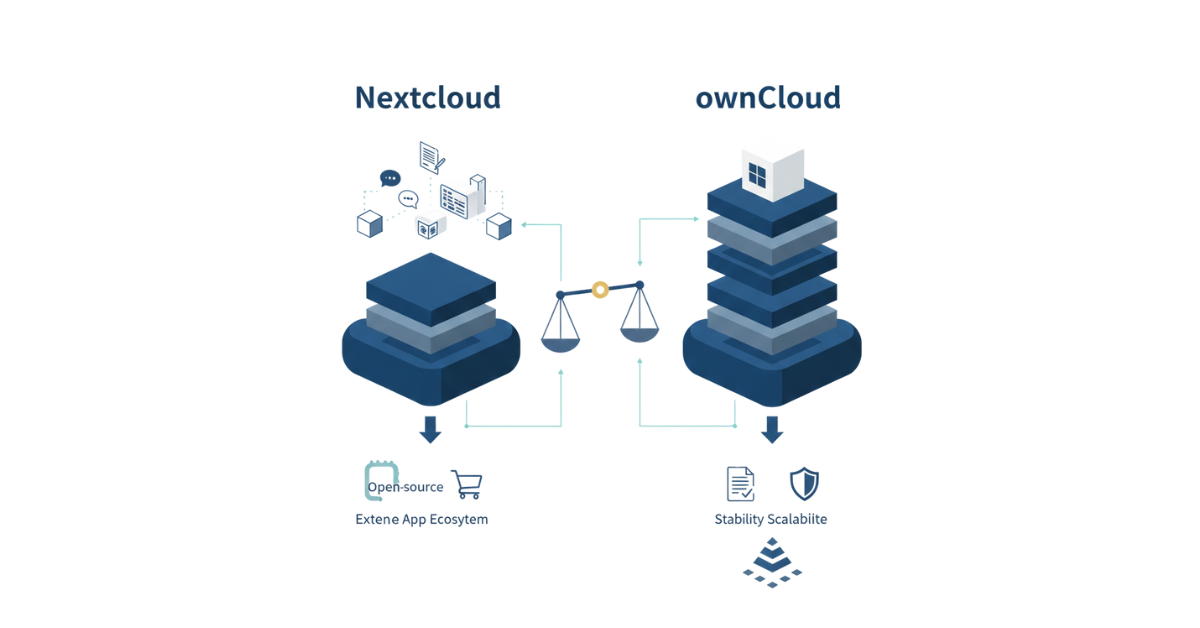
The Nextcloud app store contains hundreds of community-developed applications covering everything from password management to photo organisation. Users can extensively customise deployments without writing code.
OwnCloud offers a smaller, more curated marketplace. Stricter quality control appeals to enterprises prioritising stability, but limits customisation compared to Nextcloud.
Security Features Compared
Both platforms take security seriously, though their implementations reflect different priorities. Miniml recommends evaluating these capabilities against your specific compliance requirements.
Nextcloud security highlights:
- End-to-end encryption for designated folders (client-side encryption before server upload)
- Server-side encryption for data at rest
- Built-in file access control rules based on user attributes, IP addresses, or time
- Two-factor authentication via TOTP, hardware keys, or SMS
- LDAP, Active Directory, SAML, and OAuth2 integration
OwnCloud security highlights:
- Server-side encryption with enterprise key management integration
- Two-factor authentication and SSO support
- LDAP and Active Directory integration
- Advanced compliance reporting in enterprise edition
- Formal security certifications for regulated industries
Enterprise Pricing and Scalability
Small teams can use free community editions of either platform. Larger organisations typically need professional support and guaranteed response times.
Nextcloud pricing:
- Basic support starts around €37 per user annually
- All features available regardless of subscription tier
- Pricing scales with user counts and support levels
OwnCloud pricing:
- Standard plans begin approximately €48 per user annually
- Enterprise plans at roughly €12 per user monthly unlock exclusive features
- Workflow automation and advanced tagging require enterprise licensing
For massive scale, ownCloud developed Infinite Scale in collaboration with CERN. This Go-based rewrite eliminates PHP dependencies for extreme performance. Most organisations find Nextcloud performs well up to several thousand users without specialised architecture.
Installation and Maintenance
Technical complexity affects total cost of ownership. Nextcloud provides an all-in-one Docker installer requiring minimal configuration. Extensive community tutorials cover various hosting scenarios.
OwnCloud requires more initial setup, particularly around domain configuration and web server tuning. Documentation assumes greater technical familiarity, but proper setup typically yields predictable performance.
Maintenance considerations:
- Nextcloud releases frequent updates with smaller changes
- OwnCloud follows longer release cycles emphasising stability
- Both platforms offer automated update mechanisms
- Enterprise deployments benefit from staged rollouts regardless of platform
Which Platform Fits Your Needs?
At Miniml, we help organisations make technology decisions aligned with their strategic goals. Here is our guidance based on different scenarios.
Choose Nextcloud when:
- Collaboration features matter beyond file storage
- Budget constraints make open-source availability important
- Your team values rapid access to new capabilities
- Privacy and open-source philosophy align with organisational values
Choose ownCloud when:
- Formal vendor support meets compliance requirements
- Stability takes priority over feature velocity
- Microsoft 365 integration is paramount
- Scalability to tens of thousands of users is a near-term need
The Bigger Picture
Selecting the right self-hosted cloud platform represents one piece of a larger data strategy. How your organisation stores and governs data directly impacts future capabilities in business intelligence, process automation, and AI implementation.
Well-implemented data infrastructure positions organisations for smoother adoption of advanced technologies. Whether you choose Nextcloud or ownCloud, taking control of your data environment matters more than which specific platform you select.
Conclusion
Both Nextcloud and ownCloud deliver capable self-hosted cloud storage for different audiences. Nextcloud appeals to organisations prioritising collaboration features and open-source availability. OwnCloud suits enterprises needing formal support structures and proven stability at scale.
Consider deploying test instances of both platforms before committing. Hands-on evaluation reveals practical differences that specifications cannot capture. The right choice depends on your specific requirements around features, budget, and long-term direction.