
An AI risk assessment is a structured review that identifies what could go wrong with an AI system, scores how likely and how severe each risk is, and assigns controls and owners before and during deployment. It’s the starting point for any enterprise AI governance program, because you can’t control risks you haven’t named.
Key Takeaways on AI Risk Assessment
- Assessment comes first: an AI risk assessment decides how much control a system needs, and runtime controls then enforce it.
- Six steps: inventory, classify, map data and people, score, assign controls and owners, then monitor and reassess.
- Score, don’t guess: a simple likelihood times impact matrix on a 1 to 5 scale gives consistent results that teams can compare.
- Deadlines are set: EU AI Act high-risk obligations apply from 2 December 2027 for sensitive areas and 2 August 2028 for AI in regulated products.
- Proportionality wins: SMEs need a lightweight AI risk register, while enterprises should connect assessment to an ISO/IEC 42001 management system.
What Is an AI Risk Assessment?
An AI risk assessment is a repeatable process for finding, scoring and treating the risks an AI system creates for people, the business and compliance. It covers the model, the data, how people use the outputs and the context the system runs in. The result is a risk register with owners and review dates.
It differs from general IT risk work because AI systems behave probabilistically, change when data changes and can harm people who never touch the software, such as job applicants screened by a model. Incidents are rising too: Stanford HAI’s 2026 AI Index findings show that the AI Incident Database recorded 362 incidents in 2025, up from 233 in 2024.
AI risk assessment vs. AI governance vs. runtime controls
These three terms get mixed up, and that confusion is why many programs have policies but no scores. Here’s how they fit together.
| Activity | Question it answers | When it happens | Main output |
|---|---|---|---|
| AI risk assessment | How risky is this system, and why? | Before build or purchase, then at set intervals | Risk scores, a tier and register entries |
| AI governance | Who decides, and by what rules? | Continuously, across the portfolio | Policy, roles and approval gates |
| Runtime risk controls | Is the live system staying within limits? | On every request or transaction in production | Guardrails, alerts and logs |
This post covers the first row, with a short look at the ownership parts of the second. For the third row, read our runtime controls guide, which explains how to enforce limits once a system is live.
The Four Types of AI Risk to Assess
Frameworks group AI risk in different ways. For assessment purposes, four categories cover almost everything you’ll find:
- Technical risk: inaccurate or made-up outputs, drift as data changes and poor performance for groups underrepresented in training data.
- Security risk: prompt injection, data leakage, model theft and misuse of connected tools. Our overview of common LLM security risks goes deeper.
- Ethical and human risk: unfair outcomes, decisions nobody can explain, over-reliance on outputs and harm to people affected by a decision.
- Legal and compliance risk: breaches of data protection law, sector rules, contract terms or the EU AI Act.
Check three areas under every category: agentic features that take actions, shadow AI (tools staff use without approval) and third-party models. A vendor’s model is still your risk once it’s inside your workflow, so it belongs in your AI risk assessment too.
How to Perform an AI Risk Assessment in 6 Steps
The NIST AI RMF, short for AI Risk Management Framework, gives a solid AI risk assessment framework to build on. NIST released it for voluntary use in January 2023 and added a Generative AI Profile in July 2024. It’s now under revision in line with the White House AI Action Plan, so build around its core ideas rather than exact wording. These are the steps we use:
- Inventory your AI systems. List every model, AI feature and vendor tool, including pilots. Record the purpose, owner, supplier and data sources.
- Classify the use case. Decide whether the system informs, recommends or decides, and whether it falls into a regulated area such as hiring, credit or healthcare.
- Map data and people affected. Identify personal or sensitive data, and everyone the output touches, including people who never use the system.
- Score likelihood and impact. Rate each risk from 1 to 5 on both, multiply the two and write down the reasoning, not just the number.
- Assign controls and owners. Choose a control for every risk above your threshold and name one accountable person for each.
- Monitor and reassess. Set a review date by tier, and trigger an early reassessment whenever the model, data or use changes.
In the UK, pair step 3 with a data protection impact assessment (DPIA) wherever personal data is involved. UK GDPR requires a DPIA for processing likely to result in high risk, and the two documents share most of their evidence, so running them together saves time.
Worked AI Risk Assessment Example: A CV Screening Tool
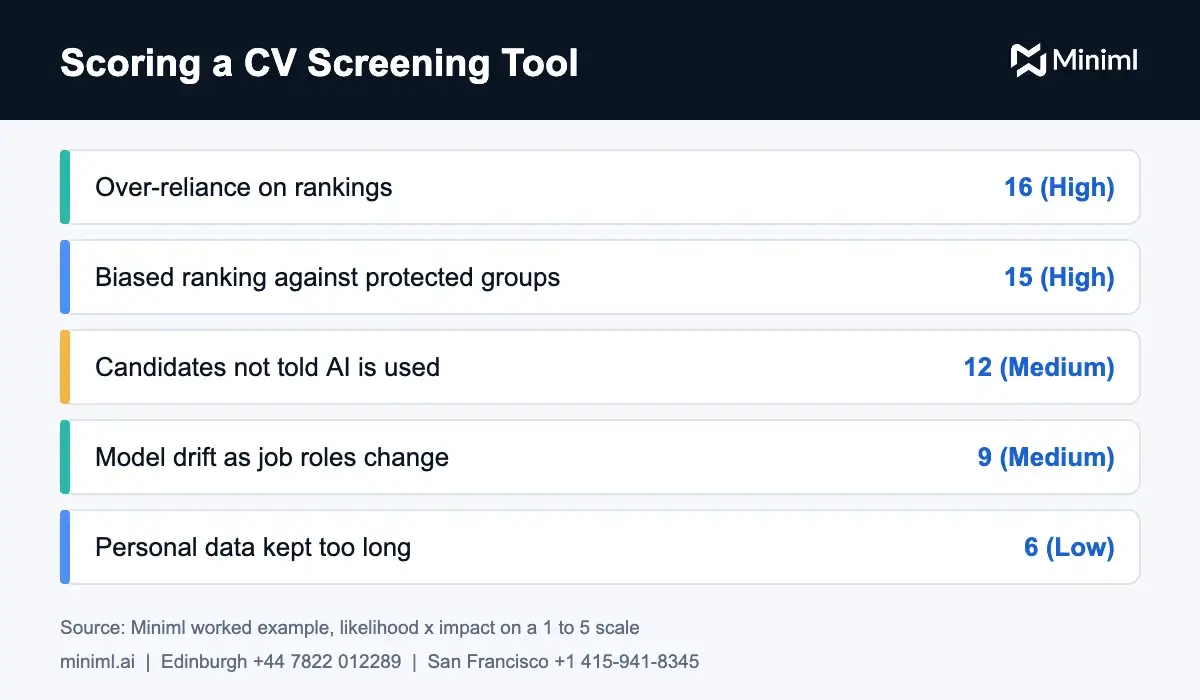
Scoring only helps if everyone applies it the same way. Here’s how we’d score a hypothetical tool that ranks job applicants for a recruitment team. Likelihood and impact both use a 1 to 5 scale, so scores run from 1 to 25.
| Risk | Likelihood | Impact | Score | Control |
|---|---|---|---|---|
| Biased ranking against protected groups | 3 | 5 | 15 | Pre-launch bias testing and quarterly outcome audits |
| Candidates not told AI is used | 4 | 3 | 12 | Clear notice in the application flow |
| Recruiters accept rankings without review | 4 | 4 | 16 | Mandatory human review with reasons logged |
| Personal data kept too long | 2 | 3 | 6 | Retention rule and automated deletion |
| Model drift as job roles change | 3 | 3 | 9 | Monthly performance check against a labeled sample |
Our rule of thumb: 15 and above is high, 8 to 14 is medium and below 8 is low. Two risks land in the high band here, which puts the whole system in the top tier. That means executive sign-off, documented human oversight and a quarterly review.
Hiring tools also sit in the EU AI Act’s high-risk category, so in this case the internal tier and the legal view agree. When they don’t, the stricter of the two should win.
Turn scores into an AI risk register
Your register is the living record of each AI risk assessment. Keep it simple enough that owners actually update it.
| Risk ID | Risk | Owner | Score | Control | Next review |
|---|---|---|---|---|---|
| R1 | Biased ranking | Head of Talent | 15 | Bias testing and outcome audit | Quarterly |
| R3 | Over-reliance on rankings | Recruitment Operations Lead | 16 | Human review with logged reasons | Quarterly |
| R2 | Missing AI notice | HR Systems Owner | 12 | Notice in application flow | Six months |
| R5 | Model drift | ML Engineer | 9 | Monthly sample check | Six months |
Have a system like this in flight and not sure where it would score? You can book an assessment workshop and we’ll run the scoring with your team on a real use case.
EU AI Act and NIST: Your 2026 AI Risk Assessment Timeline
Many guides still quote old dates. According to the European Commission’s AI Act regulatory framework page, updated in August 2026, the Act sorts AI into four risk levels and applies in stages:
- 1 August 2024: the AI Act entered into force.
- 2 February 2025: prohibited AI practices became banned.
- 2 August 2025: rules for general-purpose AI models started to apply.
- 2 December 2027: obligations for high-risk systems in sensitive areas apply.
- 2 August 2028: obligations for high-risk AI embedded in regulated products apply.
For high-risk systems, Article 9 risk management requires a continuous, iterative process across the whole lifecycle. It must identify and estimate risks, including reasonably foreseeable misuse, review them with post-market data and apply targeted mitigation. A one-off AI risk assessment filed at launch won’t meet that bar.
In the US, the NIST framework stays voluntary, but NIST announced a concept note for a critical-infrastructure profile on 7 April 2026, a sign that sector-specific expectations are coming. For older models already in production, our legacy AI Act checks cover what to review.
Right-Sizing AI Risk Assessment for SMEs and Enterprises
An AI risk assessment should cost less than the risk it manages. Match the depth of the process to your size and your exposure.
| Factor | SME approach | Enterprise approach |
|---|---|---|
| Inventory | Spreadsheet of tools and owners | Central AI registry linked to procurement |
| Scoring | 1 to 5 matrix, one assessor plus a reviewer | Standard method calibrated across business units |
| Documentation | One-page assessment per system | Full technical file for high-risk systems |
| Sign-off | Founder or managing director | Tiered approval board |
| Management system | Short policy and annual review | ISO/IEC 42001 AI management system |
| Review cycle | Yearly, or on major change | By tier: quarterly for high, yearly for low |
Who owns the assessment
The business owner of the use case owns the risk, not the data science team. Technical staff score technical risks, legal and privacy staff score compliance risks, and a risk or compliance lead checks that scores are consistent.
Sign-off should sit one level above the owner for medium risks and at executive level for high risks. If nobody senior will sign, that tells you the risk isn’t accepted yet.
AI Risk Assessment FAQs
What are the four types of AI risk?
The four types of AI risk are technical risk, such as errors and drift; security risk, such as prompt injection and data leakage; ethical and human risk, such as bias and over-reliance; and legal and compliance risk, such as breaching data protection law or the EU AI Act.
What should an AI risk assessment include?
It should include a system description, intended purpose, data sources, people affected, identified risks with likelihood and impact scores, chosen controls, named owners, a risk tier, sign-off and a next review date. For high-risk EU systems, add testing evidence and an analysis of foreseeable misuse.
What is the difference between AI risk assessment and AI governance?
An AI risk assessment evaluates one system’s risks and sets its controls. AI governance is the wider set of policies, roles and approval gates that decides when assessments happen, who signs them off and how results shape decisions across your whole AI portfolio.
How often should you reassess AI risk?
Reassess high-risk systems at least quarterly, medium-risk systems every six months and low-risk systems yearly. Trigger an immediate reassessment when you change the model, the training data, the user group or the purpose, or after any incident or near miss.
Does the EU AI Act require an AI risk assessment, and when?
Yes, for high-risk systems. Article 9 requires a continuous risk management process across the lifecycle. Those obligations apply from 2 December 2027 for high-risk systems in sensitive areas and from 2 August 2028 for AI embedded in regulated products.
Can AI write a risk assessment?
AI can draft parts of one, such as summarizing documentation, suggesting risks from a taxonomy or filling in templates. It can’t own the judgment. A person must check the scores, confirm the context and sign off, because accountability for an AI risk assessment stays with your organization.
Starting Your AI Risk Assessment Program
The fastest start is one real system, scored properly, with a register your owners will keep up to date. From there you can scale the method across the portfolio. To get help, book a scoping call and we’ll review your inventory, pick the first systems to assess and agree a scoring method that fits your size.
Prefer to talk it through first? Call our Edinburgh office on +44 7822 012289 or our San Francisco office on +1 415-941-8345.
About Miniml: Miniml is an AI consultancy with offices in Edinburgh and San Francisco that designs, builds and governs custom AI systems.