
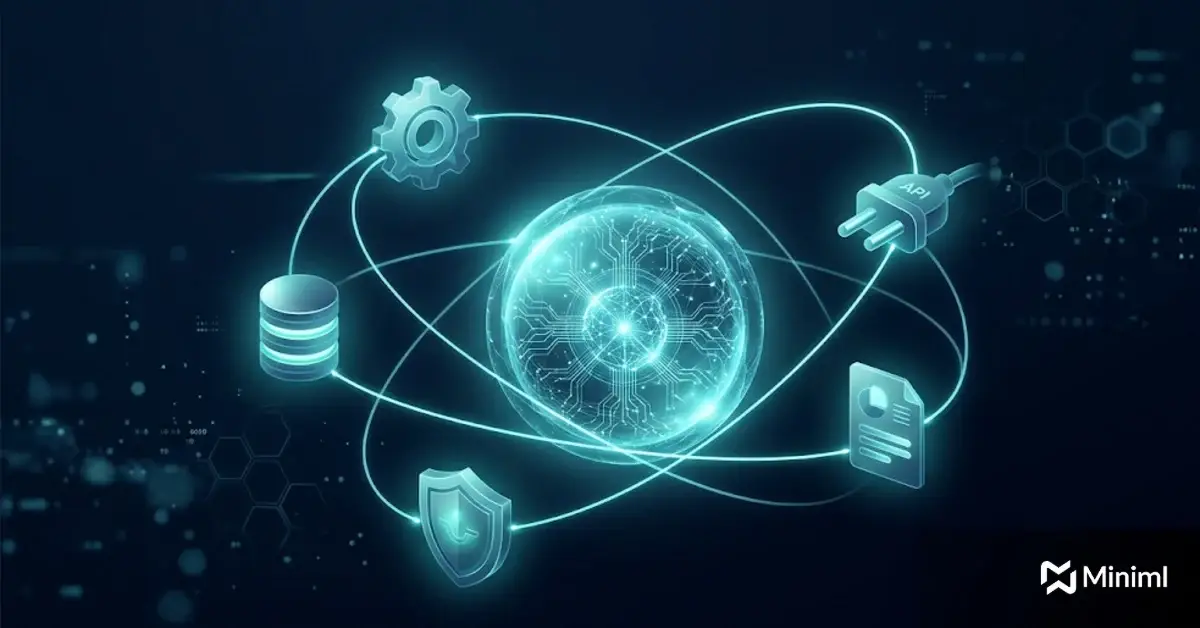
AI agent architecture is the design that connects a language model to tools, memory, data and rules so it can complete multi-step work on its own. A production agent needs more than a clever prompt. It needs bounded permissions, a planning loop, logging and a human fallback. That is how we approach custom AI agent development.
Key Takeaways: AI Agent Architecture
- An agent is a loop, not a single call. The model plans, acts with a tool, checks the result and decides what to do next.
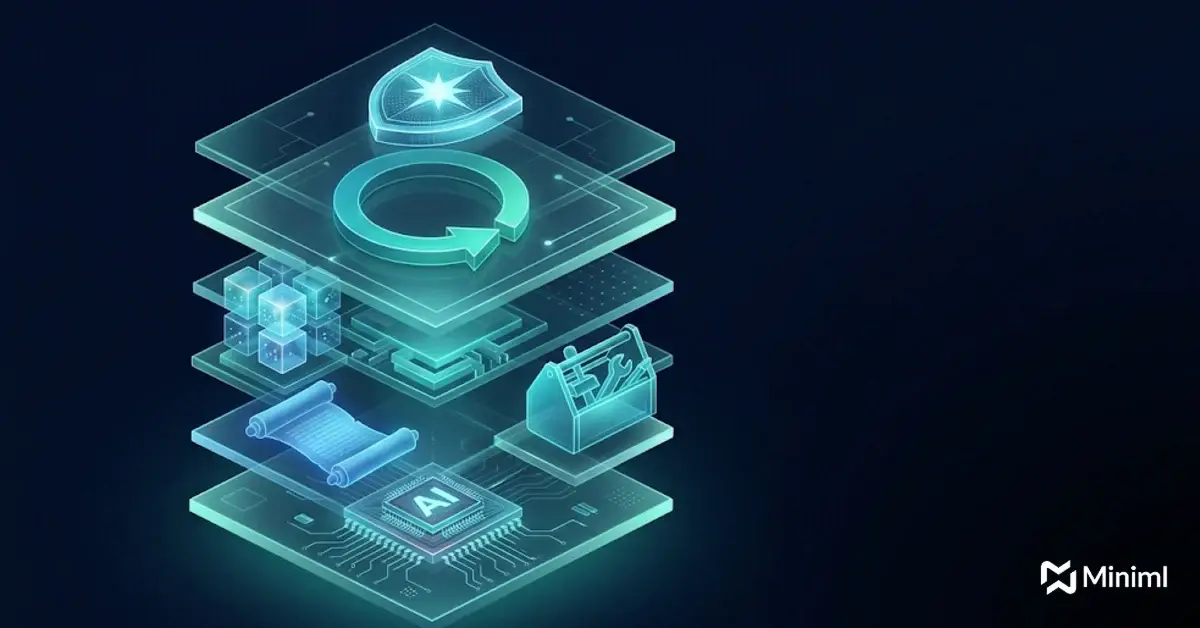
- Six components appear in almost every design: model, instructions, tools, memory, orchestration and guardrails.
- Start with the simplest pattern that works. Many tasks need a fixed workflow, not a fully autonomous agent.
- Cancellation risk is real. Gartner expects over 40% of agentic AI projects to be cancelled by the end of 2027.
- Observability is part of the architecture. If you cannot trace each step, you cannot fix or audit it.
What AI Agent Architecture Means
A chatbot answers one message at a time. An agent pursues a goal. It breaks the goal into steps, calls software tools, reads the results and keeps going until the job is done or it needs help.
AI agent architecture is the blueprint for that behavior. It decides which model does the reasoning, which systems the agent can touch, what it remembers, and where a person must approve an action.
The hype has run ahead of delivery. In June 2025, a Gartner agentic AI forecast predicted that over 40% of agentic AI projects will be cancelled by the end of 2027, citing rising costs, unclear value and weak risk controls. Gartner also estimated that only about 130 of the thousands of vendors selling agentic AI offer real agent capabilities. Good architecture is how you land on the right side of those numbers.
The Six Core Components of an AI Agent
Every production agent we build includes these layers. Skipping one usually shows up as a failure later.
| Component | What it does | Production question to answer |
|---|---|---|
| Model | Reasons, plans and writes | Which model, and can we swap it without a rewrite? |
| Instructions | Defines role, goal and limits | Are the rules versioned and tested like code? |
| Tools | APIs, databases, search, code execution | What can each tool change, and who approved that? |
| Memory | Short-term task state and long-term knowledge | What is stored, for how long, and who can read it? |
| Orchestration | Controls the loop, retries and handoffs | What stops a runaway loop or a stuck task? |
| Guardrails and logging | Checks inputs, outputs and actions | Can we replay any decision step by step? |
Model
The model is the reasoning engine. Pick it based on measured performance on your tasks, not leaderboard rank. Keep the interface generic so you can switch providers when price or quality changes.
Tools
Tools are where an agent touches the real world: a CRM update, a refund, a database query. Each tool should have a narrow scope, typed inputs, and clear error messages the model can read.
Memory
Short-term memory holds the current task. Long-term memory often uses retrieval over your documents. Treat memory as data with retention rules, not a black box.
Common AI Agent Design Patterns
There is no single correct pattern. The right one depends on how predictable the task is. The Anthropic agent design guidance makes a useful split between workflows, where code fixes the steps, and agents, where the model chooses them. It also advises starting with the simplest option and adding autonomy only when it clearly helps.
- Prompt chaining. Fixed steps run in order, each using the output of the last. Best for predictable tasks like drafting then checking a document.
- Routing. A classifier sends each request to the right specialist prompt or tool. Good for support triage.
- Single agent with tools (ReAct style). One model alternates between thinking and calling tools until the goal is met. Flexible, but needs firm limits.
- Planner and executor. One component writes the plan, another carries it out. Failures are easier to trace.
- Orchestrator with sub-agents. A lead agent hands parts of a task to specialist agents, then combines the results. Powerful, and the hardest to test.
Most enterprise use cases we see are best served by patterns 1 to 3. Multi-agent systems earn their cost only when the work truly splits into independent parts.
Signs Your Agent Architecture Is Not Production Ready
These warning signs come up again and again when teams move from a demo to live traffic:
- The agent has broad write access to systems “just for the pilot.”
- There is no step limit, so a confused agent can loop and run up cost.
- Failures are silent. The agent gives up or guesses without flagging a human.
- Nobody can explain a past decision because tool calls and reasoning were not logged.
- Prompt injection was never tested. Text inside an email or web page can redirect the agent.
- Success is measured by demo impressions, not by task completion on a fixed test set.
Our analysis of why enterprise agents fail shows that most of these trace back to missing operating design, not weak models.
Security and Guardrails in Agent Design
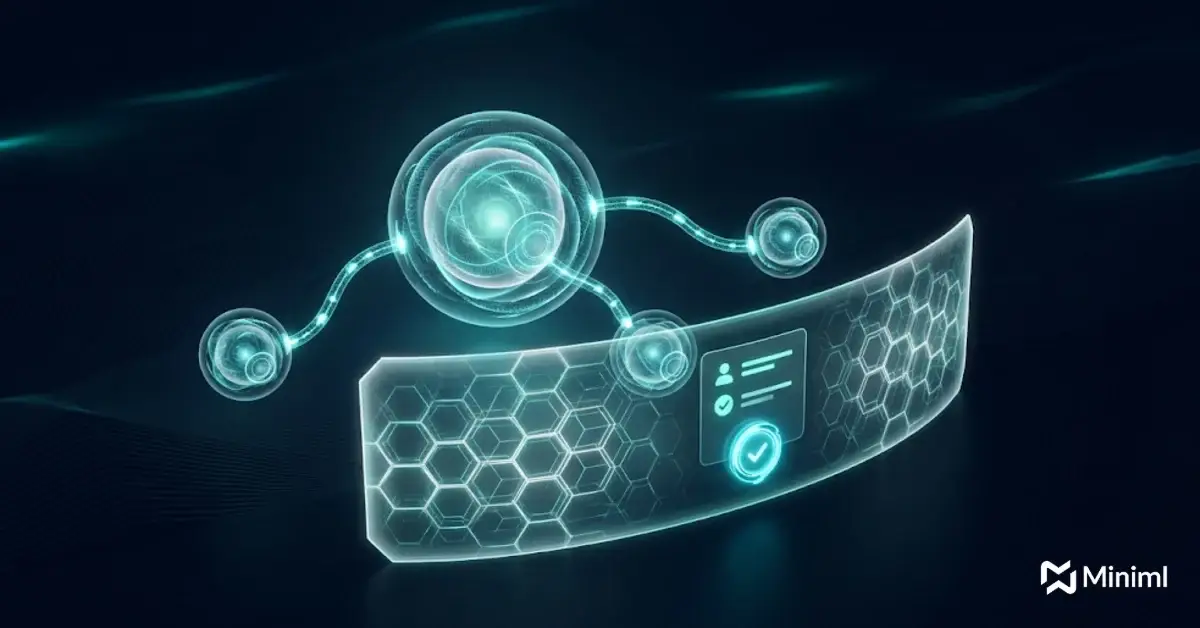
An agent that can act can also be misled. The OWASP LLM risk list names prompt injection, sensitive data disclosure and excessive agency among the top risks for LLM applications. Excessive agency means giving the model more permissions or autonomy than the task requires.
Practical controls include:
- Least privilege per tool. Read-only by default. Write access only where needed.
- Human approval for high-impact actions such as payments, deletions or customer messages.
- Input and output filters that catch injected instructions and leaked personal data.
- Hard limits on steps, spend and run time per task.
- Full traces of every model call and tool call, kept for audit.
How to Build a Production AI Agent, Step by Step
This is the sequence we follow with enterprise teams in San Francisco, Chicago, Seattle and across the UK.
- Choose one workflow with a clear finish line. For example, resolving a defined class of support ticket.
- Write the success measure first. Task completion rate, error rate, cost per task and time saved.
- Map the tools and data the agent needs, and the permissions each one requires.
- Pick the simplest pattern from the list above that can do the job.
- Build a test set of 50 to 200 real cases, including edge cases and hostile inputs.
- Add guardrails and tracing before any live user touches it.
- Launch in shadow mode, where the agent proposes actions and a person approves them.
- Widen autonomy step by step as measured accuracy holds.
The jump from step 6 to step 8 is where most pilots stall. Our guide to deploying AI agents safely covers what changes between demo and production in detail.
Single Agent vs Multi-Agent Systems
| Factor | Single agent | Multi-agent system |
|---|---|---|
| Build effort | Lower | Higher |
| Testing | One loop to evaluate | Many interactions to evaluate |
| Cost per task | Easier to predict | Grows with each agent call |
| Best fit | One workflow with a few tools | Work that splits into independent parts |
| Failure tracing | Simple | Needs strong tracing across agents |
Start with one agent. Split into several only when one agent’s instructions or tool list grows too large to test well.
AI Agent Architecture FAQs
What are the main components of AI agent architecture?
The main components are the model that reasons, the instructions that set its goal and limits, the tools it can call, the memory it reads and writes, the orchestration layer that runs the loop, and the guardrails and logging that check and record every step. Production systems need all six working together.
What is the difference between an AI agent and a workflow?
In a workflow, your code decides the order of steps and the model fills in each one. In an agent, the model decides which step or tool comes next based on what it sees. Workflows are easier to test and cheaper to run. Agents handle messier tasks but need tighter guardrails.
Which framework should we use to build AI agents?
Choose the framework after you choose the pattern. Many teams do well with a small amount of their own orchestration code and direct model APIs. Frameworks can speed up prototypes, but check that they let you trace every step, swap models and set hard limits before you commit.
How do you test an AI agent before launch?
Build a fixed set of real tasks with known correct outcomes, then measure completion rate, wrong actions, cost and time. Include attack cases such as injected instructions. Run the set after every prompt, tool or model change, and start live use in a mode where a person approves actions.
Are multi-agent systems better than single agents?
Not by default. Multi-agent systems help when a task splits cleanly into parts that need different skills or data. They also add cost, delay and more ways to fail. Most enterprise teams get better results by perfecting one well-scoped agent first.
Designing Your First Production Agent With Miniml
Good AI agent architecture is mostly about limits: what the agent can touch, when it must stop, and how every step is recorded. Get those right and the model choice becomes a detail you can change later.
Miniml is a senior team of engineers and researchers with backgrounds at GE, Amazon, Stanford, the University of Edinburgh, and the Alan Turing Institute. We design agents your team can own, with tracing and MLOps and monitoring practice built in from day one. Start with a three-week AI Workflow Opportunity Map, call +1 415-941-8345, or book a Miniml consultation. Office hours are Monday to Friday, 8am to 5pm.
San Francisco: 50 California St #1500, San Francisco, CA 94111. Phone: +1 415-941-8345. Edinburgh: 93 George St, Edinburgh EH2 3ES. Find us on our Edinburgh Google Business Profile.
About Miniml: Miniml is an AI consultancy with offices in San Francisco and Edinburgh that helps enterprise teams take AI systems past the pilot and into production.