
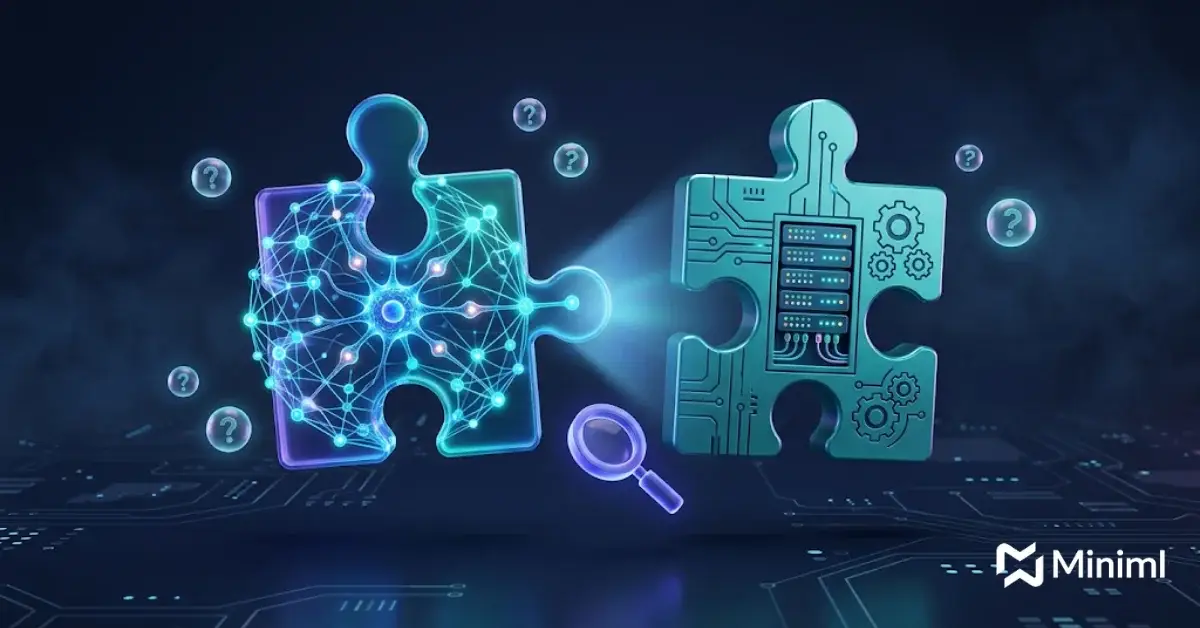
The right AI development partner can show you systems running in production, explain how it measures quality, protect your data, and hand over code your team can own. Ask the 15 questions below, listen for specific answers, and score each vendor before you sign. To see how a production-first team works, start with our enterprise AI development services.
Key Takeaways: Choosing an AI Development Partner
- Ask for production systems, not demos. A team that has only built pilots will struggle with live data and users.
- A strong AI development partner defines evaluation metrics before writing code.
- Get written answers on data handling, model hosting, and who owns the code, prompts, and weights.
- Governance should map to a known framework such as the NIST AI RMF.
- The best engagements end with a system your own team can run and extend.
Why the Questions Matter More Than the Pitch
AI projects fail in quiet ways. A model that scores well in a demo drifts in production, or the vendor leaves and nobody can retrain anything. A good AI vendor evaluation surfaces those risks early.
Most guides cover production experience, security, integration, and support. Fewer cover ownership. If your team cannot extend the system after handover, you have bought a dependency.
Our guide to AI implementation pitfalls covers the wider delivery risks. This post focuses on the build.
AI Development Partner Track Record
1. What have you taken to production, and what broke after launch?
Of all the questions to ask AI vendor teams, this one tells you the most. Production work leaves scars, and honest teams talk about them.
- Good answer: A real system, its users, and one failure after launch plus how they fixed it.
- Weak answer: A list of logos, a demo video, or “every project has been a success.”
2. Who will actually build our system?
Many firms sell with senior people and deliver with junior ones. Ask for names, roles, and time commitment.
- Good answer: The people in the room are the people who write the code.
- Weak answer: “We will assign the right resources after kickoff.”
3. How do you decide whether a use case is ready to build?
A credible AI development partner will sometimes tell you not to build yet. That is a good sign.
- Good answer: A short discovery step that checks data access, workflow fit, and a measurable target.
- Weak answer: Agreement with every idea on your list.
Evaluation and Quality
4. How will we know the system is good enough to ship?
Quality needs a number and a test set, agreed before development. For generative AI, that includes accuracy, hallucination rate, latency, and cost per task.
- Good answer: A written evaluation plan with a test set built from your real cases and a pass threshold you approve.
- Weak answer: “You will know it when you see it.”
5. How do you monitor quality after launch?
Models and data change, so monitoring belongs in the build. This is where solid MLOps and model monitoring practice shows up.
- Good answer: Logging, drift alerts, regression tests on every prompt or model change, and a named incident owner.
- Weak answer: “We can add monitoring in phase two.”
Data Security and IP
6. Where does our data go, and who can see it?
Ask which model providers, regions, and sub-processors touch your data, and whether any of it is used for training.
- Good answer: A data flow diagram, region choices, and an option for private or on-prem open-weight models.
- Weak answer: “We use a major cloud, so it is secure.”
7. Who owns the code, prompts, pipelines, and fine-tuned weights?
Ownership terms decide whether you can switch vendors later. Get them in the contract.
- Good answer: You own all deliverables, including evaluation sets and weights trained on your data.
- Weak answer: A license to a proprietary platform with no export path.
Integration
8. How will this fit our existing systems?
Most value sits in the handoff between AI and your current tools, such as your CRM, ERP, or data warehouse.
- Good answer: A map of systems touched, APIs used, and how failures fall back to a human.
- Weak answer: A standalone chat tool nobody connects to real work.
9. Are you tied to one model or cloud provider?
Being locked to one model is a risk when prices, terms, or quality change.
- Good answer: A design that lets you swap models with re-evaluation, not a rewrite.
- Weak answer: “We only work with one provider,” with no reason tied to your needs.
Governance
10. Which governance framework do you build against?
A serious AI development partner names the framework it uses and shows how its work maps to it. The NIST AI Risk Management Framework is a common choice for US teams because it organizes risk work into clear activities: govern, map, measure, and manage. NIST also publishes a profile for generative AI systems.
- Good answer: Specific controls mapped to a framework, with risk logs your auditors can read.
- Weak answer: “We follow responsible AI principles,” with nothing written down.
11. How do you support our compliance and audit needs?
Some buyers now ask about ISO/IEC 42001, the international standard for AI management systems. Even without certification, its structure is a useful checklist. Our AI governance consulting team works this way.
- Good answer: Model cards, data lineage, access logs, and human review points built in.
- Weak answer: Compliance treated as your problem after delivery.
Handover and Ownership
12. What does handover look like, week by week?
Handover should start early, not in the final week.
- Good answer: Your engineers commit code during the build, backed by a runbook and training sessions.
- Weak answer: A zip file and a one-hour walkthrough.
13. Could our team extend this system without you?
This is the real test of any AI development partner. The system should use standard tools your team can hire for.
- Good answer: Documented architecture, common frameworks, tests, and a clear path for new use cases.
- Weak answer: Custom tooling only the vendor understands.
Pricing an AI Development Partner
14. How is the engagement priced, and what is fixed?
- Good answer: A fixed-scope first phase with clear deliverables, then a priced build plan.
- Weak answer: Open time and materials with no milestones.
15. What happens if results fall short?
- Good answer: Agreed exit points and no penalty for stopping after discovery.
- Weak answer: Long lock-in terms signed before any evaluation.
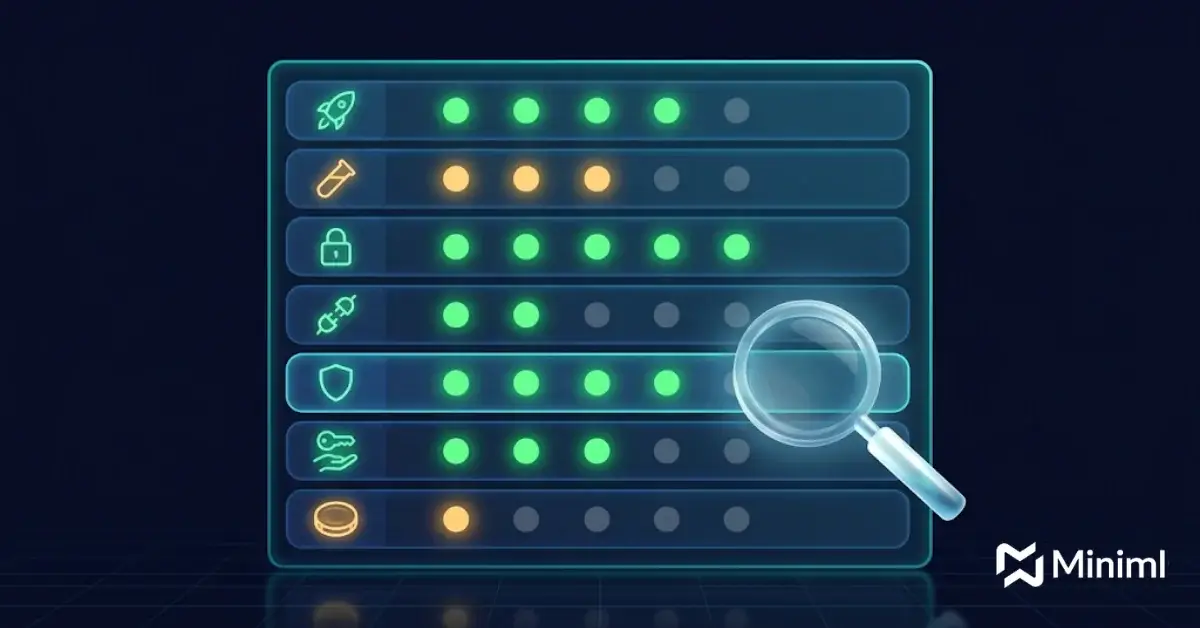
AI Vendor Evaluation Scorecard
Score each AI development partner from 1 to 5 on every row. Weight the rows that matter most for your use case, and ask for written evidence behind any score of 4 or 5.
| Area | Questions | What a 5 looks like | What a 1 looks like |
|---|---|---|---|
| Production track record | 1 to 3 | Live systems, named builders, honest failures | Demos and logos only |
| Evaluation and quality | 4 to 5 | Approved test set, live monitoring | No metrics before build |
| Data security and IP | 6 to 7 | Clear data flow, you own all outputs | Vague hosting, platform lock-in |
| Integration | 8 to 9 | Mapped systems, model-agnostic design | Standalone chat tool |
| Governance | 10 to 11 | Controls mapped to NIST or ISO | Principles with no records |
| Handover and ownership | 12 to 13 | Your team commits code from week one | Black box at exit |
| Commercials | 14 to 15 | Fixed first phase, clear exit points | Open-ended billing |
How to Choose an AI Development Partner in Five Steps
- Shortlist three vendors. Use referrals and published production work.
- Send the 15 questions in writing. Written answers are easier to compare.
- Hold a technical session. Bring your engineers and ask for a real walkthrough.
- Score with the table above. Have two or three people score separately, then compare.
- Start with a small paid phase. A two- or three-week fixed-scope review shows how an AI development partner really works.
What Separates a Partner From a Vendor?
A vendor delivers what you asked for. An AI development partner pushes back when a request will not hold up in production, shares the evaluation data, and plans for the day you take over. Our responsible AI framework guide shows how governance fits in.
Ask whether your AI development partner works to a recognised standard such as ISO/IEC 42001 for AI management. The NIST AI Risk Management Framework is another good benchmark for vendor answers.
AI Development Partner FAQs
How do I choose an AI development company for my business?
If you are deciding how to choose an AI development company, start with the problem, not the vendor. Define one workflow, the data it needs, and how you will measure success. Then shortlist teams with production work on similar systems, send each the same written questions, and score the answers. A short paid discovery phase is the best final test.
What questions should I ask an AI vendor first?
Ask what they have taken to production and what broke after launch. Then ask who will build your system and how they will measure quality before shipping. These answers quickly separate experienced teams from those selling demos. If an AI development partner cannot name a live system or the people who will do the work, treat that as a warning sign.
How long should a first engagement with an AI development partner last?
A first phase is often two to four weeks of fixed-scope work, such as a readiness review or workflow mapping. It should end with a clear recommendation, a scoped build plan, and enough evidence for you to decide whether to continue.
Should we own the model weights and prompts?
Yes, in most cases. Prompts, evaluation sets, pipelines, and any weights trained on your data are core assets. Owning them lets you switch providers, retrain, and extend the system. Put ownership terms in the contract before work starts, and list every deliverable due at handover.
Do we need ISO/IEC 42001 certification to hire an AI partner?
No. Certification is optional, and many buyers never pursue it. Still, an AI development partner that maps its controls to ISO/IEC 42001 or the NIST AI RMF makes audits and procurement easier. Ask for sample records, such as a risk log or model card, to see how the work is documented in practice.
Find an AI Development Partner Built for Your Team to Own
Miniml is a senior team of engineers and researchers with backgrounds at GE, Amazon, Stanford, the University of Edinburgh, and the Alan Turing Institute. As your AI development partner, we build systems your team can own, run, and extend, starting with fixed-scope offers like a two-week Production-Readiness Review or a three-week AI Workflow Opportunity Map. Bring your 15 questions and book a consultation with Miniml.
Miniml
San Francisco: 50 California St #1500, San Francisco, CA 94111, United States. Phone: +1 415-941-8345
Edinburgh: 93 George St, Edinburgh EH2 3ES, United Kingdom
About Miniml: Miniml is an AI consultancy with offices in San Francisco and Edinburgh that helps enterprise teams take AI systems past the pilot and into production.