
An AI readiness checklist tells you whether your business can run AI in production, not just show it in a demo. Score 12 criteria across data, people, process, technology and governance from 0 to 2 each. A total of 17 or more out of 24 means you are ready to build. Our AI strategy and roadmapping work starts from this same scorecard.
The real test: could this system survive real users, real volume and a real audit next quarter?
Key Takeaways on AI Readiness
- Readiness means ready for production, not ready to demo. A slick pilot proves very little.
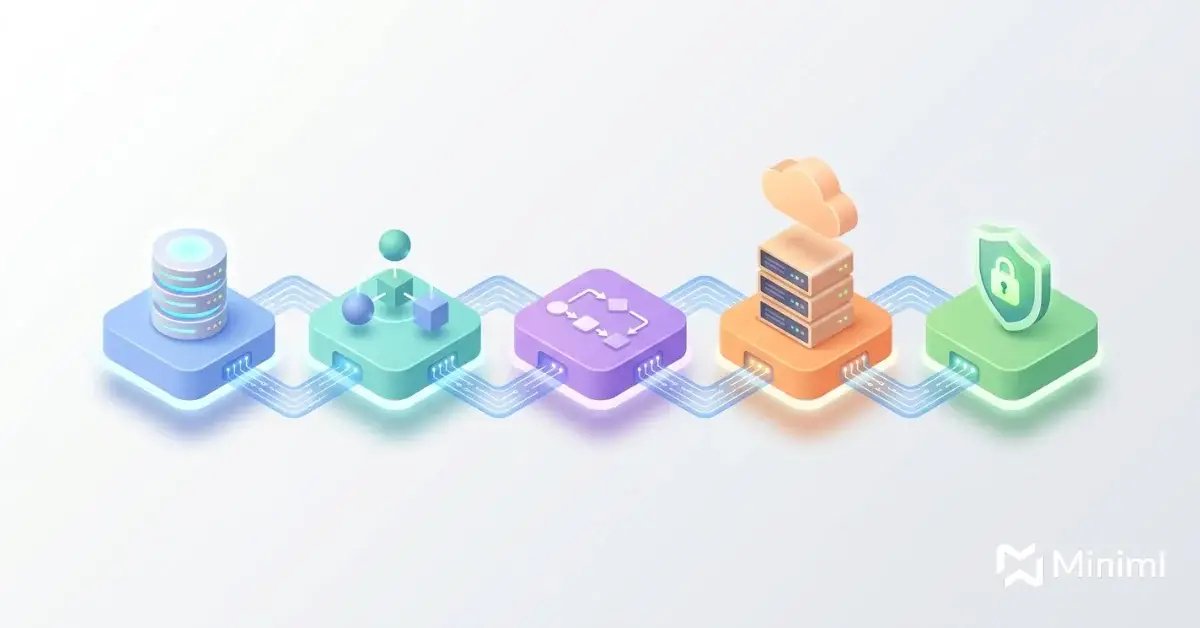
- The 12 criteria in this AI readiness checklist sit in five groups: data, people, process, technology and governance.
- Each criterion scores 0, 1 or 2, so the total runs from 0 to 24 with clear bands.
- You can run the full AI readiness checklist in one working week with five or six people.
- A low score is not a stop sign. It is a list of what to fix first.
What Is an AI Readiness Assessment?
An AI readiness assessment is a short, structured review of whether your organization can build, run and govern an AI system in daily work. An AI readiness checklist turns that review into scored, testable questions. A weakness in any one area can stall the whole effort.
The gap it closes is real. Plenty of companies can start an AI pilot. Far fewer can scale one into daily operations.
Is My Business Ready for AI? Why Demo Readiness Is Not Enough
A demo runs on clean sample data, one happy-path user and a developer watching every output. Production runs on messy records, hundreds of users, edge cases and nobody watching at 2 a.m.
Data is where most teams fall short. Projects stall when records are hard to reach, out of date or never classified, and those problems rarely show up in a demo.
So when someone asks “is my business ready for AI,” the honest answer is usually “partly.” The AI readiness checklist below shows you which part.
The AI Readiness Checklist: 12 Criteria in 5 Groups
Think of this as a simple AI readiness framework. Each group holds two or three criteria. Each item on the AI readiness checklist asks a yes or no question you can test with evidence, not opinion.
Data (criteria 1 to 3)
1. Data access. Can a system reach the documents, records or tables your use case needs, through an API or a governed connection, today? If access needs a six-week ticket, that is a 0.
2. Data quality and freshness. Is the data accurate and current enough to make decisions with? Check a sample of records by hand.
3. Data classification. Has anyone recorded which data is personal, confidential or regulated? Without this, security will block the project late.
People (criteria 4 and 5)
4. A named business owner. One person, not a committee, owns the outcome and has budget authority.
5. Skills to run it. Do you have people who can operate, monitor and improve the system after launch? Building a system and running it are separate skills.
Process (criteria 6 and 7)
6. A mapped workflow. Is the target process written down step by step, with handoffs, exceptions and volumes?
7. A baseline metric. Do you know today’s cycle time, error rate or cost per case? Without a “before” number, you cannot prove the “after,” and funding for phase two gets hard.
Technology (criteria 8 to 10)
8. Integration path. Can the AI system read from and write back to the tools people already use, such as your CRM, ERP or ticketing system?
9. Environment and hosting. Is there an approved place to run it, whether a cloud account, a private deployment or an on-prem setup for sensitive data?
10. Monitoring and evaluation. Can you log inputs and outputs, track accuracy over time and get an alert when quality drops? This is the criterion demos skip most often.
Governance (criteria 11 and 12)
11. Risk and approval process. Is there a clear path to approve a new AI use case, with a known owner and turnaround time? A simple intake form and a named reviewer are enough to start.
12. Human oversight and incident handling. Does everyone know where to report an AI mistake, who reviews it and how a fix ships? Without that, small errors become trust problems. Our AI governance consulting team helps set this up without slowing delivery.
How to Score Your AI Readiness Assessment
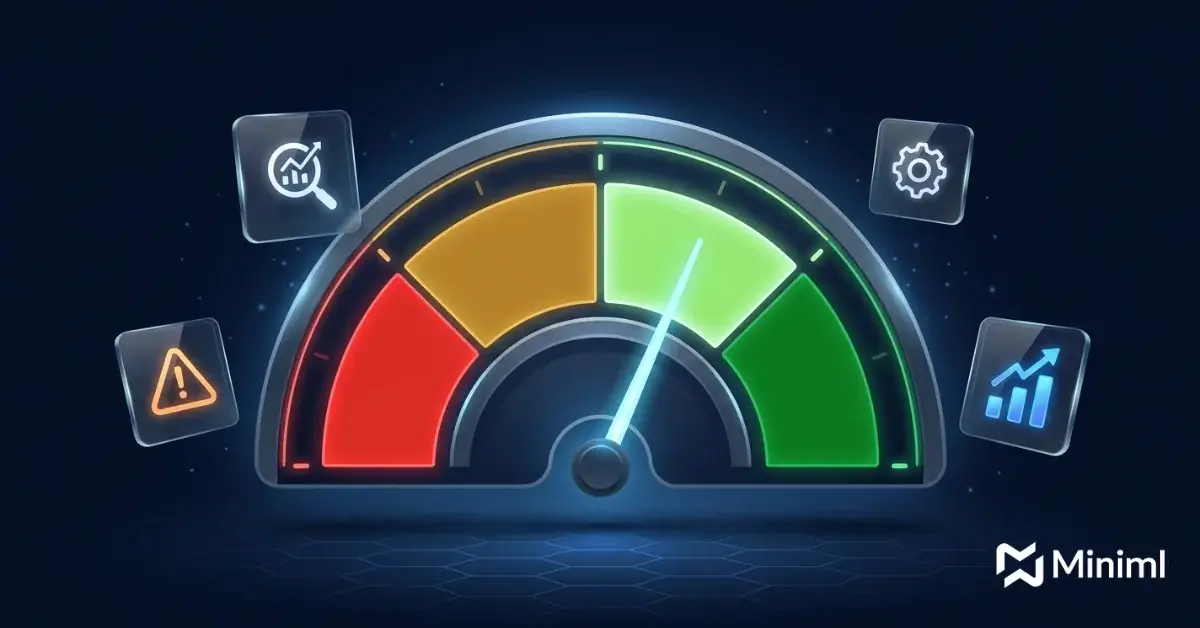
Score each criterion on the AI readiness checklist with the same simple rule. A 0 means it does not exist. A 1 means it exists in part or only on paper. A 2 means it exists, works and you can show evidence.
| Group | Criterion | 0 points | 1 point | 2 points |
|---|---|---|---|---|
| Data | 1. Data access | No access path | Manual exports only | Governed API or connector |
| Data | 2. Quality and freshness | Unknown | Spot-checked once | Measured and maintained |
| Data | 3. Classification | Not done | Partly tagged | Fully classified |
| People | 4. Business owner | None or a committee | Named, no budget | Named with budget |
| People | 5. Skills to run it | None | Build skills only | Build and operate skills |
| Process | 6. Mapped workflow | Not documented | Rough outline | Mapped with volumes |
| Process | 7. Baseline metric | None | Estimated | Measured |
| Technology | 8. Integration path | None | Read-only | Read and write |
| Technology | 9. Hosting environment | Undecided | Proposed | Approved |
| Technology | 10. Monitoring | None | Basic logs | Evaluation and alerts |
| Governance | 11. Approval process | None | Ad hoc | Defined with owner |
| Governance | 12. Oversight and incidents | None | Informal | Documented and tested |
Add your AI readiness checklist scores for a total out of 24. Then read your band:
| Total score | Band | What it means |
|---|---|---|
| 0 to 8 | Not ready | Fix data and ownership before any build |
| 9 to 16 | Pilot ready | Run a narrow, measured pilot while closing gaps |
| 17 to 21 | Production ready | Build for real users with monitoring in place |
| 22 to 24 | Scale ready | Expand to more workflows and teams |
One rule matters more than the total. Any criterion scored 0 in data or governance is a blocker, even if your total looks healthy. A score of 18 with zero monitoring is not production ready.
How to Run the Assessment in One Week
A focused team can complete this AI readiness checklist in five working days.
- Day 1, pick one use case. Choose a single workflow with clear volume and pain, such as invoice handling or support triage. Name the owner and invite five or six people.
- Day 2, test data criteria. Pull real samples, check access paths and confirm classification. Score criteria 1 to 3 with evidence attached.
- Day 3, map the workflow. Walk through the process with the people who do it. Record steps, handoffs, exceptions and today’s baseline numbers.
- Day 4, review tech and governance. Confirm integration points, hosting options, monitoring needs and the approval path. Score criteria 8 to 12.
- Day 5, score and decide. Total the scorecard, flag any 0s in data or governance, and agree on the top three gaps to close next.
An AI readiness checklist only works if the scoring is honest. If you cannot show evidence for a 2, it is not a 2.
What to Do With a Low Score
A low score on the AI readiness checklist is useful. It tells you where the money should go before you fund a build.
Start with the blockers. Then pick a use case that fits your current band. A “pilot ready” team should run a tight, measured test built to scale, as covered in our guide to a scalable AI proof of concept. If the bigger issue is direction across many teams, read our piece on aligning AI with business goals first.
For a wider view of AI risk controls, the NIST AI Risk Management Framework is a useful companion to this AI readiness checklist. Teams that want a certifiable standard can also look at ISO/IEC 42001.
AI Readiness Checklist FAQs
What is an AI readiness checklist?
An AI readiness checklist is a list of criteria that shows whether your organization can build and run AI in daily work. A good one covers data, people, process, technology and governance, uses evidence rather than opinion, and points to specific gaps you can fix.
How long does an AI readiness assessment take?
A focused AI readiness assessment for one use case takes about one working week. You need a named business owner and five or six people from operations, IT, data, security and legal. Reviews across many workflows take longer, often two to three weeks.
What is the difference between an AI readiness framework and a checklist?
An AI readiness framework is the structure, such as the five groups of data, people, process, technology and governance. An AI readiness checklist is the set of specific, testable questions inside that structure. You need both to score readiness in a week.
What score means my business is ready for AI?
On this scorecard, 17 or more out of 24 means you are ready to build for production users. Between 9 and 16, run a narrow pilot while you close gaps. Below 9, fix data access and ownership first. Any 0 in data or governance is a blocker regardless of your total.
Who should take part in the assessment?
Include the business owner of the target workflow, someone who does the work daily, an IT or platform lead, a data owner, and a security or legal reviewer. Keep the group to five or six people so scoring stays honest and fast.
Should we score readiness for the whole company or one use case?
Start with one use case. Company-wide scores average out the details and hide the blockers that matter for a specific workflow. Once you have scored two or three use cases with the AI readiness checklist, patterns appear, such as weak monitoring everywhere, and those become company-wide workstreams on your roadmap.
Turn Your Readiness Score Into a Production Plan
Miniml’s AI consulting services start where this AI readiness checklist ends. Our two-week Production-Readiness Review tests your target use case against these criteria with your real data and systems, then hands you a ranked fix list. If you are still choosing where AI should go, our three-week AI Workflow Opportunity Map scores and ranks the workflows across your business.
Either way, you leave with a plan built for production, not a demo. Book a consultation to talk through your score.
Miniml
San Francisco: 50 California St #1500, San Francisco, CA 94111, United States. Phone: +1 415-941-8345
Edinburgh: 93 George St, Edinburgh EH2 3ES, United Kingdom
About Miniml: Miniml is an AI consultancy with offices in San Francisco and Edinburgh that helps enterprise teams take AI systems past the pilot and into production.