
Moving from AI pilot to production fails most often because the pilot was built to impress in a demo, not to run inside a real workflow. Getting there takes clean data, a named owner, real system integration, ongoing evaluation and clear governance. Teams that plan for those five things early, often with help from an experienced enterprise AI consulting team, get live systems instead of slide decks.
Key Takeaways on AI Pilot to Production
- Pilots stall for operational reasons far more often than for model reasons.
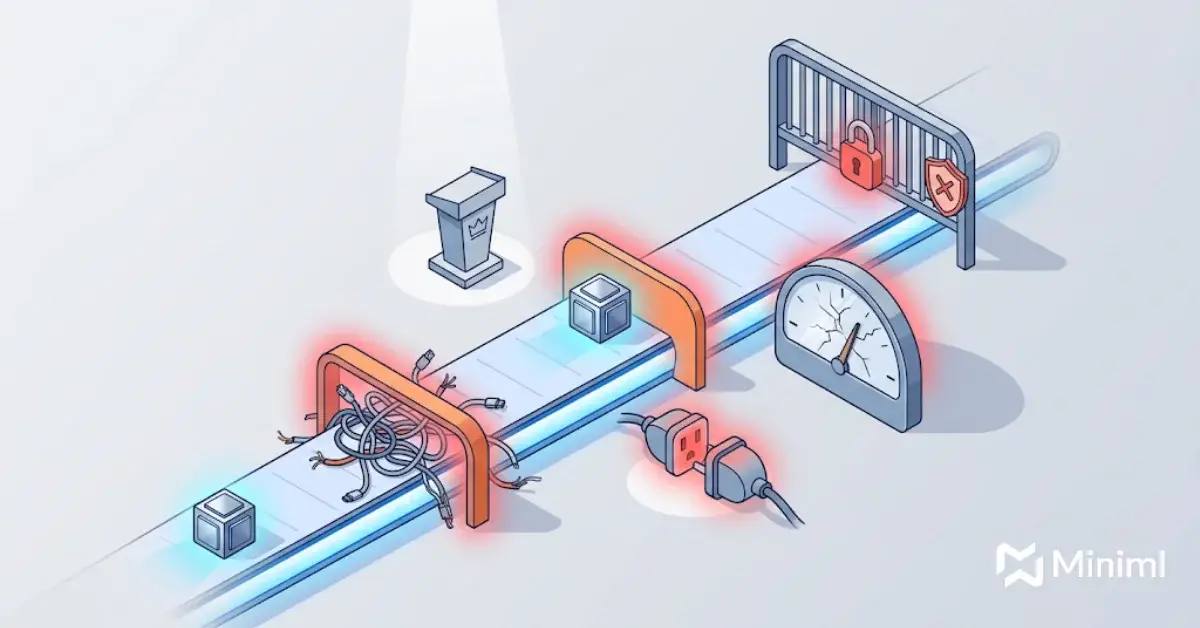
- The five common blockers are messy data, no owner, no integration, no evaluation and no governance.
- A production system needs monitoring, access controls, fallbacks and a budget line, none of which a pilot has.
- A short, fixed-scope review before scaling tells you exactly what your AI pilot to production plan is missing.
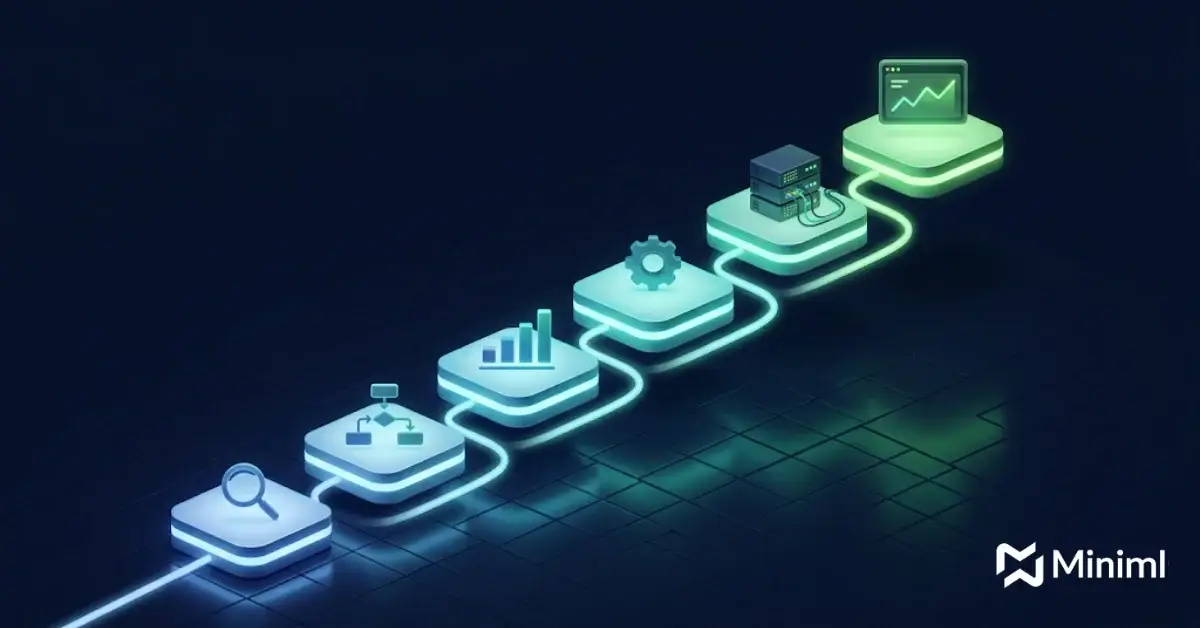
- The path from AI pilot to production works best as a staged plan: Discover, Map workflows, Prioritize, Prototype, Implement, Operate.
How Big Is the AI Pilot to Production Gap?
The AI pilot to production gap is wide. Industry analysts and university researchers have spent the last few years tracking enterprise AI, and they keep reaching the same finding: many generative AI projects are dropped after the proof of concept, and only a small share of custom enterprise tools ever reach live use.
The reasons they cite are familiar: poor data quality, weak risk controls, rising costs, unclear business value, brittle workflows and systems that do not learn from feedback.
There is progress. More large companies now say AI is scaling across their business, not just sitting in one team. Yet far fewer can point to a clear profit impact. In other words, scaling AI pilots is getting more common, but turning them into business results is still hard.
Why AI Pilots Fail: The 5 Common Stall Points
When we look at why AI pilots fail inside large organizations, the same five issues show up. None of them are about picking the “best” model.
1. Messy or Unavailable Data
A pilot often runs on a hand-picked sample, like a clean export or a tidy spreadsheet. Production data is spread across systems, full of gaps and owned by teams who were never asked to share it. When the pilot meets real data, accuracy drops and trust goes with it.
2. No Clear Business Owner
Many pilots are sponsored by an innovation team, and nobody in the business unit that would use the tool owns the outcome. Without an owner, nobody signs off on rollout, budget or process changes.
3. No Integration With Real Systems
A pilot in a separate chat window asks people to copy and paste, which rarely survives a busy week. Production AI has to read from and write to the CRM, ERP, ticketing tool or document store where work already happens.
4. No Evaluation Framework
“It looked good in the demo” is not a test. Without a fixed set of test cases, accuracy targets and a way to catch regressions, nobody can say whether the system is ready, or whether last week’s prompt change made it worse.
5. No Governance or Risk Sign-Off
Legal, security and compliance teams often see the project for the first time right before launch. If no one can answer their questions about data handling, access and audit trails, the project stops. Our guide to common AI implementation pitfalls covers more of these traps.
Pilot vs Production: What Changes?
A pilot proves something is possible. Production proves it is reliable, safe and worth paying for every month. That gap is what any AI pilot to production plan has to close.
| Requirement | AI Pilot | Production System |
|---|---|---|
| Data | Small, cleaned sample | Live data from source systems, with pipelines and quality checks |
| Users | A few friendly testers | Whole teams, with training and support |
| Ownership | Innovation or IT sponsor | Named business owner with a budget line |
| Integration | Standalone demo or chat window | Connected to CRM, ERP, ticketing or document systems |
| Evaluation | Ad hoc spot checks | Test sets, accuracy targets, regression checks |
| Monitoring | None | Logging, alerts, drift and cost tracking |
| Governance | Informal | Access controls, audit trails, risk review, human oversight |
| Failure handling | Restart the demo | Fallbacks, escalation paths, incident process |
| Success metric | “It works” | Time saved, cost per task, error rate, revenue impact |
The 5 Things That Unstick a Stalled AI Pilot
Each fix maps to one of the stall points above and shortens the AI pilot to production timeline.
1. Fix the Data Path First
Map where the real input data lives, who owns it and how it reaches the system every day. In any AI pilot to production effort, build the pipeline before you tune prompts.
- List every source system the workflow touches.
- Agree on data access with each owner in writing.
- Set simple quality checks that flag missing or broken inputs.
2. Name a Business Owner and a Metric
Pick one person in the business unit who is accountable for the result. Tie the project to a number they already care about, such as handling time, backlog size or cost per case. Our piece on moving to workflow economics explains why the workflow, not the model, should be the unit of value.
3. Integrate Into the Workflow People Already Use
Put the AI where the work is: a button inside the ticketing tool, a draft in the CRM or a background agent that updates records. If users have to switch screens, adoption fades and the AI pilot to production effort stalls.
4. Build Evaluation and Monitoring In
Create a test set from real past cases before launch. Set a target accuracy and a rule for when a human must review. After launch, track quality, latency and cost over time. Solid MLOps and model monitoring practice is what keeps a live system from quietly getting worse.
5. Bring Governance In Early
Invite security, legal and risk teams in during design, not the week before launch. Agree on data handling, access rules, audit logging and human oversight up front. A clear AI governance framework turns governance from a late blocker into a checklist you clear as you build.
How Do You Move From AI Pilot to Production Step by Step?
At Miniml, our thesis is simple: past the pilot, into production. We use the same six-stage delivery model for every enterprise AI engagement so that production needs are planned from day one.
- Discover. Understand the business goal, the constraints and who owns the outcome.
- Map workflows. Document how work moves today, including systems, handoffs and exceptions.
- Prioritize. Score use cases by value, feasibility, data readiness and risk, then pick the fastest path to payback.
- Prototype. Build against real data with an evaluation set from day one, to test production assumptions.
- Implement. Integrate with source systems, add access controls, logging and fallbacks, and train users. Complete the governance review before go-live.
- Operate. Monitor quality, cost and usage, adjust as data shifts and report against the agreed business metric.
This sequence keeps the AI pilot to production path short because nothing important is left for “later.”
What Is a Production-Readiness Review?
If your pilot has stalled, you may not need to start over. Miniml offers a fixed-scope Production-Readiness Review that takes two weeks and checks your AI pilot to production plan against the five stall points above.
It covers data, ownership, integration, evaluation and governance readiness. You get a clear go, fix or stop recommendation with a prioritized plan. Teams at an earlier stage can start with a three-week AI Workflow Opportunity Map.
For the engineering side of moving a model into daily use, Google Cloud explains MLOps automation pipelines in detail. To manage risk as pilots scale, the NIST AI Risk Management Framework is a good reference.
AI Pilot to Production FAQs
Why do most AI pilots never reach production?
Most AI pilots stall for operational reasons rather than technical ones. Common causes are messy data, no business owner, no link to the systems where work happens, no evaluation plan and late governance reviews. Many pilots are never designed for the reliability, monitoring, controls and budget that production needs.
How long does it take to move an AI pilot to production?
It depends on data readiness, integration depth and risk level. A focused use case with clean data and one integration can go live in a few months. Complex, regulated workflows take longer. A short readiness review helps you set a realistic timeline and surfaces blockers early.
What is the difference between an AI pilot and a proof of concept?
A proof of concept tests whether an idea is technically possible, often with sample data. An AI pilot goes a step further and puts a working version in front of real users for a limited time. Neither is production. Production means the system runs on live data, at scale, with monitoring, support and governance in place.
Who should own an enterprise AI project?
A leader in the business unit that benefits from the system should own the outcome. IT, data teams and AI partners build and run it, but the business owner sets priorities, approves process changes and holds the budget. Projects owned only by an innovation lab tend to stall at the AI pilot to production stage.
What should you measure when scaling AI pilots?
Measure business results, not just model accuracy. Useful metrics include time saved per task, cost per case, error or rework rate, throughput and user adoption. Track model quality, latency and running cost alongside them, and agree on these metrics before you build.
Can a stalled AI pilot be saved?
Often, yes. Many stalled pilots have a sound core idea but are missing data pipelines, ownership, integration or governance. A structured AI pilot to production review shows which gaps matter most and whether fixing them is worth the cost. Sometimes the right answer is to narrow the scope or redirect budget.
Get Your Stalled AI Pilot Into Production
If your team has a pilot that works in the demo but has not gone live, a two-week Production-Readiness Review is the fastest way to find out why and what to fix first. We build on OpenAI, Anthropic, AWS, Azure and Google Cloud, plus on-prem models when data cannot leave your environment.
Miniml
San Francisco: 50 California St #1500, San Francisco, CA 94111, United States. Phone: +1 415-941-8345
Edinburgh: 93 George St, Edinburgh EH2 3ES, United Kingdom
Book a production readiness consultation and get a clear plan to move your AI pilot to production.
About Miniml: Miniml is an AI consultancy with offices in San Francisco and Edinburgh that helps enterprise teams take AI systems past the pilot and into production.