

The build vs buy AI decision comes down to total cost of ownership, not the sticker price. Off-the-shelf APIs are cheapest to start, fine-tuned open-weight models win at steady high volume or under strict data rules, and fully custom AI models only pay off when they earn a measured advantage cheaper options cannot match.
Key Takeaways on Build vs Buy AI
- Buying through an API has the lowest upfront cost, but spend scales with every token and you inherit the vendor’s roadmap.
- Fine-tuned open-weight models on your own hardware trade usage fees for fixed infrastructure and staff costs.
- Fully custom models carry the highest cost and risk. Build one only when the gain is measurable.
- In any build vs buy AI comparison, hidden costs often outweigh the model price itself.
- The best answer is often hybrid: buy for breadth, build for the few workflows that drive real value.
What Does “Build vs Buy AI” Actually Mean?
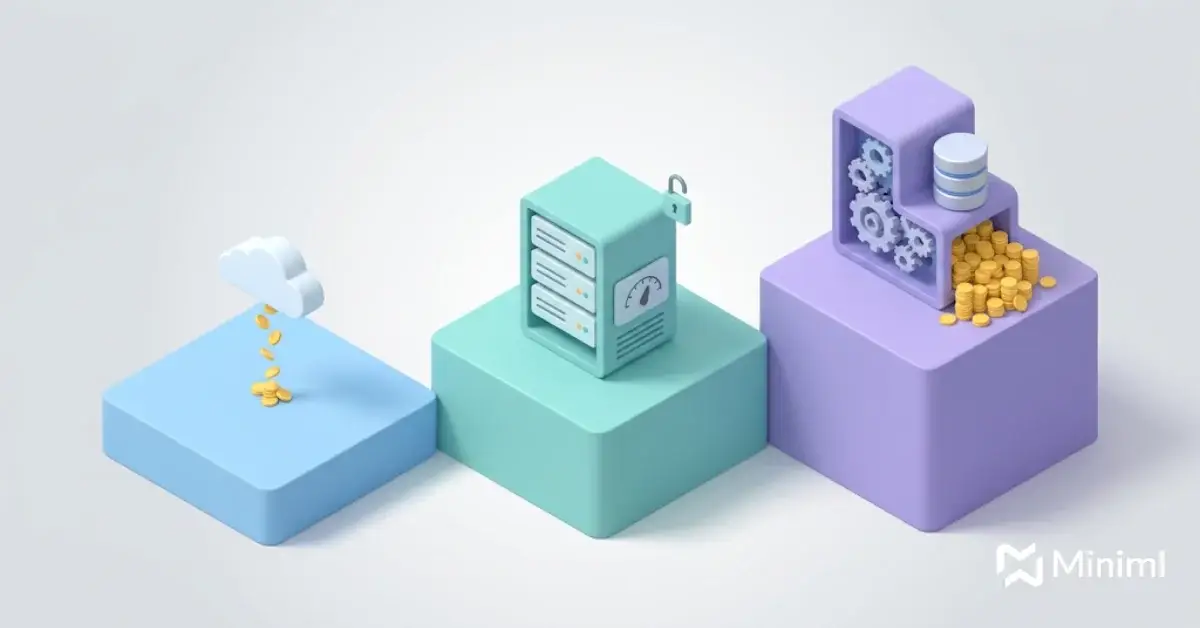
The phrase build vs buy AI sounds binary, but there are really three paths. Each one moves cost from one bucket to another rather than removing it.
Buy (hosted API). You call a model from a provider such as OpenAI, Anthropic, AWS, Azure or Google Cloud. You pay per token, and the provider runs the hardware and updates.
Adapt (fine-tuned open-weight model). You fine-tune a published open-weight model on your data and run it in your own cloud account or data center. You control when anything changes.
Build (fully custom model). You design, train and maintain a model for a narrow task. You own everything, including every cost and every failure.
When people compare custom AI vs off the shelf, they often skip the middle path, which is frequently where the best economics live.
Why Off-the-Shelf API Pricing Looks So Attractive
Hosted models have become far cheaper to call over the past few years. Prices for a given level of quality keep falling as providers release smaller, faster models and compete on price.
For low or unpredictable volume, an API is almost always the cheaper starting point. You get a strong model on day one, with no GPUs to manage and no training pipeline to staff.
The catch, and the reason to revisit build vs buy AI later, is that per-token pricing is a variable cost. It grows with usage, and agent workflows that loop, retry and pass long context can multiply token counts fast. A falling price per token does not mean your monthly bill falls too.
Custom AI vs Off the Shelf: Cost Drivers Compared
The table compares the three build vs buy AI paths over a two- to three-year horizon. It shows where each cost lands rather than dollar figures, because your numbers depend on volume, data and team.
| Cost driver | Buy: hosted API | Adapt: fine-tuned open-weight | Build: fully custom |
|---|---|---|---|
| Upfront cost | Very low | Medium | High |
| Ongoing compute | Per-token fees that scale with use | Fixed GPU or instance cost | Fixed GPU cost plus retraining |
| Data preparation | Light | Moderate (labeled sets) | Heavy (large curated datasets) |
| Evaluation | Rerun on every provider update | Rerun per fine-tune cycle | Built from scratch, ongoing |
| Integration | Similar effort | Similar effort plus serving | Similar effort plus serving |
| Monitoring and MLOps | Usage and quality tracking | Full model ops on your side | Full model ops on your side |
| Vendor lock-in | High | Low | None |
| Deprecation risk | Set by provider | You decide | You decide |
| Data residency control | Depends on provider terms | Full | Full |
| Time to first value | Days to weeks | Weeks to months | Months or longer |

The Hidden Costs Behind Every Custom AI Model Cost Estimate
These costs turn a neat build vs buy AI estimate into a budget overrun.
Evaluation
Every model needs a test set built from your real work, with clear pass and fail rules. You pay to build it once and to rerun it whenever the model, prompt or data changes. Teams without one cannot settle build vs buy AI questions or tell if a cheaper model is good enough, so they overpay by default.
Integration and Monitoring
Integration is the part of build vs buy AI that rarely changes: connecting a model to your systems costs roughly the same either way. After launch, you need logging, cost tracking, alerts and a human review path. With self-hosted models, you also own uptime, scaling and patching.
Data Preparation
Fine-tuning and custom training need clean, labeled, permission-checked data. Collecting and labeling it is often the largest line in a custom AI model cost estimate.
Vendor Lock-In and Model Deprecation
Hosted models retire on the provider’s schedule, not yours. Each forced migration means new evaluation runs, prompt rework and regression testing. Budget for at least one migration per year for each production workflow in your build vs buy AI plan.
When Open-Weight Models on Premise Make Financial Sense
Running open-weight models on premise, or in your own private cloud, flips the cost structure. You stop paying per token and start paying for hardware, power and the people who run it.
That trade pays off under a few clear conditions:
- Volume is high and steady, so GPU capacity stays busy instead of idle.
- Data cannot leave your environment because of regulation or client contracts.
- The task is narrow enough that a smaller fine-tuned model matches a larger hosted one.
- You need a frozen model version for an audited workflow.
If none of these apply, self-hosting usually costs more than it saves, and the build vs buy AI answer is to buy. Miniml’s sovereign and on-prem models work starts by testing whether these conditions are true for your workload before any hardware is bought.
When Is a Fully Custom Model Worth the Cost?
In build vs buy AI terms, a fully custom model makes sense far less often than vendors suggest. It earns its cost when the task is specialist, the data is proprietary, and a measured accuracy or latency gain turns directly into revenue or lower risk.
Good candidates include high-volume extraction on domain documents and low-latency edge use cases, not general chat or drafting.
Our rule is simple: a custom model gets built only when it earns the cost. Prove the gap with an evaluation set, then build the smallest model that closes it. Many teams start with LLM development and fine-tuning on an open-weight base before training anything from scratch.
A Build vs Buy AI Decision Framework
Use this sequence to make the build vs buy AI call with evidence instead of instinct.
- Define the workflow and metric. Name the task, the volume and the business number it moves.
- Build an evaluation set. Collect real examples with expected outputs.
- Test a hosted API first. If a strong off-the-shelf model passes, buy and stop here.
- Model the token bill at real volume. Project two to three years of usage, including retries and agent loops.
- Check data residency rules. If data cannot leave your environment, go straight to open-weight options.
- Test a fine-tuned open-weight model. Compare its score and running cost against the API.
- Add the hidden costs. Price evaluation, integration, monitoring, data prep and one migration per option.
- Build custom only if a gap remains. Commit when no cheaper option passes and the gain justifies the spend.
- Prove it in a scoped pilot. Validate on live data with a production path planned from day one, as covered in our guide to a scalable AI proof of concept.
How Miniml Approaches the Build vs Buy AI Decision
Most build vs buy AI debates stall because no one has run the numbers on the actual workflow. We map the workflow, test the cheapest credible option first, and move up the cost ladder only when the evaluation demands it.
That production-first approach drives our custom AI solutions for enterprise work across OpenAI, Anthropic, AWS, Azure and Google Cloud, plus open-weight models in your own environment when sovereignty or volume makes that the better deal.
To see how many open-weight options exist before you build, browse the Hugging Face model hub. If you plan to adapt an open model, read up on how fine-tuning works.
Build vs Buy AI FAQs
Is it cheaper to build or buy AI?
Buying is cheaper to start and usually cheaper at low or uneven volume. Building or fine-tuning can be cheaper at high, steady volume, or when data rules block hosted APIs. For any build vs buy AI decision, model total cost over two to three years, not month one.
What is the biggest hidden cost in AI projects?
For most teams it is the work around the model: evaluation sets, integration with existing systems, data preparation and monitoring after launch. These costs exist whether you buy or build, and they often exceed the model fees. Price them before you compare options.
How much does a custom AI model cost?
There is no reliable single figure. Cost depends on data volume and labeling effort, model size, training compute, evaluation and ongoing operations. Fine-tuning an open-weight model is usually far cheaper than training from scratch. Scope a small pilot against a clear metric first.
Are open-weight models good enough for enterprise use?
For many tasks, yes. Fine-tuned open-weight models can match larger hosted models on narrow work such as extraction, classification and routing, while giving you full control over data and versions. They are less suited to broad, open-ended tasks where the strongest hosted models still lead.
How do I avoid vendor lock-in with AI APIs?
Keep prompts, evaluation sets and business logic outside any one provider’s tooling. Add a thin abstraction layer between your application and the model so you can swap providers. Rerun your evaluation set on an alternative model at least once a year, so a deprecation or price change never leaves you stuck.
When should we move from an API to a self-hosted model?
Consider it when token spend is high and stable, when data residency rules tighten, or when provider model changes keep breaking audited workflows. Test a fine-tuned open-weight model against your evaluation set first. Move only if it passes and the full running cost, including staff, comes in lower.
Get a Clear Cost Picture Before You Build or Buy
If your team is weighing an API contract against a self-hosted or custom model, a short, scoped build vs buy AI review will show which path pays off. Miniml’s Production-Readiness Review runs in two weeks and ends with a costed recommendation for your actual workflows.
Miniml
San Francisco: 50 California St #1500, San Francisco, CA 94111, United States. Phone: +1 415-941-8345
Edinburgh: 93 George St, Edinburgh EH2 3ES, United Kingdom
Book a consultation with Miniml to compare your build and buy options with real numbers.
About Miniml: Miniml is an AI consultancy with offices in San Francisco and Edinburgh that helps enterprise teams take AI systems past the pilot and into production.