

The most common AI implementation challenges are solving the wrong problem, data that isn’t AI-ready, no success metrics, pilots with no route to production, ignoring the people who must use the system, weak governance and unmanaged running costs. Each has an early warning sign, and our production AI deployment support starts by checking for all seven.
Key Takeaways
- Problem framing: the top cause of AI project failure is a poorly defined business problem, not a weak model.
- Data readiness: test whether your data is fit for the specific use case before you commit a build budget.
- Phase mapping: AI implementation challenges change by phase, so check for different warning signs at framing, build, launch and run.
- Post-launch risk: drift, silent quality regressions and token cost creep hurt systems that looked fine on launch day.
- Vendor diligence: many products sold as AI agents aren’t, so test claims against your own data and workflows.
Why AI Implementation Challenges Sink So Many Projects
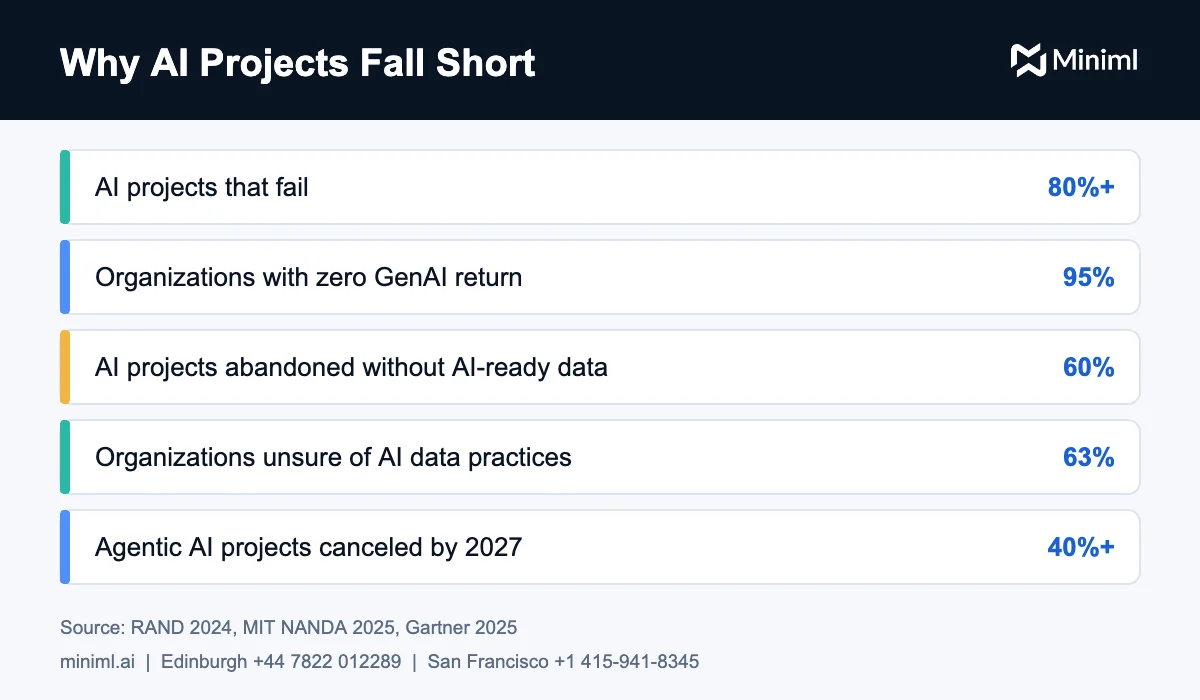
AI projects fail more often than ordinary IT work. RAND’s root cause study found that more than 80% of AI projects fail, twice the rate of non-AI IT projects. The top root cause was leaders misunderstanding the problem AI should solve, followed by data issues, a technology-first focus, underinvestment in infrastructure and immature technology.
Generative AI hasn’t changed the pattern. MIT NANDA’s GenAI report reports that despite $30 to 40 billion in enterprise GenAI investment, 95% of organizations are getting zero return. That doesn’t mean the technology doesn’t work. It means most AI implementation challenges are organizational and operational, not purely technical.
The upside is that AI implementation challenges are predictable. If you know the pitfalls and the signs that show up before them, you can fix most of them while they’re still cheap to fix.
The 7 Most Common AI Implementation Pitfalls
Here are the AI implementation pitfalls we check for in every scoping engagement, each with a one-line fix:
- Solving the wrong problem: write the business decision or task the AI changes, and the baseline it must beat, before choosing any tool.
- Data that isn’t AI-ready: sample the real data for the target use case and test quality, coverage and access rights early.
- No success metrics: agree on one business KPI and one quality metric up front, with a threshold for go or stop.
- Pilot with no path to production: design the pilot on production data, security rules and integrations from week one.
- Ignoring workflow and people: involve the end users in design and change the process, not just the software.
- Weak governance and security: set access controls, logging, human review points and an incident plan before launch.
- Unmanaged running costs: model cost per transaction at expected volume and set budget alerts from day one.
None of these AI implementation challenges needs advanced research to fix. They need someone to ask the awkward questions early, and a plan that treats production as the goal rather than the demo.
AI Implementation Challenges by Project Phase
Most guides give a flat list. In practice, AI implementation challenges show up at different points in a project, and the warning signs differ each time. This is the phase map we use to review a plan:
| Phase | Common pitfall | Warning sign | Fix |
|---|---|---|---|
| Framing | Vague or tech-first problem | The brief names a tool, not a decision or task | Write the decision, owner, baseline and target |
| Data | Data not fit for the use case | No one has sampled the actual records | Run a two-week data audit on real samples |
| Build | No evaluation method | Quality is judged by demos and gut feel | Build a test set and scoring rules before coding |
| Launch | Pilot stuck in sandbox | No integration, security or support plan | Plan the production path at kickoff |
| Adoption | Users work around the system | Usage drops after the first month | Redesign the workflow with users, track usage |
| Run | Drift and cost creep | Accuracy and spend aren’t monitored | Set monitoring, alerts and monthly reviews |
If you can’t point to the fix for these AI implementation challenges in each row of your own plan, that’s where your project is most likely to stall. Start there before you add scope.
Data Readiness: The Pitfall That Hides Until Build
Of all AI implementation challenges, data problems are the least likely to show up in a slide deck. They show up when engineers start pulling records. Gartner’s AI-ready data warning predicts that through 2026, organizations will abandon 60% of AI projects unsupported by AI-ready data, and that 63% of organizations lack, or are unsure they have, the right data management practices for AI.
“AI-ready” doesn’t mean perfect. It means the data is good enough for one specific use case. A customer database can be fine for churn scoring and useless for contract review. So judge readiness against the use case, not against a general standard.
Four checks cover most of it: Is the data you need actually captured? Can the project legally and technically access it? Is it labeled or structured enough to measure results? And does it reflect current conditions, not last year’s process?
Post-Launch AI Implementation Challenges Most Guides Skip
Launch isn’t the finish line. Some of the costliest AI implementation challenges appear months later, when nobody is watching closely. These are the ones we plan for from the start:
Model drift and silent regressions
Drift happens when real-world inputs change and the model’s accuracy slowly drops. Regressions happen when a prompt, model version or data source changes and quality falls without anyone noticing. Both need continuous monitoring of inputs, outputs, quality scores and failures, plus a fixed test set you re-run after every change. Our guide to what LLM observability covers explains the setup.
Token cost creep and vendor lock-in
Among post-launch AI implementation challenges, cost is the one finance teams notice first. Usage-based pricing looks cheap in a pilot and expensive at scale. Longer prompts, retries and agent loops multiply token use. Set a cost per transaction target, monitor it monthly and design your system so you can switch models or providers without a rebuild.
Agent washing and overreach
Gartner’s agentic AI forecast predicts that over 40% of agentic AI projects will be canceled by the end of 2027 due to escalating costs, unclear business value or inadequate risk controls. It also estimates only about 130 of the thousands of vendors claiming agentic AI are real, a practice it calls agent washing. We cover the agent-specific failure modes in our piece on why enterprise agents fail.
Before you sign with a vendor, ask for a trial on your own data, the evaluation results behind their claims, and a clear answer on what happens to your data. If your plan has gaps like these, book a readiness review before the build budget is committed.
AI Adoption Challenges vs AI Implementation Challenges
People often use these terms as if they mean the same thing. They overlap, but they aren’t the same, and mixing them up leads to the wrong fix. AI adoption challenges are about whether people and teams actually use AI: skills, trust, incentives and habits. AI implementation challenges are about whether a specific system gets built, launched and run well.
A project can clear every technical hurdle and still fail on adoption, because users don’t trust the outputs or the process around them never changed. The reverse also happens: an eager team with poor data and no evaluation method. You need a plan for both, owned by different people.
A simple rule helps. If the problem sits in the data, the model, the integration or the run costs, treat it as an implementation issue and give it to the delivery lead. If it sits in behavior, training or incentives, it’s an adoption issue for the business owner.
How to Pressure-Test Your Plan Before You Build
A short pre-mortem catches most AI implementation challenges while changes are still cheap. Run these steps with the business owner, a data lead and a risk lead in the room:
- State the problem in one sentence. Name the decision or task, who owns it and the baseline number AI must beat.
- Sample the real data. Pull a few hundred actual records and check quality, gaps and access rights.
- Define pass and stop thresholds. Agree on the KPI and quality score that justify scaling, and the level that ends the project.
- Map the production path. List the integrations, security reviews and support team needed to go live.
- Model the run cost. Estimate cost per transaction at full volume, including retries and human review time.
- Assign the risk controls. Decide who reviews outputs, what gets logged and how incidents are handled.
- Imagine it failed. Ask everyone to write the most likely reason the project failed a year from now, then fix the top three.
AI Implementation Challenges FAQs
What are the biggest challenges in AI implementation?
The biggest AI implementation challenges are solving the wrong problem, data that isn’t ready for the use case, missing success metrics, pilots that can’t reach production, low user adoption, weak governance and rising running costs. Most are organizational rather than technical, so they can be caught during planning.
Why do most AI projects fail?
Research from RAND points to leaders misunderstanding the problem AI should solve as the top cause, followed by poor data, a technology-first focus, weak infrastructure and immature technology. In short, projects fail when they start from a tool instead of a clearly defined business problem with a measurable target.
What is the 30% rule in AI?
There’s no official 30% rule. The phrase is used online with different meanings, most often the idea that AI should handle part of a job while people keep the judgment calls. Treat it as a rough slogan, and set your own targets based on measured results for each use case.
How do you know if your data is ready for AI?
Test it against the specific use case. Check that the data you need is captured, that you can legally and technically access it, that it’s structured or labeled enough to measure results, and that it reflects current processes. A small sample audit answers most of these questions quickly.
How do you control the running costs of an AI system?
Set a cost per transaction target before launch, and monitor it monthly. Keep prompts short, cache repeated answers, limit agent loops and retries, and route simple tasks to smaller models. Budget alerts and a design that lets you switch providers also protect you as usage grows.
Should you build AI in-house or work with a partner?
It depends on your team’s skills and how core the system is. Many firms work with a partner to scope, build and set up monitoring, while training internal staff to run it. Either way, keep ownership of your data, evaluation tests and business KPIs in-house.
Plan Your AI Rollout Around the Risks, Not After Them
Most AI implementation challenges are visible before a single line of code is written. If you’d like a second pair of eyes on your plan, schedule a scoping call with Miniml. Call our Edinburgh office on +44 7822 012289 or our San Francisco office on +1 415-941-8345.
About Miniml: Miniml is an AI consultancy with offices in Edinburgh and San Francisco that designs, builds and governs custom AI systems for business and technology leaders.