
AI transparency means people can see what data an AI system uses, how it reaches its outputs, who is accountable for it and when they’re dealing with it. Pair it with fairness testing so outcomes don’t unjustly disadvantage any group, and record both at every stage. Good AI governance consulting turns that into routine work.
Key Takeaways on AI Transparency
- Two jobs, one workflow: AI transparency shows how a system works, while fairness checks who it works for. Run both checks at every stage, from data to monitoring.
- Disclosure is falling: The average Foundation Model Transparency Index score dropped to 40 in 2025, so you can’t rely on model vendors to do this work for you.
- UK regulators already expect it: The ICO treats unjust discrimination by an AI system as a breach of the UK GDPR fairness principle.
- Fairness needs a number: Pick protected groups, choose a metric, set a threshold and write down the trade-offs before launch.
- Match artifacts to readers: Users need plain disclosures, regulators need records, and auditors need model cards and data sheets.
What AI Transparency and Fairness Really Mean
Ethics in AI feels abstract until a customer asks why they were refused. Two practical ideas carry most of the weight: transparency and fairness. They overlap, but they answer different questions.
AI transparency in plain terms
AI transparency is the degree to which people can see what an AI system is, what data shaped it, how it produces outputs and who owns it. It has three layers: the data, the model logic and the disclosure you give to the people affected. A system can be accurate and still fail on AI transparency if nobody can say where its training data came from.
Fairness in AI in plain terms
Fairness in AI means a system’s outcomes don’t unjustly disadvantage people because of traits like sex, race, age or disability. It’s measurable. You compare approval rates or error rates across groups and decide what gap is acceptable. AI fairness is never finished, because data and users change after launch.
Transparency versus explainability
Explainability is a narrower slice. It’s the ability to show why a model produced one specific output, such as the top factors behind a single loan decision. We cover explanation methods, reason codes and decision logs in our guide to auditable AI decision records, so this article stays with the wider, system-level view.
Why AI Transparency Is Slipping in 2026
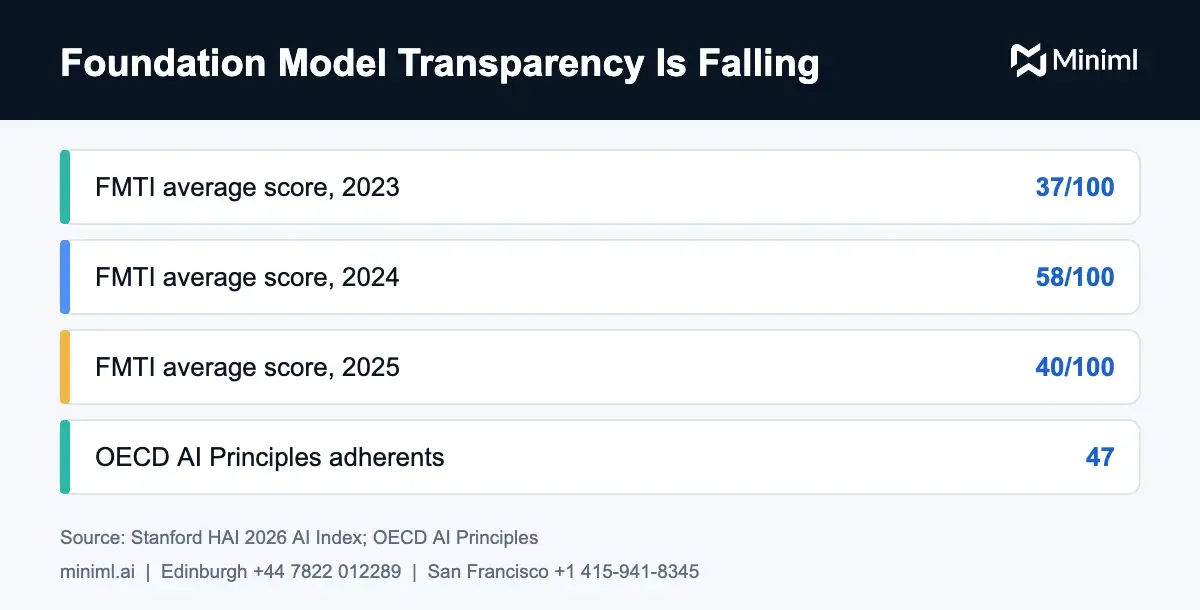
Disclosure isn’t improving as AI matures. The Stanford AI Index researchers report that the average Foundation Model Transparency Index score rose from 37 in 2023 to 58 in 2024, then fell to 40 in 2025.
The biggest gaps were disclosure on training data, compute and post-deployment impact. Those are exactly the facts you need when you build on a third-party model. If your vendor won’t say what went into the model, your own AI transparency starts with a hole in it.
That matters for fairness too, because bias often enters through training data. The practical answer is to test outputs directly, record what you know and what you don’t, and make vendor disclosure a buying criterion.
The business case beyond compliance
Transparency in AI isn’t only about avoiding fines. Clear records shorten security reviews and make enterprise procurement questionnaires easier to answer. They also make incidents cheaper to investigate, because a team with data sheets and change logs doesn’t start from scratch when a model misbehaves.
UK and US Rules That Shape Fair and Transparent AI
There’s no single global AI ethics law, but the main frameworks point the same way. The OECD trustworthy AI principles list fairness and privacy, plus transparency and explainability, among five values-based principles, and they have 47 adherents. Most national rules echo them.
United Kingdom
The ICO fairness guidance says AI processing under UK GDPR must stay within people’s reasonable expectations and avoid unjustified adverse effects. AI that causes unjust discrimination breaches the fairness principle. The ICO also expects inferences to be sufficiently statistically accurate, so a biased model is a data protection problem, not just a reputational one.
For the public sector, the Algorithmic Transparency Recording Standard sets a standard way to publish how and why algorithmic tools are used. It’s mandatory for all government departments, and for arm’s-length bodies that deliver public services or deal directly with the public. Private firms can copy its structure as a free, tested template for their own AI transparency records.
United States
The US has no single federal AI transparency law, so duties come from sector rules and local laws. Lenders must already give applicants the main reasons for adverse credit decisions under the Equal Credit Opportunity Act. New York City requires bias audits and candidate notices for automated hiring tools, and many employers use the four-fifths rule from federal hiring guidelines as a first screen for adverse impact.
European Union exposure
If you sell into the EU, the EU AI Act adds disclosure duties for systems such as chatbots, and heavier documentation for high-risk uses. UK and US firms serving EU customers can fall in scope.
A Lifecycle Workflow for Fair and Transparent AI
Fairness and AI transparency share the same stages, owners and evidence. The table below is the workflow we use when scoping governance work: each stage gets one fairness check, one transparency check and one artifact that proves both happened.
| Stage | Fairness check | Transparency check | Artifact |
|---|---|---|---|
| Data | Group representation and label quality by protected trait | Sources, consent basis and known gaps recorded | Data sheet |
| Build | Proxy features flagged, such as ZIP code standing in for race | Model choice, vendor disclosures and limits logged | Model card draft |
| Test | Fairness metric per group checked against the agreed threshold | Test sets, results and trade-offs documented | Fairness test report |
| Deploy | Human review route for contested decisions | User notice and explanation method live | Disclosure notice and decision log |
| Monitor | Group metrics tracked on live traffic | Drift, incidents and model changes logged | Monitoring dashboard and change log |
The monitor row is where most programs fall down. Fairness at launch tells you little about fairness six months later, once your user mix and data shift. Wire group metrics into your LLM observability in production setup, so fairness alerts sit next to latency and cost alerts.
How to Test an AI System for Bias
Bias testing sounds technical, but the choices behind it are business choices. What engineers can’t decide alone is which groups matter, which errors hurt most and how big a gap is acceptable.
- Name the decision and the harm. Write one sentence on what the system decides and what a wrong answer costs the person affected, such as a wrongly declined insurance claim.
- Pick the protected groups. Start with the legally protected traits that apply in your market. If you don’t hold that data, decide how you’ll estimate it or test on a labeled sample.
- Choose one primary fairness metric. Demographic parity compares approval rates across groups. Equal opportunity compares true positive rates, meaning how often qualified people are correctly approved.
- Set a threshold before you look. Agree the largest acceptable gap in advance, so nobody moves the goalposts after seeing results.
- Test on held-out and edge-case data. Include small subgroups and intersections, such as older women, where gaps often hide.
- Document the trade-offs. Record what you changed, what it cost in accuracy and who signed off.
- Repeat on live data. Run the same test on a set schedule and after any model, data or prompt change.
For generative AI, swap names, genders or dialects in otherwise identical prompts and compare the outputs. Score tone, refusal rates and answer quality per group, and keep your prompt sets under version control.
Not sure which fairness metric fits your use case? Our team can review your decision, data and likely harms in a short session, so book a fairness review before your next release goes live.
Who Needs What: Matching AI Transparency to Each Audience
A long technical report helps nobody if the reader is a customer on a phone. Good AI transparency gives each audience the depth they can actually use. Here’s how we map artifacts to readers.
| Audience | What they need | Format | Update trigger |
|---|---|---|---|
| Users and customers | That AI is involved, what it decides and how to challenge it | Short in-product notice and plain-language FAQ | Any change to purpose or data use |
| Regulators | Lawful basis, risk assessment and fairness evidence | DPIA, records of processing and transparency record | New use case or material change |
| Auditors | How the model was built, tested and monitored | Model cards, data sheets, test reports and change logs | Every model version |
| Internal leaders | Risk status and open issues | One-page dashboard with group metrics | Monthly review |
| Staff who operate it | When to override and escalate | Runbook with worked examples | Any process change |
A few habits keep these artifacts useful instead of shelfware:
- Write for the reader: Test user notices with people outside the project team.
- Record unknowns: Say what a vendor didn’t disclose, rather than leaving the field blank.
- Version everything: Tie each model card to a model version and a date.
- Name an owner: Every artifact needs one person who is accountable for keeping it current.
Miniml’s Decision Rules for Fairness Trade-offs
Closing one fairness gap can widen another, and some fairness metrics can’t all be met at once. These rules help teams decide quickly and consistently.
- Harm beats accuracy: If a small accuracy loss removes a large gap on a high-harm decision, accept the loss.
- No threshold, no launch: A system that affects access to money, jobs, health or housing doesn’t go live without an agreed fairness threshold.
- Explain it or add a human: If you can’t give an affected person a meaningful reason, route that decision to human review.
- Unknown data means more testing: When a vendor won’t disclose training data, expand your output testing instead of trusting the model.
- Monitor what you promise: Every fairness claim in a user notice needs a live metric behind it.
These rules also make change easier to handle, because you already know which metric to check and who decides. Our article on when autonomous models drift covers the response playbook.
AI Transparency FAQs
What is the difference between AI transparency and explainability?
AI transparency is openness about a whole system: its data, design, limits, owners and use. Explainability is narrower, showing why a model produced one specific output, such as the main factors behind a decision. You need explainability for individual challenges, and transparency for trust, audits and regulators.
What does fairness mean in AI?
Fairness in AI means outcomes don’t unjustly disadvantage people because of protected traits. In practice, you choose groups, pick a metric such as approval rate or error rate, and set the largest acceptable gap. The ICO treats unjust discrimination by AI as a breach of UK GDPR fairness.
What are the three levels of AI transparency?
A practical split is data, model and disclosure. Data transparency covers sources, consent and gaps. Model transparency covers design, testing and limits. Disclosure transparency tells affected people that AI is involved, what it decides and how they can challenge the result.
What are the 5 ethics of AI?
There’s no single official list, but the OECD’s five values-based principles are widely used. They cover inclusive growth and well-being; human rights and democratic values, including fairness and privacy; transparency and explainability; robustness, security and safety; and accountability.
How do you test an AI system for bias?
Define the decision and the harm, pick protected groups, choose one fairness metric and set a threshold before testing. Test on held-out and edge-case data, including small subgroups. Document trade-offs and sign-off, then repeat the test on live data after model or prompt changes.
Is AI transparency a legal requirement in the UK and US?
Partly. In the UK, UK GDPR fairness and transparency duties apply when AI uses personal data, and government departments must publish ATRS records. The US has no single federal law, but sector rules apply, such as adverse action notices in lending and New York City’s hiring audit law.
Make Your Next AI Release Fair and Transparent
Fair and transparent AI doesn’t need a huge program. It needs a clear workflow, a fairness threshold agreed before testing, and artifacts written for the people who’ll read them. Start with one high-impact system.
If you’d like a second pair of eyes, book a scoping call with Miniml. We’ll review one system, map its fairness and AI transparency gaps, and agree a practical plan. Call our Edinburgh office on +44 7822 012289 or our San Francisco office on +1 415-941-8345.
About Miniml: Miniml is an AI consultancy with offices in Edinburgh and San Francisco that designs, builds and governs custom AI systems. We help UK and US teams turn AI ideas into production systems they can explain and defend.