

An AI business strategy is a plan that ties every AI project to a named business goal, a measurable KPI and a funding decision. You start from two or three outcomes, map use cases to them, score each on value and feasibility, and review the portfolio every quarter. That’s how structured AI strategy work keeps AI aligned with business goals.
In this article: why goals come first, what the strategy includes, the 5 alignment steps, the goal to KPI map, use case prioritization, ownership, FAQs.
Key Takeaways on AI Business Strategy
- Goals first: an AI business strategy begins with two or three business outcomes, not a list of tools or models.
- KPI mapping: every use case needs a KPI the finance team already tracks, plus a leading metric you can see within weeks.
- Portfolio funding: fund AI in stages with clear gates, so weak ideas stop early and strong ones get more budget.
- Named ownership: a business leader owns the outcome, while technology, data and risk teams own delivery and controls.
- Quarterly review: the strategy is a living document that you re-score against real results every quarter.
Why an AI Business Strategy Has to Start With Goals
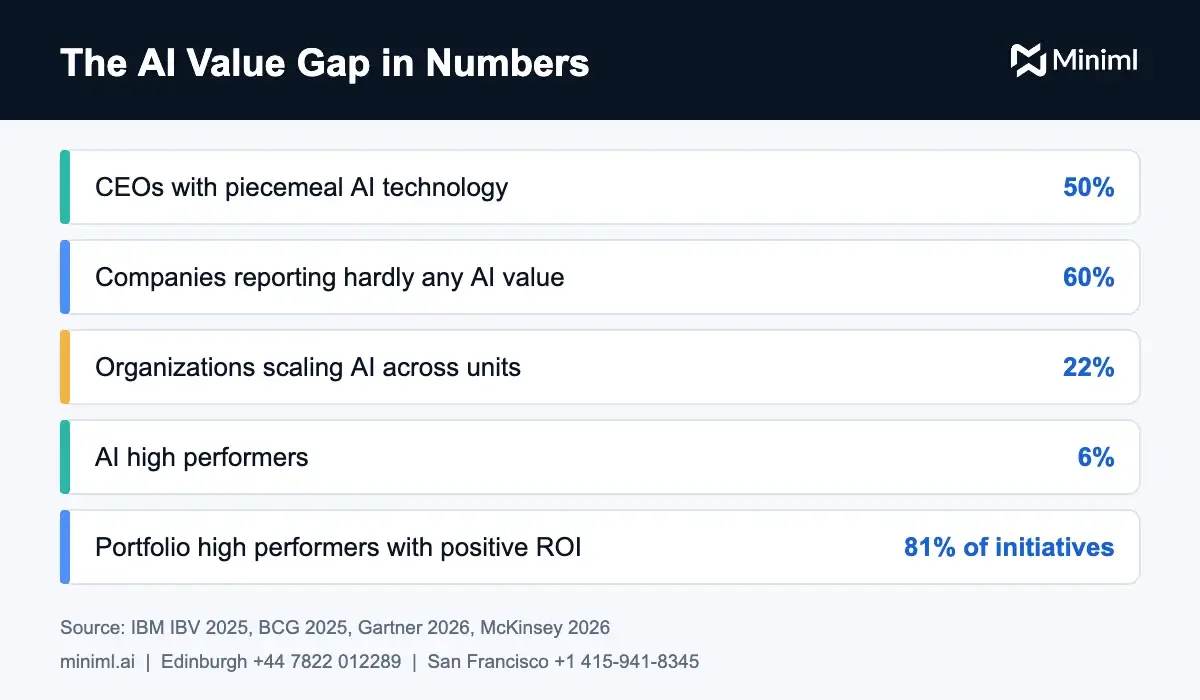
Most companies don’t lack AI projects. They lack a reason for each one. According to IBM’s CEO study, 50% of CEOs say rapid investment has left them with disconnected, piecemeal technology. That’s what happens when teams buy tools before they agree on what the business needs to change.
The value gap is wide. BCG’s AI value research found that only 5% of companies are “future-built” and generating material value from AI, while 60% report hardly any material value despite substantial investment. The difference isn’t model quality. It’s whether AI work is pointed at outcomes the business actually measures.
So a sound AI business strategy is less about technology choices and more about discipline. It answers three questions for every project: which goal does this serve, how will we know it worked, and what happens to the budget if it doesn’t?
What a Good AI Strategy Framework Includes
An AI strategy framework is the set of decisions and rules that turns ambition into a funded roadmap. It sits above individual projects. It’s also different from how you redesign work around AI, which we cover in our piece on the workflow economics of AI, and from change management and adoption.
At Miniml, we expect a working framework to cover six parts:
- Business outcomes: two or three goals, such as lower cost to serve or faster quote turnaround, each with a baseline number.
- KPI tree: the chain from each goal to a lagging KPI (the result) and a leading metric (an early signal).
- Use case backlog: candidate projects, each linked to one goal, with rough value and effort estimates.
- Prioritization rules: a scoring method everyone agrees on before any scores are given.
- Funding and stage gates: small budgets for early stages, larger ones released only when evidence meets a set bar.
- Ownership and controls: who is accountable for value, delivery, data quality and risk, including rules like the EU AI Act and the NIST AI Risk Management Framework.
If any of these six parts is missing, the strategy tends to drift back toward a tool list. The most common gap we see when scoping an AI business strategy is the KPI tree, because it forces uncomfortable conversations about baselines.
How to Align AI With Business Goals in 5 Steps
Aligning AI with business goals is a repeatable process, not a one-off offsite. Here’s the sequence we use when we build an AI business strategy with a leadership team:
- Pick two or three business outcomes. Choose goals the board already cares about, and write down today’s baseline for each. More than three dilutes focus and budget.
- Translate each outcome into measurable KPIs. Set one lagging KPI, such as margin per order, and one leading metric, such as the share of orders processed without manual rework.
- Score use cases on value and feasibility. List every idea against a goal, then score it with the same weighted criteria. Ideas that don’t map to a goal go to a parking list.
- Fund the work as a portfolio with stage gates. Give each use case a small budget to prove its leading metric, then release more only when it passes the gate.
- Review quarterly against the KPIs. Re-score the backlog with real data, stop what isn’t moving the numbers, and add new ideas that fit the goals.
The workflow part matters. McKinsey’s latest AI survey reports that only 6% of respondents qualify as AI high performers, and nearly three-quarters of those high performers have fundamentally redesigned workflows, up from 55%. Aligning AI with business goals means the KPI owner changes how work gets done, not just which software gets bought.
The Goal to KPI to Use Case Map
This table is the core of an AI business strategy. It shows how a business goal breaks down into something a delivery team can build and a finance team can check. The examples are illustrative, so swap in your own goals and baselines.
| Business goal | Lagging KPI | AI use case | Leading metric | Outcome owner |
|---|---|---|---|---|
| Reduce cost to serve | Support cost per customer | Ticket triage and draft replies | Share of tickets resolved without handoff | Head of customer operations |
| Grow revenue per account | Net revenue retention | Churn risk scoring for account teams | Accounts flagged and contacted within 7 days | Chief revenue officer |
| Speed up order to cash | Days sales outstanding | Invoice data extraction and matching | Invoices matched without manual touch | Finance director |
| Cut operational risk | Compliance exceptions per quarter | Contract clause review | Clauses flagged versus lawyer review | General counsel |
| Improve forecast accuracy | Forecast error at SKU level | Demand forecasting model | Weekly error versus current method | Supply chain lead |
Notice that every row in this AI business strategy map has a human owner outside the technology team. If you can’t name one, the use case isn’t ready for funding. That single rule removes a large share of the pet projects that clog most AI backlogs.
How to Prioritize Use Cases in Your AI Business Strategy
Once your backlog maps to goals, your AI business strategy needs a fair way to rank it. We score each use case on value and feasibility using weights agreed before scoring starts. Agreeing weights first stops the loudest sponsor from winning by default.
| Criterion | What you score | Suggested weight |
|---|---|---|
| Business value | Size of the KPI change if it works, in money or hours | 30% |
| Strategic fit | How directly it serves one of the chosen goals | 15% |
| Data readiness | Whether the data exists, is accessible and is good enough | 20% |
| Technical feasibility | Maturity of the approach and integration effort | 15% |
| Adoption effort | How much process and behavior must change | 10% |
| Risk and compliance | Regulatory exposure, privacy and harm if it fails | 10% |
Plot the results on a simple two-by-two grid: value on one axis, feasibility on the other. High value and high feasibility items become first-wave pilots. High value but low feasibility items usually need data work first, so they go into the roadmap as foundations.
Use stage gates to protect the portfolio
Stage gates are checkpoints where a project must show evidence before it gets more money. Gartner’s 2026 AI survey found that only 22% of organizations have scaled AI across multiple business units, but high performers that track ROI and manage AI as a portfolio reported positive returns on 81% of initiatives. Portfolio thinking is the habit that separates the two groups, and it should be written into your AI business strategy.
A simple gate set works well: framing (goal and baseline agreed), proof (leading metric moves on real data), pilot (KPI moves for real users) and scale (run costs and controls signed off). For decisions that need ranking and trade-offs in real time, decision intelligence systems can sit on top of the same scoring logic. If you want an outside view on your scores, book a prioritization workshop and bring your current backlog.
Who Owns an Enterprise AI Strategy
Ownership is where many enterprise AI strategy efforts stall. When the CIO owns the AI business strategy alone, it becomes a technology program. When a business unit owns it alone, it fragments into disconnected tools. The fix is shared ownership with clear roles.
| Role | Accountable for | Typical title |
|---|---|---|
| Executive sponsor | Choosing goals, approving budget at each gate | CEO, COO or divisional president |
| Outcome owner | Hitting the KPI and changing the workflow | Business unit or function head |
| AI product owner | Backlog, scoring and delivery priorities | Product or transformation lead |
| Data owner | Access, quality and lineage of the data used | CDO or data platform lead |
| Risk owner | Governance, compliance and model controls | CRO, DPO or legal lead |
For UK and US mid-market firms, one person may hold two of these roles, and that’s fine. What matters is that value and risk never sit with the same person, because the pressure to ship will quietly win.
Scaling an AI Business Strategy for Mid-Market Firms
Most published advice assumes a global enterprise with a chief AI officer and a large central team. Mid-market firms in the UK and US rarely have that. The good news is that an AI business strategy for a smaller company uses the same logic, just with fewer goals, fewer gates and tighter budgets.
We suggest three adjustments. First, cap the first wave at one or two use cases, so one team can deliver them well. Second, choose use cases where the data already lives in systems you control, such as your CRM, ERP or ticketing tool. Third, build light governance from day one, because fixing it later costs more than setting it up now.
Regulation also shapes your AI business strategy. If you sell into the EU, the EU AI Act sets duties based on risk level. UK firms work under a principles-based approach led by existing regulators, and many US firms use the NIST framework as a voluntary baseline. Put your highest-risk use cases later in the roadmap unless the controls are already in place.
Whatever your size, keep the strategy short enough to read in ten minutes. A long document nobody opens is worse than a one-page AI business strategy that the leadership team reviews every quarter.
AI Business Strategy FAQs
What is an AI business strategy?
An AI business strategy is a plan that links AI investment to specific business outcomes. It names two or three goals, sets KPIs for each, ranks use cases by value and feasibility, funds them through stage gates and assigns owners, so every AI project has a clear purpose and a measurable result.
How do you align AI initiatives with business objectives?
Start with the objective, not the tool. Write down the baseline, pick a lagging KPI and a leading metric, and only fund use cases that clearly move one of them. Then review the portfolio every quarter and stop projects that aren’t moving the numbers.
What KPIs should an AI strategy track?
Track two layers. Lagging KPIs are business results like cost per customer, revenue retention or forecast error. Leading metrics show early progress, such as the share of tasks completed without manual rework. Add run cost per transaction and adoption rate so you can see whether value is sustainable.
What is the 10/20/70 rule for AI?
It’s a BCG guideline for where AI effort should go: about 10% on algorithms, 20% on technology and data, and 70% on people and processes. The point is that most of the value comes from changing how work gets done, not from the model itself.
How do you prioritize AI use cases?
Agree on weighted criteria first, typically business value, strategic fit, data readiness, technical feasibility, adoption effort and risk. Score every use case the same way, plot value against feasibility, and fund the high value, high feasibility items as first-wave pilots.
Who should own AI strategy: the CIO, CDO or business leaders?
Ownership should be shared. An executive sponsor picks goals and approves budget, business leaders own the KPIs, the CIO or CDO owns data and delivery, and a risk lead owns controls. Keeping value and risk with different people prevents pressure to ship from overriding safety.
Turn Your Business Goals Into a Funded AI Roadmap
A strong AI business strategy fits on a page: a few goals, a KPI tree, a scored backlog and named owners. If you’d like help building yours, book a scoping call with our team. You can reach our Edinburgh office on +44 7822 012289 or our San Francisco office on +1 415-941-8345.
About Miniml: Miniml is an AI consultancy with offices in Edinburgh and San Francisco that designs, builds and governs custom AI systems for business and technology leaders.