
An AI proof of concept is a time-boxed experiment, usually 4 to 8 weeks, that tests an AI idea on your real data against success thresholds agreed up front. To make it scalable, build production habits in from day one and end with a clear scale, pivot or stop decision, as our custom AI development services do.
Key Takeaways
- Test value, not just tech: An AI proof of concept should prove business value and technical feasibility against thresholds agreed before work starts.
- Most PoCs stall: Gartner predicted at least 30% of generative AI projects would be abandoned after proof of concept by the end of 2025.
- Design for scale from day one: A reusable data pipeline, an evaluation suite and cost per transaction tracking belong inside the PoC, not after it.
- Use a scorecard: Score technical, value, operational and risk thresholds, then apply a written scale, pivot or stop rule.
- Keep it short: Four to eight weeks on real data beats six months on a demo dataset.
What an AI Proof of Concept Is and Isn’t
An AI proof of concept answers one question: can this AI idea work on your data, in your process, at a cost that makes sense? It’s a short, focused experiment with a decision at the end. It isn’t a demo built to impress a steering committee.
The word “scalable” changes the brief. A throwaway AI PoC proves a model can hit a number in a notebook. A scalable one proves the same result can survive real data volumes, security review and daily use, which shortens the path from AI pilot to production.
AI PoC vs prototype vs pilot vs MVP
Teams often mix these terms up, which leads to mismatched budgets and expectations. The lengths below are indicative, not fixed rules.
| Stage | Main question | Indicative length | Who uses it | Output |
|---|---|---|---|---|
| Proof of concept | Can it work on our data and create value? | 4 to 8 weeks | Project team and a few experts | Scorecard and a scale, pivot or stop decision |
| Prototype | What will it look and feel like? | 2 to 4 weeks | Designers and sample users | Clickable or partial interface |
| Pilot | Does it work in live operations? | 2 to 4 months | One real team or region | Operational metrics and a rollout plan |
| MVP | Will people adopt it or pay for it? | 3 to 6 months | Early customers or wider staff | Released product with core features |
Why Most AI Proofs of Concept Never Reach Production
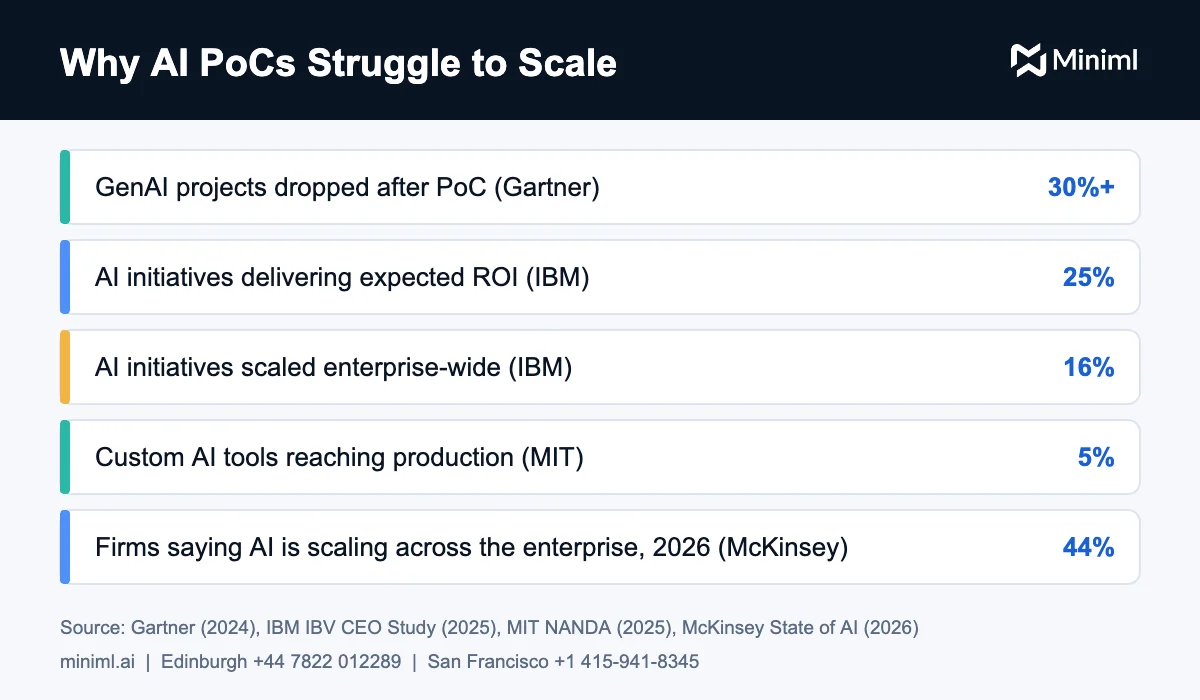
The numbers are sobering. Gartner’s 2024 prediction said at least 30% of generative AI projects would be abandoned after proof of concept by the end of 2025. The reasons were poor data quality, inadequate risk controls, escalating costs or unclear business value.
Returns lag too. An IBM CEO study found only 25% of AI initiatives delivered expected ROI in recent years, and only 16% have scaled enterprise-wide. MIT NANDA’s 2025 research found just 5% of custom enterprise AI tools reached production.
There’s progress for companies that get the basics right. McKinsey’s State of AI 2026 edition found 44% of respondents say AI is scaling across their enterprise, up from 38% a year earlier.
The cause is rarely the model itself. It’s usually missing data access, no agreed success metric, no business owner and no plan for running costs. We break down enterprise agent failure modes in a separate guide, so here we focus on designing around them.
Design Your AI Proof of Concept for Scale From Day One
The cheapest time to plan for production is before you write code. That doesn’t mean building the full system. It means making a handful of choices you’d otherwise have to undo later.
- Reusable data pipeline: Pull data through the connectors and access controls production will use, not a one-off spreadsheet export.
- Evaluation suite: Build a versioned test set and scoring script, so every model or prompt change is measured the same way.
- Cost per transaction: Track compute or API cost per request from week one, and project it at expected volume.
- Latency budget: Agree how fast a response must be for the process to work, and measure against it.
- Early security review: Share the architecture with your security team in week one, not week eight.
- Logging hooks: Log inputs, outputs and errors, so the pilot team inherits real evidence.
None of these add much effort to a six-week AI proof of concept, but each can save months later. They’re also the groundwork for MLOps consulting for production, where models are deployed, versioned and monitored as routine work rather than a rescue.
The AI PoC Scorecard: Metrics and a Decision Rule
Every AI proof of concept needs success metrics agreed before the first sprint. Otherwise the team grades its own homework. We use a four-part scorecard, with thresholds set jointly by the business owner and the technical lead.
AI PoC success metrics
The example thresholds below are illustrations for a document extraction PoC. Set your own based on the current process and its costs.
| Dimension | What you measure | Example threshold |
|---|---|---|
| Technical | Accuracy or task success on a held-out test set | At least 90% field-level accuracy on test documents |
| Value | Time saved, errors avoided or revenue per case | Projected yearly benefit repays build and run cost within an agreed payback period |
| Operational | Latency, cost per transaction and integration effort | Under 5 seconds per document at projected volume |
| Risk | Data protection, bias checks and security findings | No unresolved high-severity findings |
Then apply a simple rule. Scale if all four dimensions pass. Pivot if value passes but a technical or operational threshold misses by a fixable margin, and stop if value fails or a risk finding can’t be resolved.
Write the rule down at kickoff. Stopping isn’t failure: an AI proof of concept that stops at week six with clear evidence saves the budget a pilot would have burned.
How to Build a Scalable AI Proof of Concept in 8 Steps
This is the sequence we follow when scoping an AI proof of concept. Each step has a clear output, so nobody has to guess whether it’s done.
- Pick a narrow, valuable use case. Choose one process step with measurable volume and cost, such as extracting fields from invoices, not “use AI in finance.”
- Name a business owner. One person who owns the process outcome signs off the thresholds and the final decision.
- Check data before committing. Confirm access, volume, quality and legal basis in week one. If the data isn’t ready, pause.
- Agree the scorecard. Set technical, value, operational and risk thresholds, plus the scale, pivot or stop rule.
- Build a baseline first. Measure the current process and a simple approach, such as rules or an off-the-shelf model, so gains are real.
- Iterate against the evaluation suite. Run short cycles and log every model, prompt and data change with its score.
- Test with real users. Put outputs in front of the people who’d use them, and note where they’d override the system.
- Write the handover pack. Include scorecard results, architecture, cost projection, risks and a pilot plan, then make the call.
Step 8 is where an AI PoC becomes an AI pilot to production plan. A good handover pack lets a different team start the pilot without redoing your work.
Build in-house or with a partner?
Both can work. MIT NANDA found pilots built through external partnerships were about twice as likely to reach full deployment as internal builds. Treat that as one data point, not a rule: partners help most when you lack production AI experience, while in-house teams suit firms already running models live.
If you’re weighing your first use case and want thresholds you can defend, plan your PoC scope with our team before you commit budget.
Timelines, Team and Budget Drivers by AI PoC Type
Length and effort depend more on data readiness and integration than on the model. These AI proof of concept examples show indicative ranges for a focused scope with data access already agreed.
| PoC type | AI proof of concept example | Indicative length | Main effort drivers |
|---|---|---|---|
| RAG knowledge assistant | Answers staff questions from policy documents | 4 to 6 weeks | Document cleanup, access controls, building the evaluation set |
| Document extraction | Pulls fields from invoices or claim forms | 4 to 6 weeks | Document variety, labeling, integration with the target system |
| Classifier or predictive model | Routes tickets or flags risky transactions | 6 to 8 weeks | Historical label quality, feature work, bias testing |
| Agent workflow | Completes multi-step tasks across tools | 6 to 10 weeks | Tool integrations, guardrails, error handling |
Who you need on the team
A lean team is usually enough. You need a business owner, a domain expert for a few hours a week, a data or ML engineer and a technical lead who owns the architecture. Security and legal join at set checkpoints rather than full time.
What drives the budget
We don’t quote fixed prices before scoping, because data condition changes the effort so much. The biggest drivers are data preparation, integration with existing systems and the number of evaluation cycles. A tight AI proof of concept costs a small fraction of full deployment, which Gartner put at $5 million to $20 million for generative AI.
UK and US Compliance Gates Inside the PoC
Compliance shouldn’t wait for the pilot. A light gate at the start and end of your AI proof of concept stops you building something you can’t legally deploy.
- UK GDPR and DPIA: If you use personal data, confirm your lawful basis and check whether you need a data protection impact assessment (DPIA) before data is shared.
- EU AI Act exposure: If you serve EU users, check whether the use case could be high-risk or carry disclosure duties. Our guide to legacy model compliance checks covers existing models too.
- NIST AI RMF: US teams can map PoC risks to the four functions of the NIST AI Risk Management Framework: govern, map, measure and manage.
- Data residency: Confirm where data is processed and stored, especially when you call third-party model APIs.
AI Proof of Concept FAQs
How long should an AI proof of concept take?
Most AI proofs of concept should take 4 to 8 weeks. That’s long enough to test a model on real data against agreed thresholds, and short enough to stop cheaply. If data access isn’t ready, fix that before you start the AI proof of concept.
How much does an AI PoC cost?
Cost depends mainly on data preparation, integration work and the number of evaluation cycles, so an honest quote follows scoping. A focused PoC costs a small share of full deployment, which Gartner estimated at $5 million to $20 million for generative AI. Narrow scope keeps spend under control.
What is the difference between an AI PoC, a pilot and an MVP?
An AI proof of concept tests whether an idea works on your data and creates value, usually in weeks. A pilot tests it in live operations with a real team. An MVP is a released product with core features, built to test adoption at wider scale.
What success metrics should an AI PoC use?
Use four dimensions, each with a threshold agreed up front. Technical metrics cover accuracy on a held-out test set, and value metrics cover time saved or errors avoided. Operational metrics cover latency and cost per transaction, while risk metrics cover data protection, bias and security findings.
Why do most AI proofs of concept never reach production?
Most stall because of poor data quality, weak risk controls, rising costs or unclear business value, the reasons Gartner cited. Other common causes are missing business owners, no agreed success metric and PoCs built on demo data that can’t survive production volumes or security review.
What data do you need before starting an AI PoC?
You need legal access to a representative sample of real data, enough labeled examples to build a held-out test set, and a clear lawful basis for any personal data. You also need baseline numbers for the current process, so the AI proof of concept can show a real improvement.
Turn Your AI Proof of Concept Into a Production Plan
A scalable AI proof of concept is short, measured and built on production habits. Agree the scorecard first, test on real data, and finish with a handover pack that makes the next decision easy.
Ready to test an idea properly? Book a scoping call with Miniml, and we’ll help you pick the use case, set thresholds and plan an AI proof of concept that can grow. Call our Edinburgh office on +44 7822 012289 or our San Francisco office on +1 415-941-8345.
About Miniml: Miniml is an AI consultancy with offices in Edinburgh and San Francisco that designs, builds and governs custom AI systems. We work with UK and US teams to move AI from experiments to systems that run in production.