
Responsible AI consulting is outside help that turns ethical principles into a working responsible AI framework: clear owners, risk checks, documentation and sign-off rules your teams follow every time they build or buy AI. A good consultant works alongside your AI governance function to close skills gaps and leave evidence an auditor can check.
In this article: what a responsible AI framework is, why it matters in 2026, principles mapped to artifacts, what a consultant delivers, build or buy, standards to map to, FAQs.
Key Takeaways
- Definition: a responsible AI framework is the set of principles, roles, processes and documents that decides how your organization designs, buys, tests and monitors AI.
- Artifacts over slogans: every principle should produce something you can inspect, such as a bias test report, a model card or a risk register.
- Know-how is the blocker: most organizations stall on skills and clarity, not intent, which is where outside help adds the most value.
- Standards give structure: map one framework to ISO/IEC 42001, the NIST AI RMF and the OECD AI Principles so it holds up in the UK, EU and US.
- Right-sized scope: start with your highest-impact AI systems, prove the process works, then extend it across the portfolio.
What Is a Responsible AI Framework?
A responsible AI framework is a documented system of principles, roles, processes and controls that governs how an organization designs, buys, deploys and monitors AI. It turns values like fairness and accountability into repeatable checks, named owners and records, so every AI system is assessed the same way before and after launch.
Most frameworks rest on six principles. Different bodies group them slightly differently, but the core set looks like this:
- Fairness: the system doesn’t produce unjustified differences in outcomes between groups of people.
- Transparency and explainability: people know when AI is in use and can get a meaningful account of how a decision was reached.
- Accountability: a named person owns each system and answers for its behavior.
- Privacy and data governance: personal data is collected, used and kept lawfully, and only as much as the task needs.
- Safety and reliability: the system performs as intended, fails gracefully and is tested against misuse.
- Human oversight: people can review, override or stop the system when the stakes justify it.
The difference between responsible AI and AI ethics is practical. Ethics asks what the right thing is. A responsible AI framework makes sure the right thing happens consistently, even after the original champions leave the project.
Why Responsible AI Matters More in 2026
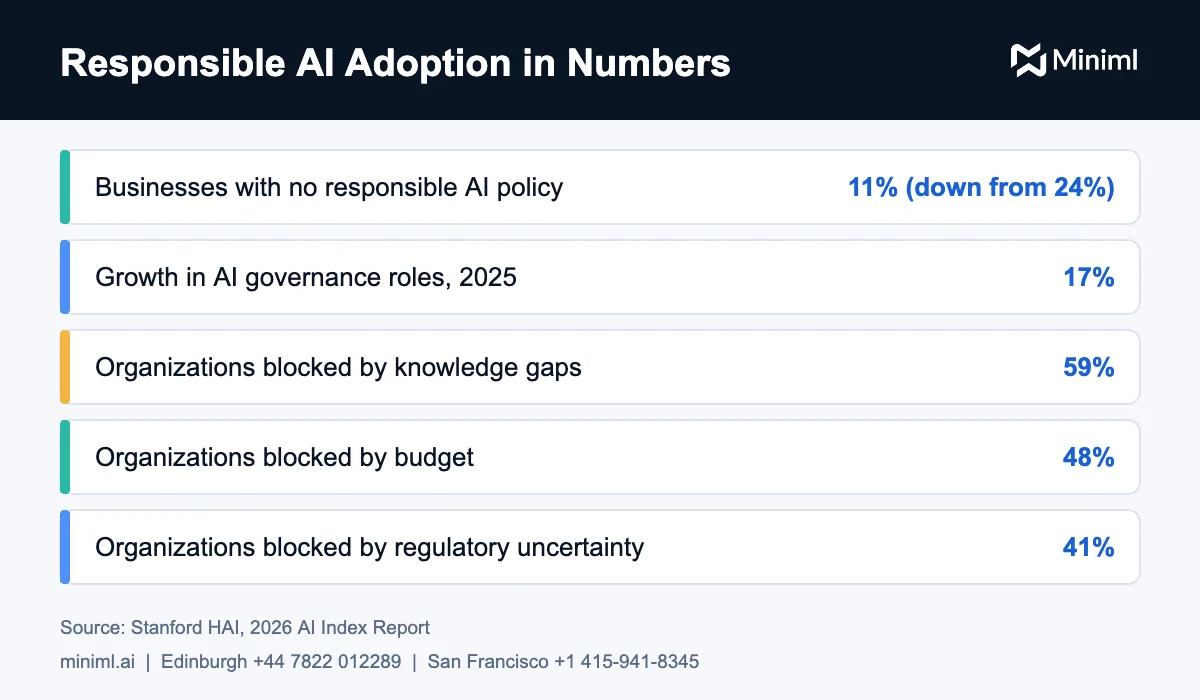
Adoption has outpaced policy for years, but the gap is closing. The Stanford 2026 AI Index reports that the share of businesses with no responsible AI policies fell from 24% to 11%, and AI-specific governance roles grew 17% in 2025. Having a policy, though, isn’t the same as having a framework that works.
The same report names the blockers. Knowledge gaps top the list at 59%, followed by budget at 48% and regulatory uncertainty at 41%. In plain terms, most teams want to do this properly but don’t know which controls matter, who should own them or how much is enough.
Demand for outside help, from AI ethics consulting to full assurance, reflects that. The UK government’s DSIT AI assurance report estimates that 524 firms supply AI assurance in the UK, generating about £1.01bn in gross value added and employing roughly 12,572 people. It projects the market could reach £6.53bn by 2035.
What changes for US and UK teams
US organizations mostly work from voluntary guidance such as the NIST AI Risk Management Framework, plus sector rules and customer due diligence. UK organizations follow a principles-based approach led by existing regulators like the ICO, the UK data protection regulator. Anyone selling into the EU also faces the AI Act. One responsible AI framework that maps to all three saves you running separate programs for each market.
From Principles to Artifacts: What a Responsible AI Framework Produces
Most guides list principles and stop. The test we apply at Miniml is simpler: if a principle doesn’t produce an artifact someone can open, review and sign, it isn’t part of your responsible AI framework yet. The table below shows the mapping we use when we scope an engagement.
| Principle | Question it answers | Artifact | Typical owner |
|---|---|---|---|
| Fairness | Does it treat groups differently without good reason? | Bias test report with agreed thresholds | Data science lead |
| Transparency | Can users and reviewers understand it? | Model card and user-facing AI notice | Product owner |
| Accountability | Who answers when it goes wrong? | RACI matrix and sign-off record | Executive sponsor |
| Privacy | Is personal data handled lawfully? | Data protection impact assessment | Data protection officer |
| Safety and reliability | Does it hold up under stress and misuse? | Evaluation and red-team report | Engineering lead |
| Human oversight | Can a person step in on time? | Human oversight procedure | Operations manager |
| Risk management | Which systems need the most scrutiny? | AI risk register and AIMS scope | Risk or compliance lead |
The OECD AI Principles are a useful sense check here. They have 47 adherents, including the 37 OECD members and the EU, and their five values-based principles include transparency and explainability, and accountability. For the transparency row in particular, our guide to auditable AI decision design shows what good evidence looks like. If your artifacts cover those, you’re aligned with the broadest international baseline.
Artifacts also make the next stage easier. Once a system is live, you need controls that act in real time, which we cover in our guide to runtime AI risk controls.
What Does Responsible AI Consulting Involve?
A responsible AI consultant helps you design the framework, fit it into how you already work and prove that it works. The engagement should end with your team running the process, not with a consultant on permanent retainer. Here’s how we structure the work.
- Discovery: list every AI system in use or in development, including vendor tools and AI features switched on inside existing software.
- Gap assessment: compare current practice against your chosen standards and rank the gaps by risk, not by how easy they are to fix.
- Framework design: write the policy, define roles, set risk tiers and create a template for each artifact in the table above.
- Embedding: build the checks into existing delivery gates, procurement and change management so nobody has to remember a separate process.
- Assurance: test the responsible AI framework on real systems, fix what breaks and prepare evidence for internal audit or certification.
Who needs to be in the room
Responsible AI fails when it lives only in legal or only in engineering. A working group should include a senior sponsor, a business owner, a technical lead, your data protection officer and someone from risk or compliance. Consultants facilitate, but the decisions in your responsible AI framework have to belong to these people.
What you should have at the end
Expect a short policy, a risk tiering method, templates for each artifact, a completed pilot assessment on one or two live systems and a plan for the rest of the portfolio. If a proposal promises a 100-page framework document and nothing you can run, push back.
Not sure where your gaps are? A focused gap assessment on your two or three highest-impact systems is usually the quickest way to find out, and you can book a framework review with our team to scope one.
Build In-House or Bring In a Responsible AI Consultant?
Plenty of organizations can build a responsible AI framework themselves. The real question is whether you have the skills and time to do it before your AI portfolio grows past the point where retrofitting gets expensive. Use these decision rules:
- Build in-house if you already run a mature risk or privacy function, have only a handful of AI systems and have staff who’ve worked with NIST or ISO management standards.
- Bring in help if AI is spreading across teams faster than anyone can track, or you can’t name who owns each system.
- Bring in help if you sell into regulated sectors or the EU, where customers and regulators expect documented evidence.
- Bring in help if you plan to certify against ISO/IEC 42001 and nobody on staff has been through a management system audit.
- Choose a hybrid if you have the people but lack a method: a consultant designs the framework, then your team runs it.
Given that knowledge gaps block 59% of organizations, the hybrid route to a responsible AI framework is often the best value. You pay for expertise once and keep the capability inside the business.
Do vendor AI tools need a framework too?
Yes. Buying AI moves the engineering work to a supplier, but not the accountability. Your framework should cover procurement questions, contract terms on data use and how you watch a vendor model’s behavior once it’s inside your workflows.
Which Standards Should Your Responsible AI Framework Map To?
You don’t need to pick just one standard. Most organizations map a single framework to several, and a good mapping means one assessment satisfies many audiences.
| Standard | Type | Best for | What it gives you |
|---|---|---|---|
| ISO/IEC 42001 | Certifiable management system standard | Organizations that want external certification | Requirements to set up, run and improve an AI management system |
| NIST AI RMF | Voluntary framework | US teams and global risk functions | Govern, map, measure and manage functions for AI risk |
| OECD AI Principles | Intergovernmental principles | A shared values baseline | Five values-based principles backed by 47 adherents |
| EU AI Act | Binding regulation | Anyone placing AI on the EU market | Legal obligations that scale with a system’s risk category |
ISO/IEC 42001 standard, published in December 2023, is described as the world’s first AI management system standard. It sets requirements for establishing, maintaining and continually improving an AI management system, or AIMS: the organizational wrapper around your policies and controls.
For EU obligations, the detail depends on your system’s risk category and when it reached the market. If you run older models, our legacy model compliance guide walks through what the AI Act means for them.
Responsible AI Consulting FAQs
What does a responsible AI consultant do?
A responsible AI consultant inventories your AI systems, assesses gaps against standards like ISO/IEC 42001 and the NIST AI RMF, then designs a practical framework with roles, risk tiers and templates. They embed those checks into your delivery process and help you produce evidence for auditors, customers and regulators.
What are the 6 principles of responsible AI?
The six most common principles are fairness, transparency and explainability, accountability, privacy and data governance, safety and reliability, and human oversight. Some organizations merge or split them, but a complete responsible AI framework covers all six with named owners and artifacts.
What is the difference between responsible AI and AI governance?
Responsible AI defines the outcomes you want, such as fair and explainable systems. AI governance is the machinery that makes those outcomes happen: decision rights, approval gates, risk assessment and monitoring. You need both, because governance is how a responsible AI framework gets enforced.
Do we need a responsible AI framework if we only use vendor AI tools?
Yes. You stay accountable for how AI affects your customers and staff, even when a supplier built the model. A lighter framework focused on procurement checks, data terms, human oversight and monitoring is usually enough for organizations that only buy AI.
Which standards should a responsible AI framework map to?
Map to ISO/IEC 42001 if you want certification, the NIST AI RMF for a practical risk structure and the OECD AI Principles as a values baseline. Add the EU AI Act if you place AI systems on the EU market or serve EU users.
How long does a responsible AI engagement take?
It depends on how many systems you run and how mature your risk function is. A gap assessment on a few high-impact systems usually takes weeks. Designing and embedding a full framework, or preparing for ISO/IEC 42001 certification, is a program measured in months.
Putting Your Responsible AI Framework to Work
A framework earns its keep when a product team can pick it up on a Monday and know exactly what evidence to produce before launch. If you want help getting there, book a scoping call and we’ll look at your current AI systems, your markets and the standards that matter to you, then agree the smallest responsible AI framework that will satisfy them.
Prefer to talk first? Call our Edinburgh office on +44 7822 012289 or our San Francisco office on +1 415-941-8345.
About Miniml: Miniml is an AI consultancy with offices in Edinburgh and San Francisco that designs, builds and governs custom AI systems.