

Generative AI Models: As artificial intelligence continues to evolve, one of the most talked-about areas is generative modeling. This technology is changing how businesses interact with data, create content, and solve real-world problems. From generating human-like text to designing realistic images, generative models are quietly shaping the future across various industries.
This article explores the different types of generative models in detail what they are, how they work, and which business applications they support. Whether you’re a business leader, data scientist, or curious reader, this guide will help clarify the key categories and their relevance today.
Introduction to Generative AI
Generative AI refers to machine learning models that can create new content based on the data they’ve been trained on. Unlike traditional models that classify or predict, generative models are designed to generate something new be it a sentence, a photo, or even a piece of music.
In business, this can mean writing product descriptions, designing fashion prototypes, generating synthetic customer data, or assisting with legal document drafts. The possibilities are expanding quickly.
The Foundations of Generative Modeling
Before diving into the types, it helps to understand what sets generative models apart. These systems are trained on large datasets to understand patterns and then reproduce similar patterns from scratch.
Key principles include:
- Latent Space Representation: A compressed version of data that models use to understand structure.
- Sampling: Generating outputs by sampling from this latent space.
- Training Objectives: Generative models typically learn by reducing the difference between real and generated data.
In short, these models don’t just memorize they learn to create.
Types of Generative AI Models
Let’s explore the five main types of generative models that are currently used in business and research.
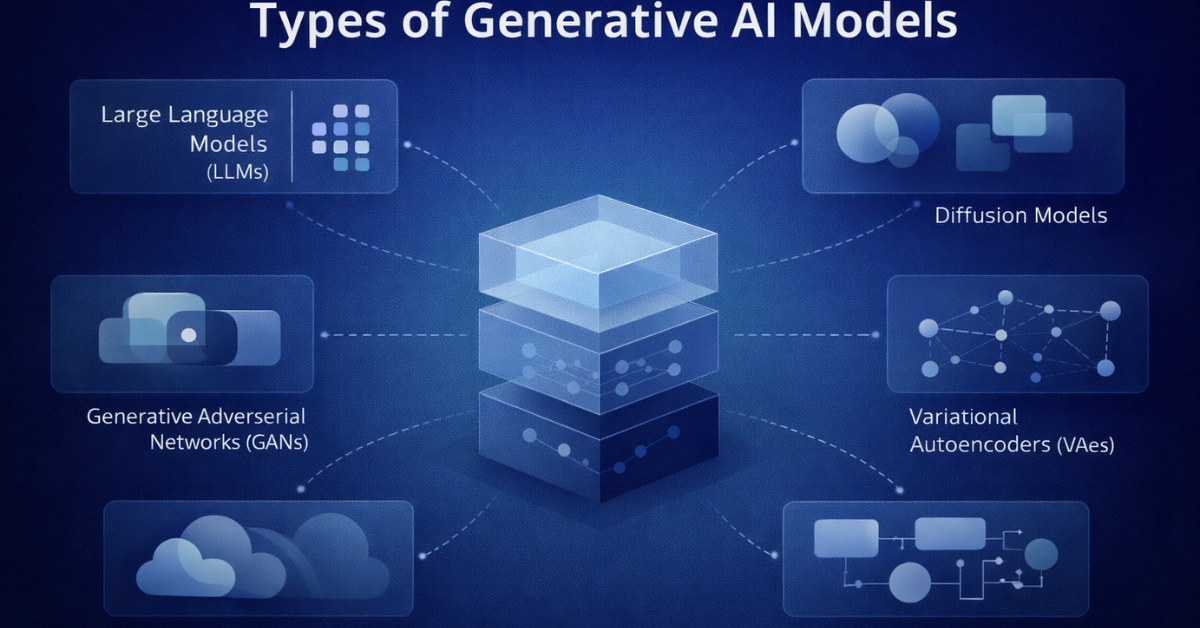
1. Large Language Models (LLMs)
Large Language Models are among the most widely used generative tools today. These models are trained on enormous text datasets to understand grammar, facts, and context.
Common Applications:
- Drafting emails, legal documents, or blog posts
- Chatbots for customer service
- Automatic code generation
- Summarizing long documents or reports
Examples: GPT, Claude, LLaMA
Key Advantage: LLMs offer fast, coherent responses and require minimal prompting.
2. Generative Adversarial Networks (GANs)
GANs work by pitting two models against each other a generator that creates fake data and a discriminator that tries to tell if it’s fake. Over time, the generator becomes better at producing convincing content.
Real-World Use Cases:
- Synthetic product images for retail
- Fashion design prototypes
- Deepfake detection and mitigation
- Art and gaming asset creation
Pros:
- High-quality, realistic output
- Effective for both visual and audio generation
Cons:
- Training can be unstable
- Prone to producing artifacts if not tuned properly
3. Variational Autoencoders (VAEs)
VAEs are useful when the goal is to create new variations of existing data. They work by encoding input data into a simplified structure and then decoding it back with slight modifications.
Used For:
- Medical imaging (e.g., generating varied tumor profiles for training)
- Anomaly detection in finance or cybersecurity
- Creating personalized media content
What Makes VAEs Unique:
- Outputs are usually smoother and more controlled than GANs.
- Easier to interpret latent space for business insights.

4. Diffusion Models
Diffusion models are newer entrants in generative modeling. They start with noise and gradually refine the image or data to match patterns from the training set.
Key Applications:
- High-resolution image generation
- Visual marketing materials
- Text-to-image content for e-commerce or education
Examples: DALL·E 2, Stable Diffusion
These models excel in creating photorealistic visuals and are gaining attention for their quality output in creative industries.
5. Multimodal Transformer-Based Models
Multimodal models are trained to understand and generate across different formats such as text, images, and audio together. These models are valuable in situations where data types need to interact.
Used In:
- Visual search: user uploads a photo and gets related product suggestions
- Caption generation for accessibility
- Educational tools combining visuals and text
- Marketing where visual and verbal content are generated together
This is an emerging field but already shows promise in cross-platform and human-centered applications.
Choosing the Right Model for Your Business
Each generative model offers specific strengths. Picking the right one depends on your industry, goals, and technical constraints.
Here’s a quick breakdown:
| Industry | Ideal Model Type | Use Case |
| Healthcare | VAEs | Medical imaging, synthetic patient data |
| Finance | GANs, VAEs | Fraud detection, report generation |
| Retail | Diffusion, LLMs | Product visuals, chatbot support |
| Education | Multimodal Transformers | Interactive learning content |
| Legal | LLMs | Drafting and summarizing legal documents |
Key considerations before implementing:
- Data availability: Do you have enough and the right kind of data?
- Security needs: Does the data involve sensitive information?
- Cost and infrastructure: Some models require powerful hardware.
- Accuracy vs Creativity: Some tasks require precision, others novelty.
The Value of Working with a Specialist
For many organizations, building and maintaining generative models in-house isn’t practical. That’s where consultancies like Miniml come in.
A good consultancy will:
- Identify the right model type for your goals
- Help train and fine-tune models using your data
- Ensure safe and secure deployment
- Integrate solutions into your existing processes
- Monitor and update the models for performance over time
Miniml works closely with companies in sectors such as healthcare, education, retail, and finance to deliver custom-built AI tools that are practical, compliant, and efficient.

Challenges to Be Aware Of
Despite their potential, generative models come with risks and limitations.
Common Issues Include:
- Bias in training data, leading to unfair or inaccurate results
- Security vulnerabilities, especially when models are exposed to users
- Computational costs, which can limit access for smaller firms
- Overfitting or poor generalization, especially with limited datasets
Regular evaluation and ethical oversight are essential to reduce these risks.
Future Trends in Generative Modeling
The field is still rapidly changing, but a few trends are becoming clear:
- Open-source adoption: Tools like Stable Diffusion are making advanced generative models accessible.
- Multimodal everything: Expect more tools that understand both text and visuals.
- Industry-specific tuning: Companies are focusing on domain-specific applications rather than general-purpose models.
- New regulations: Compliance with privacy laws and ethical AI guidelines will become a priority.
As adoption spreads, the importance of guided implementation by experienced professionals will only grow.
Final Thoughts
Generative models are not a one-size-fits-all solution. Understanding their types, capabilities, and constraints is key to using them effectively. From LLMs that write reports to GANs that design clothing samples, the use cases are vast but selecting the right model is what determines long-term value.
For businesses looking to move forward with confidence, partnering with experienced consultants like Miniml can make the difference between a promising idea and a real-world solution.