
Verifying whether a voice is real, with evidence a rights team can act on.
Provenium is an authenticity and provenance verification platform for music, built as a venture partnership between a music-industry founder and Miniml as the AI and product engineering team. Live since May 2026.
AI made music easy to generate and hard to trust.
Cloned voices can impersonate artists. AI-generated tracks enter release and royalty workflows without disclosure or attribution. Labels, distributors and rights holders have no reliable way to verify what is authentic, synthetic or misrepresented before a release, a licence or a dispute.
The existing tools do not solve this. Watermarks are fragile. Fingerprinting catches exact copies but not a cloned voice singing a new song. And a single black-box “AI or not” score is not something a rights team can put in front of a lawyer or a release committee.
The founding insight was that the music industry needs a verification layer, not another detector: something that produces evidence, keeps a record, and fits into the workflows where authenticity decisions are actually made.
A verification workflow, from custom models to a signed record.
Custom audio models
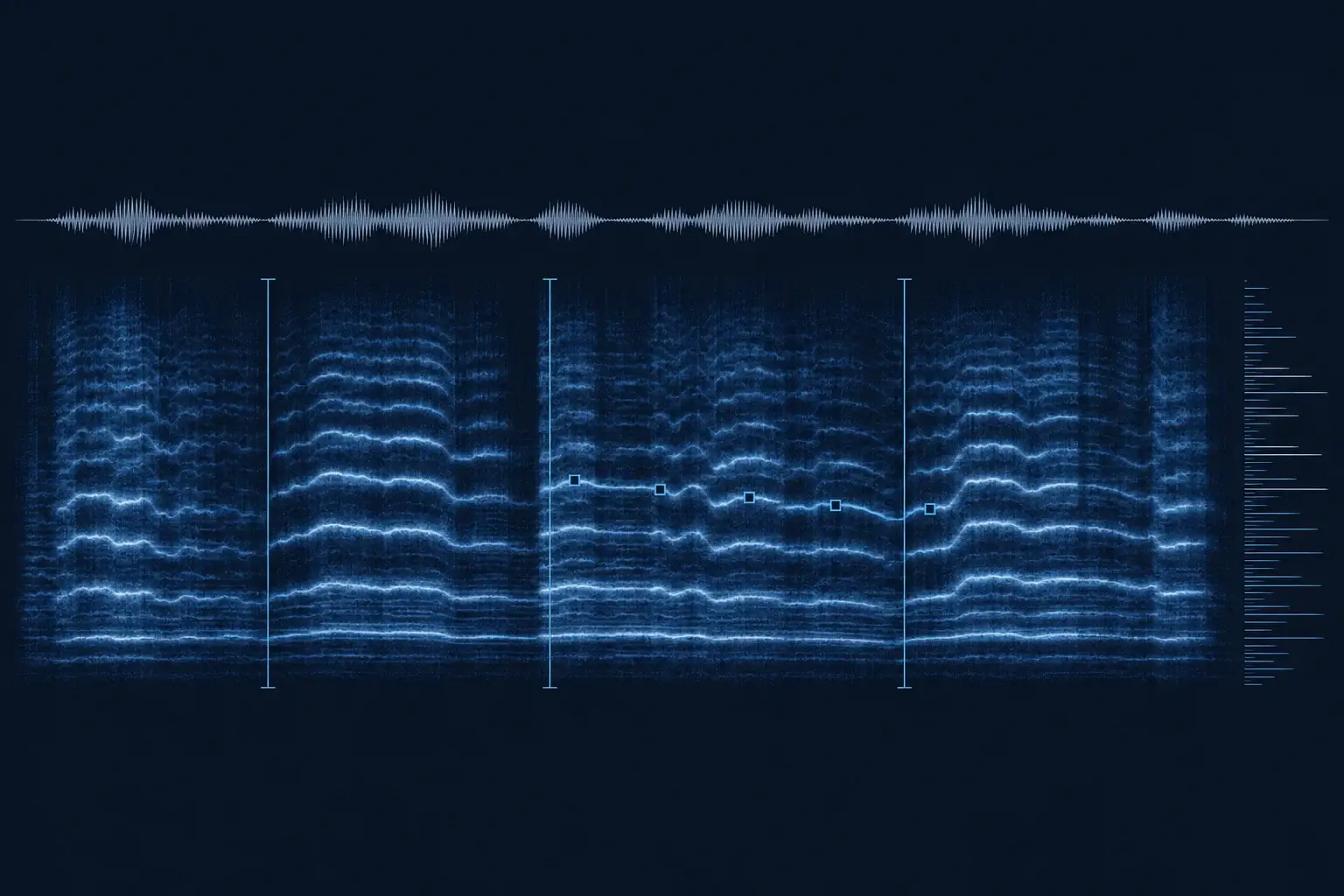
Miniml built the model layer: models trained to distinguish human-performed from AI-generated music, and a segment-based voice similarity engine that splits a track into short vocal moments, builds a voice signature for each, and finds similar moments across recordings, including partial matches. The models are adapted to music, where voices shift with style, emotion and production in ways that speech systems do not handle.
Provenance signals
Alongside the audio analysis, the platform draws on provenance and metadata signals built on open content-provenance standards, so a verification decision rests on more than one class of evidence.
Human review for high-risk cases
Where the evidence is ambiguous or the stakes are high, a case is routed to human review rather than decided by a threshold.
Evidence bundle and verification record
The output is designed for business action: an authenticity assessment, the supporting evidence with timestamps showing where overlap occurs and how strongly each segment supports the decision, and a signed verification record that can be shared with partners.
- Track intake fits existing release workflows: upload reference and candidate tracks, receive a decision-ready result
- Two-stage verification: fast candidate retrieval, then detailed segment comparison
- Public site and demo live at provenium.ai since May 2026
Music is harder than speech, and evidence is harder than a score.
Speech verification assumes a fairly stable voice. Singing does not: register shifts, vibrato, expressive delivery, layered production and effects all change what a voice looks like to a model. The similarity engine had to be built for singer verification specifically, starting from a strong pretrained voice foundation and adapting it to music-specific similarity, with segment-level analysis so that noise, effects and partial overlap do not defeat it.
Generalisation is the second problem. New voice-cloning methods appear constantly, so a detector tuned to today’s generators will fail on tomorrow’s. The model layer was designed to be modular and to combine signals, so that individual methods can be replaced as the landscape changes without rebuilding the product.
The third is interpretability. A legal or release context needs to know what matched, when, and how strongly, not just a probability. That requirement drove the segment-based architecture and the evidence bundle, which are the product, not a feature of it.
Upload, analyse, decide, record.
A rights team uploads a recording, stem or voice sample along with reference material. The platform evaluates voice characteristics, synthetic artefacts and provenance signals, retrieves candidate matches, then compares at segment level. Ambiguous or high-value cases go to a reviewer.
The team receives a verification outcome with confidence signals, the timestamped evidence behind it, and a signed record they can attach to a release approval, a catalogue check or a dispute file.
From research to a launched product.
Provenium is at an early stage. The outcomes below describe what has been delivered, not commercial results.
Built for a market that needs both industry trust and technical rigour.
Every outcome is backed by segment-level evidence with timestamps. The platform is designed to support release decisions and disputes, not to issue verdicts.
High-risk and ambiguous cases route to a person. Automated results are signals for a decision, not the decision.
Provenance records are built on open content-authenticity standards so they remain portable and verifiable across partners.
Detection methods are swappable as generation techniques evolve, so the product does not depend on any single model remaining state of the art.
Where this expertise lives.
Building a product that needs real model work behind it?
Book a 30-minute consultation with a senior consultant. We will map where AI can compound in your operation and what the first 90 days could look like.
Book a Consultation →