
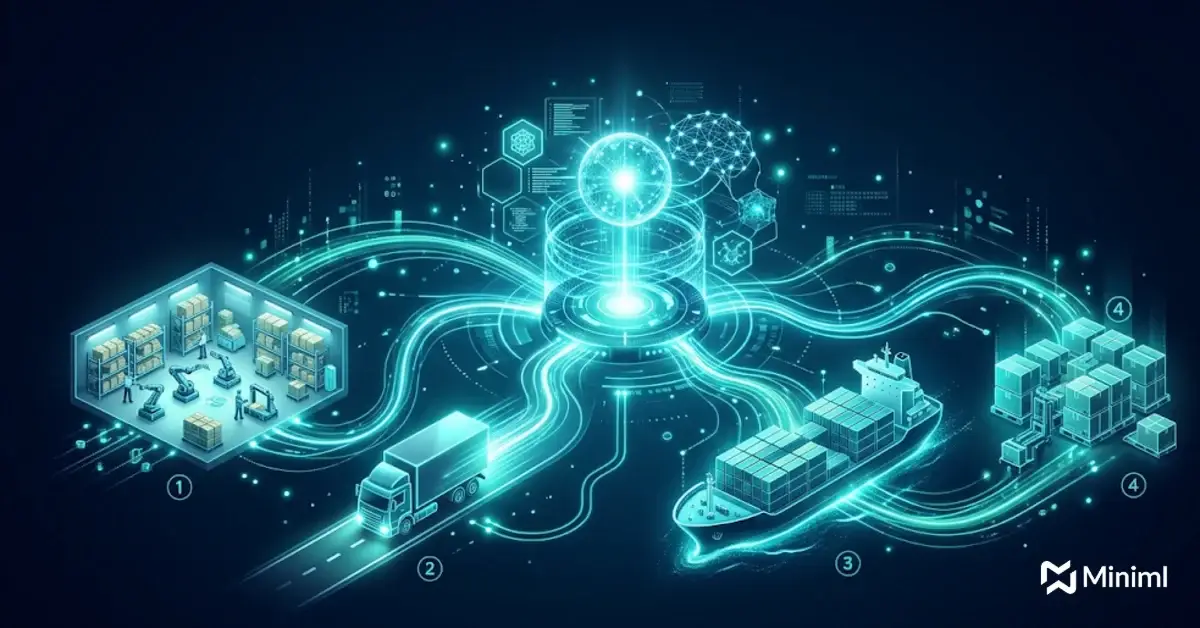
AI in supply chain means using machine learning, language models and AI agents to forecast demand, set inventory, process trade documents and handle exceptions faster than manual teams can. The use cases that pay back in year one target work you already measure, use data you already hold, and keep a person in the loop. That is how we approach AI for logistics teams.
Key Takeaways: AI in Supply Chain
- The upside is proven. McKinsey found early adopters of AI-enabled supply chain management improved logistics costs by 15%, inventory levels by 35% and service levels by 65%.
- Fast payback comes from narrow, measured tasks. Document processing and exception triage often beat big planning overhauls in year one.
- Data quality decides timelines. Clean order, shipment and inventory data matters more than the choice of model.
- Agents are early. Few companies have scaled AI agents in any one function, so start with bounded workflows.
- Keep a human in the loop for any decision that moves money, stock or customer commitments.

Why AI in Supply Chain Is Getting Board Attention
Supply chains run on thousands of small decisions every day. Reorder now or wait? Which carrier? Is this delay a problem? Most of those decisions still depend on spreadsheets, email and experience.
AI can make many of them faster and more consistent. In its McKinsey supply chain research, published in April 2021, McKinsey reported that early adopters of AI-enabled supply chain management improved logistics costs by 15%, inventory levels by 35% and service levels by 65% compared with slower competitors.
The same research carried a warning. In a survey of global supply chain leaders, more than 60% of planning change programs ran late or over budget, with poor process design the most common cause. AI pays back when the process around it is designed well.
Seven AI in Supply Chain Use Cases, Ranked by Speed to Payback
Not every use case pays back at the same speed. The table below ranks common options by how quickly they tend to show measurable results, based on how much new data and integration each one needs.
| Use case | What AI does | Data needed | Typical speed to value |
|---|---|---|---|
| Trade and shipping document processing | Reads invoices, bills of lading and customs forms, extracts fields | Scanned or emailed documents | Fast |
| Exception triage | Sorts delay and shortage alerts by impact, drafts next steps | Order, shipment and alert history | Fast |
| Supplier email and query handling | Answers routine supplier and customer status questions | Order system access, email history | Fast |
| Demand forecasting | Predicts demand by product and location | Sales history, promotions, external signals | Medium |
| Inventory and reorder settings | Recommends safety stock and reorder points | Demand, lead times, service targets | Medium |
| Route and load planning | Improves routes and truck fill | Orders, locations, vehicle data | Medium |
| End-to-end planning agents | Coordinates decisions across planning steps | Clean data across many systems | Slow |
The fast group shares three traits. The work is already measured, the data already exists, and a person can check each output quickly.
Use Cases That Pay Back Fastest
Trade and shipping document processing
Supply chains run on paper, even when it arrives as a PDF. Invoices, packing lists, bills of lading and certificates of origin are still keyed in by hand in many teams. Modern document AI reads these files, pulls out the fields, and flags anything that does not match the purchase order.
The cost case is simple to build because you already know how many documents you handle and how long each one takes. Start with one document type, such as carrier invoices, and measure the share of fields extracted correctly without a person touching them. Once that rate holds steady for a few weeks, add the next document type. Mismatches between invoice, purchase order and receipt are where the savings show up first, because each one caught early avoids a payment dispute later. Our guide to automated document processing costs walks through the numbers.
Exception triage
Planners spend much of their day reading alerts. Most do not need action. AI can rank exceptions by financial or customer impact, group related alerts, and draft a recommended response for a planner to approve.
Supplier and customer status queries
“Where is my order?” emails eat hours each week. A retrieval-based assistant connected to your order and shipment systems can answer routine questions and pass anything unusual to a person. The assistant should quote the live record it used, such as the shipment status and last scan time, so staff can trust the reply and customers get the same answer every time.
Use Cases That Pay Back in Year Two
Demand forecasting
Machine learning forecasts can combine sales history with promotions, pricing, weather and other signals. Gains are real, but they take time to prove because you need several cycles of results. Our AI demand forecasting guide covers the data and planning steps in detail.
Inventory settings
Once forecasts improve, safety stock and reorder points can follow. This is where the inventory gains McKinsey describes usually come from, but it depends on trusted forecasts first.
Where AI Agents Fit in the Supply Chain
AI agents can read an exception, check stock in another warehouse, draft a transfer and ask a planner to approve it. That is a real step forward. But adoption is early.
The McKinsey State of AI survey, published in November 2025, found that no more than 10% of respondents said their organizations were scaling AI agents in any single business function. Separately, the Gartner agentic AI forecast predicted that over 40% of agentic AI projects will be cancelled by the end of 2027 because of cost, unclear value or weak risk controls.
The safe path is a bounded agent for one workflow, with clear permissions and a human approval step. Our team builds custom AI agent workflows this way, starting narrow and widening autonomy as accuracy holds.
Warning Signs Before You Start
These issues slow down supply chain AI projects more than any model choice:
- Master data is out of date. Wrong lead times or units will poison every forecast.
- Key data sits in email and spreadsheets with no system of record.
- Nobody owns the outcome. A planning manager, not IT, should own each use case metric.
- The pilot uses clean sample data that looks nothing like daily operations.
- There is no baseline. Without today’s numbers, you cannot prove payback later.
A Seven-Step Rollout Plan for Supply Chain Teams
- Pick one painful, measured workflow. Document intake and exception triage are common first choices.
- Record the baseline. Volume, time per task, error rate and cost today.
- Check the data. Confirm you can access the documents, orders and shipment records needed.
- Build a test set from real past cases, including messy ones.
- Run in assist mode first. AI suggests, a person approves.
- Measure for 60 to 90 days against the baseline.
- Scale or stop based on the numbers, then pick the next use case.
Teams in Chicago, Atlanta, Los Angeles and across the UK follow the same pattern. The location changes, but the order of operations does not.
AI in Supply Chain FAQs
What are the benefits of AI in the supply chain?
The main benefits are faster decisions, lower logistics and inventory costs, better service levels and less manual data entry. McKinsey reported that early adopters improved logistics costs by 15%, inventory by 35% and service levels by 65%. Results depend on data quality and process design.
How does AI improve visibility in the supply chain?
AI pulls signals from orders, shipments, carrier updates, emails and documents into one view, then flags the items that need attention. Instead of reading every alert, planners see a ranked list of real problems with suggested next steps.
What are the challenges of implementing AI in the supply chain?
The biggest challenges are poor or scattered data, systems that do not connect, unclear ownership and pilots that never reach daily operations. Starting with one measured workflow, a clear baseline and a human approval step reduces most of these risks.
Which AI supply chain use case should we start with?
Start where work is high volume, already measured and easy to check. Trade document processing, exception triage and supplier status queries usually fit. Demand forecasting and planning agents offer bigger gains but take longer to prove.
How does AI improve customer service in the supply chain?
AI assistants connected to order and shipment systems can answer routine status questions instantly and hand complex cases to a person with context attached. Customers get faster answers, and service teams spend more time on problems that need judgement.
Planning Your First Supply Chain AI Project
AI in supply chain pays back fastest when you start with work you already measure, data you already hold, and a person who checks every output. Bigger planning gains come next, on top of that foundation.
Miniml is a senior team of engineers and researchers with backgrounds at GE, Amazon, Stanford, the University of Edinburgh, and the Alan Turing Institute. Our three-week AI Workflow Opportunity Map ranks your supply chain use cases by value and readiness. Call +1 415-941-8345 or book a Miniml consultation to find your first year-one win. Office hours are Monday to Friday, 8am to 5pm.
San Francisco: 50 California St #1500, San Francisco, CA 94111. Phone: +1 415-941-8345. Edinburgh: 93 George St, Edinburgh EH2 3ES. Find us on our Edinburgh Google Business Profile.
About Miniml: Miniml is an AI consultancy with offices in San Francisco and Edinburgh that helps enterprise teams take AI systems past the pilot and into production.