

RAG in AI stands for retrieval-augmented generation. It is a method that lets a large language model look up facts in your own documents before it answers. The model retrieves the most relevant passages, reads them, and writes a reply grounded in that text. This is the core of our enterprise knowledge retrieval services.
Key Takeaways: What Is RAG in AI
- RAG adds a search step before the model writes, so answers come from your sources instead of memory alone.
- It is the most common enterprise pattern. Enterprise RAG adoption rose from 31% to 51% in one year.
- Retrieval quality decides answer quality. Most RAG failures start with bad chunking or weak search, not the model.
- RAG and fine-tuning solve different problems. RAG adds knowledge. Fine-tuning changes behavior and style.
- You must measure it. Track retrieval hit rate, answer faithfulness, and citation accuracy before launch.
What Is RAG in AI, in Plain Terms?
A large language model (LLM) learns from a huge snapshot of public text. After training, its knowledge is frozen. It does not know your pricing sheet, your policy manual, or last week’s product update.
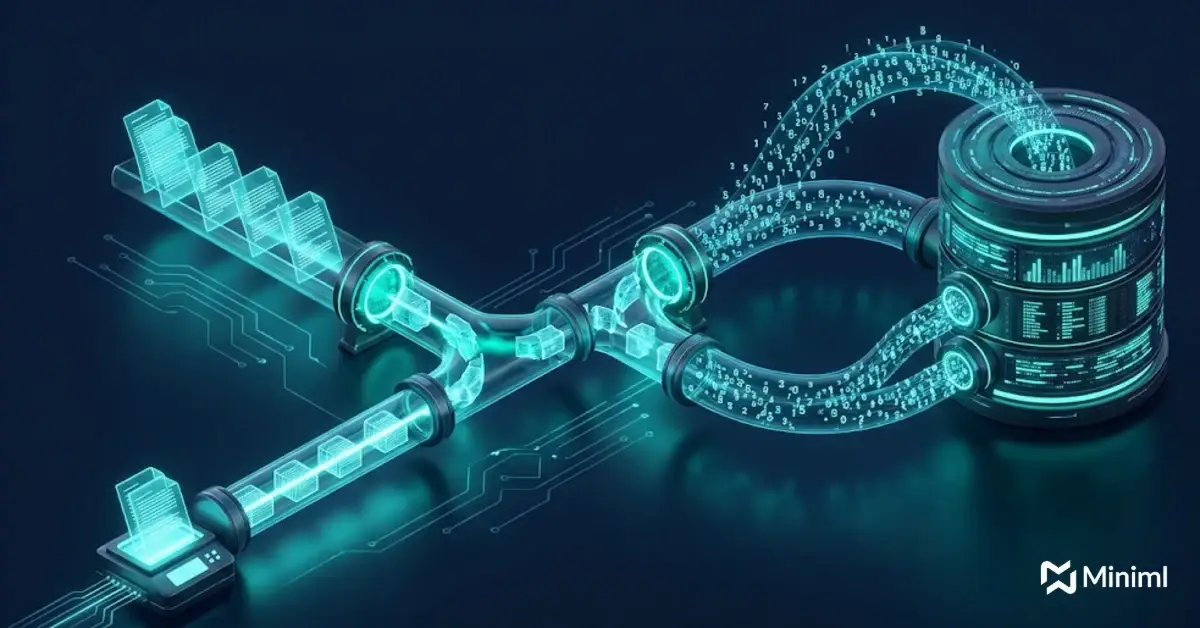
RAG fixes that gap without retraining. When a user asks a question, the system first searches a library of your content. It then hands the best matching passages to the model, along with the question. The model answers using that context.
Think of it as an open-book exam. The model still does the reasoning and the writing. But it reads the right page first.
The idea was formalised in a 2020 paper from Facebook AI Research, University College London, and New York University. That original RAG research paper showed that pairing a model with a searchable document index gave more specific and more factual answers on knowledge-heavy tasks than the model alone.
How Retrieval-Augmented Generation Works, Step by Step
Every RAG system follows the same basic pipeline. The names change between vendors, but the steps do not.
- Collect the sources. Gather the documents the system is allowed to use: PDFs, wiki pages, tickets, contracts, product specs.
- Split them into chunks. Break each document into passages of a few hundred words. Good chunks keep a heading and its paragraph together.
- Create embeddings. An embedding model turns each chunk into a list of numbers that captures its meaning.
- Store them in an index. The numbers go into a vector database, often alongside a keyword index for exact terms like part numbers.
- Retrieve at question time. The user’s question is embedded the same way, and the system pulls the closest matching chunks.
- Rerank and filter. A second model scores the results and drops anything the user is not permitted to see.
- Generate the answer. The LLM receives the question plus the top passages and writes a reply, ideally with citations.
Steps 2, 5 and 6 are where most teams win or lose. A strong model cannot rescue a passage that was never retrieved.
Why Enterprises Use RAG in AI Systems
RAG has become the default way to connect generative AI to company data. In the Menlo Ventures enterprise survey of 600 US IT decision makers, RAG use rose from 31% to 51% year over year. The same report found that only 9% of production models were fine-tuned.
The reasons are practical:
- Fresh information. Update a document and the next answer reflects it. No retraining cycle.
- Traceable answers. Each reply can point to the passage it came from, so staff can check it.
- Access control. Retrieval can respect existing permissions, so a sales rep never sees HR files.
- Lower cost to change. Swapping or upgrading the model does not mean rebuilding your knowledge base.
- Less confabulation. Grounding the model in real text reduces confident but wrong answers.
That last point matters for risk teams. The NIST Generative AI Profile lists confabulation, its term for hallucination, as one of 12 risks that generative AI creates or makes worse. RAG is one of the main controls teams use against it, but it only works if retrieval is measured.
RAG vs Fine-Tuning vs Long Context
Buyers often ask whether they need RAG, fine-tuning, or just a model with a very large context window. The honest answer is that they solve different problems.
| Approach | What it changes | Best for | Main limit |
|---|---|---|---|
| RAG | What the model knows at answer time | Large, changing document sets with citations | Answer quality depends on retrieval quality |
| Fine-tuning | How the model behaves, formats and phrases | Fixed tasks, house style, structured outputs | Slow and costly to update with new facts |
| Long context | How much text fits in one prompt | A handful of long documents per question | Cost and latency grow with every token |
| RAG plus fine-tuning | Both knowledge and behavior | Regulated, high-volume production systems | More components to test and maintain |
For most enterprise question answering, RAG is the starting point. Fine-tuning comes later, if at all, when you need a very specific output format or tone at scale.
Common RAG Failure Points
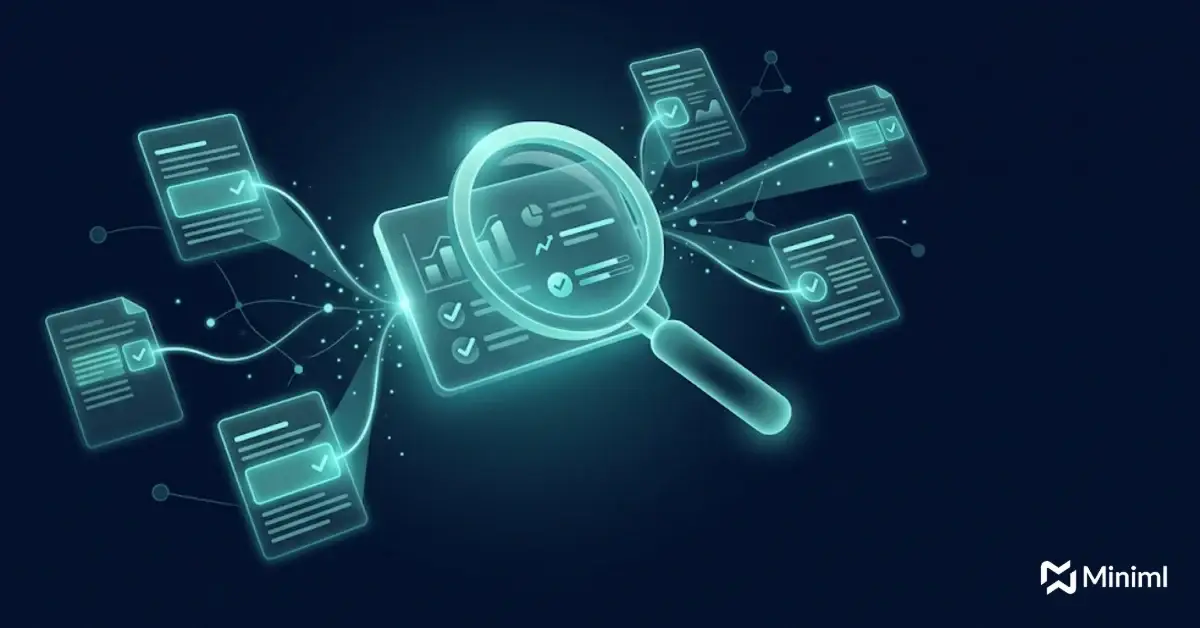
A demo RAG system can be built in an afternoon. A production one takes careful engineering. These are the warning signs we see most often:
- Right answer exists, wrong chunk retrieved. Usually a chunking or embedding problem.
- Tables and scanned PDFs come out as noise. Parsing needs work before indexing. Our AI document intelligence services handle this layer.
- Old versions outrank new ones. The index needs dates, owners, and a rule for superseded content.
- Answers ignore the retrieved text. The prompt or model is not following its grounding instructions.
- Nobody can say if it got better. There is no fixed test set, so every change is a guess.
Our post on the RAG architecture that scales goes deeper into why measured retrieval beats swapping models.
How to Evaluate an Enterprise RAG System
Measure retrieval and generation separately. If you only score the final answer, you cannot tell which half broke.
| Layer | Metric | What it tells you |
|---|---|---|
| Retrieval | Hit rate at top 5 | Did the right passage appear in the results? |
| Retrieval | Permission leaks | Did any result break access rules? |
| Generation | Faithfulness | Is every claim supported by the retrieved text? |
| Generation | Citation accuracy | Does each citation point to the passage it used? |
| System | Latency and cost per answer | Can it run at the volume you need? |
Build the test set from real questions your staff already ask. Fifty to two hundred well-chosen examples, each with the correct source passage marked, is enough to start.
Where RAG Fits in Your Stack
RAG is rarely a standalone product. In practice it sits inside a workflow: a support assistant, a contract review tool, an internal search page, or an AI agent that needs facts before it acts.
Data location matters too. Teams in finance, healthcare, and the public sector often need the index and the model inside their own environment. Running private on-prem models alongside the retrieval layer keeps sensitive text off third-party servers.
Whether your team sits in San Francisco, New York, or Edinburgh, the build order stays the same: pick one workflow, define what a good answer looks like, measure retrieval first, then tune generation.
What Is RAG in AI: FAQs
Is ChatGPT a RAG model?
ChatGPT on its own is a large language model, not a RAG system. Some versions can search the web or read uploaded files, which uses retrieval in a similar way. An enterprise RAG system is different because it searches your private, permissioned content and can cite the exact internal document behind each answer.
What is the difference between RAG and an LLM?
An LLM is the model that reads and writes text. RAG is an architecture that wraps around the LLM. It adds a search step that finds relevant passages from your documents and feeds them to the model, so the LLM answers from current, specific sources rather than only from what it learned in training.
Is RAG still relevant now that context windows are huge?
Yes. Large context windows help when a question needs a few long documents. But stuffing thousands of pages into every prompt is slow and expensive, and models can miss details buried in the middle. RAG keeps prompts small, costs predictable, and answers traceable, so most enterprise systems combine retrieval with a generous context window.
What are the main steps of RAG?
The core steps are: collect and parse documents, split them into chunks, turn chunks into embeddings, store them in an index, retrieve the closest matches for each question, rerank and filter for permissions, and generate a grounded answer with citations.
Can you explain RAG in a simple way?
RAG is like giving an assistant a well-organised filing cabinet. Before answering, the assistant pulls the right folders, reads the relevant pages, and then replies. The assistant still writes the answer, but it is based on your files instead of memory.
Getting a RAG System Past the Pilot
Most RAG projects stall between a working demo and a system people trust. The fix is not a bigger model. It is a measured retrieval pipeline, a real test set, and clear ownership of the content behind it.
Miniml is a senior team of engineers and researchers with backgrounds at GE, Amazon, Stanford, the University of Edinburgh, and the Alan Turing Institute. We build retrieval systems your team can own, run, and extend, starting with fixed-scope offers like a two-week Production-Readiness Review. Call +1 415-941-8345 or book a Miniml consultation to review your RAG use case. Office hours are Monday to Friday, 8am to 5pm.
San Francisco: 50 California St #1500, San Francisco, CA 94111. Phone: +1 415-941-8345. Edinburgh: 93 George St, Edinburgh EH2 3ES. Find us on our Edinburgh Google Business Profile.
About Miniml: Miniml is an AI consultancy with offices in San Francisco and Edinburgh that helps enterprise teams take AI systems past the pilot and into production.